


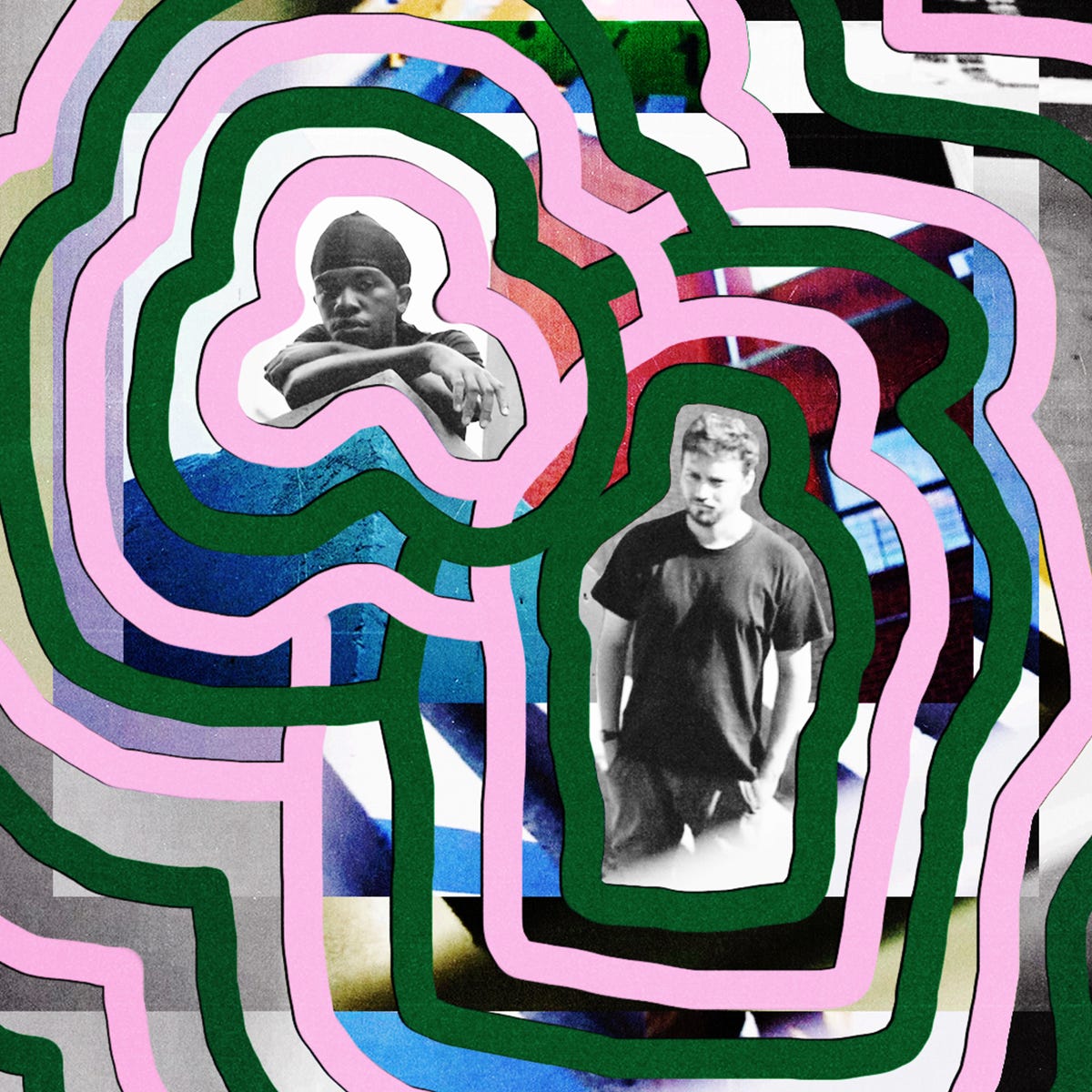
Though the record is called the hermit, shemar and Sasco have a distinctly pro-social approach to their work. The duo—the former a rapper-producer whose serpentine flows are vehicles for deeply personal writing, the latter a producer pushing New York’s underground emcees to and past the alleged limits of the genre—have, even over Zoom, the sort of easy rapport that suggests a semishared consciousness. In their telling, demos kick back and forth through email and iMessage, mutual admiration becomes the catalyst for self-discovery, and an emerging avant-garde meets up regularly at shows and release parties on the way home from their day jobs.
We spoke just before the release of that new, four-track EP about how radical art comes from chasing ghosts and good friends alike.
Was the genesis of this EP you two saying, “We’ve really got to do a record together,” or did it just flow naturally out of doing sessions here or there?
shemar: So when we got to know each other, it was like, “Yo, let’s work on music together. Let’s do a project together.” So that’s been the intention for essentially our whole friendship. And then we were working on a group project with another rapper that wound up falling through. And around when it fell through, I was feeling particularly inspired. It was just like, “Well, let’s still do a thing and let’s just see what happens.” I don’t know, Steve, if you have more to add, but.
Sasco: That’s exactly it.
And are these four songs pieces of those old sessions? Or are they totally distinct from that other project?
shemar: Lyrically, a lot of that stuff is based within that old project, kind of me reworking it in a different context, closer to where my head space was at the time of recording this EP. The beats, though, they’re all new. I think the beat for “action!” I had for a while, I was just sitting on it. But the other three beats, yeah, they’re just for this thing.
Sasco: shemar’s one of the first people I sent any beat to—not on the level of I want you to rap on this, but just Check out this cool thing I made. I sent the beats probably about as soon as I made them. shemar took them and used them. And then track two, idea-wise, was a collaborative thing. It took a concept I made another project out of, that I put out some months ago, and reapplied it with some creative guidance from shemar, especially on the samples that were used.
How did shemar’s input change it?
Sasco: Well, just thematically. The concept was like I took the idea of The Disintegration Loops, the William Basinski series where the tape would degrade over time, and I tried to just replicate it with MP3 degradation, just exporting, re-importing over and over and over again. And shemar kind of came with a concept of doing a version of that on this EP. And when I’d done it before, it was really, purely the idea. I didn’t add any kind of thematic throughline through any of them other than it happening. So shemar linked a bunch of timestamps from a showing of The Glass Menagerie on there.
shemar: I read the play in high school and I was a really big fan; at that point, I was in theater and in an English class, we were reading plays and shit, so I was super theatered up. And it’s just something that’s always stuck with me. And I guess as I’ve grown and developed as a writer, and my relationship with writing has changed, I think have very consistently seen myself in the main character—for better or for worse.
How so?
shemar: I think the way that bro views his desire to be a writer is something that I especially related to. I wanted to be a writer essentially my whole life. And I think my bag lately has just been plays and the act of acting—not in the literal sense, more so just putting on an act. I’ve been working on an album independently of this thing that Steve and I have done, and a lot of that has had to do with just this idea of performance and things like that: me rapping under shemar, but my literal government name is Shemar and having to engage with the question of, when someone is saying “Shemar,” are they talking to Shemar the person? Or shemar the rapper? So I guess the idea of performance has just always been in my mind. This particular showing, I found it on YouTube and it was all Black people, and I super appreciated that. I think that added an interesting lens to my perspective on the play.
Well yes, you two have been, in the last several years, getting attention for being on the cutting edge of this music out in Brooklyn. I think vocalists generally, and rappers specifically, are usually not given credit for what they are doing as performance. So to the point of what you were talking about, how has that felt now that there’s an audience?
shemar: I can’t lie, it’s kind of weird. I mean, Sasco and I have had conversations about maneuvering through that. I’d say on some level, this EP was inspired by, influenced by the exhaustion. I don’t want to fully speak for him, but I’d like to say that we both feel kind of like: I have to go to this show. I have to listen to this album, and this album, and this album right now. It’s not that we’re uninterested in the things that our peers, collaborators, whatever word you might want to use are doing. But it’s more just like, there’s just so much music and there’s so much life that we also have to live as individuals. We both have day jobs. We both deal with our different living circumstances and this and that. So it’s not the easiest thing to show up and be present. And sometimes we just want to sit in the room and I don’t know, just sit, make music, and live in that bubble.
Is that how we get to the title of this project?
shemar: Yeah. It was inspired by a lot of those feelings. When I started—even though this project doesn’t have a lot to do with it—but not long before I started this project, my dad passed away. I was just like, “I don’t want to be outside. I’m just going to be in my hole. I’m going to reflect and sit with myself.” Yeah, that’s been my bag lately. I play a lot of Balatro. In Balatro, they have the tarot cards and the Hermit tarot card just looks particularly cool. It’s like this dude in the hood with a staff. And I was like, “Yeah, that’s sick. What does the hermit mean?” And I looked it up and was like, “Oh, I feel this.”
Now, Sasco, you’ve managed to be really prolific through this period. What’s it like for you going through this grind of a social and artistic scene?
Sasco: Yeah, me and Sunmundi had some success with Contacting, and then right after that I decided I want to experiment. And now I’m just trying to reacquaint people with the full breadth of what I do. I’m not sure if that was the right choice, to be honest. I’m glad I did it. I’m proud of the work I put out, but what I’ll say is I’m super grateful for how excited people seem to be about this EP right now.
When you say potentially not the right choice, do you mean if you had someone who’s a career advisor saying This is how you get more famous or whatever…
Sasco: Oh, they would’ve told me not to do Misophonia I through V. I think Depletion Halos, that would’ve got the green light. I hope so. I don’t really want to work with someone who’s telling me not to do that album, because I think that was great. But Misophonia I through V, yeah, I don’t know, perception-wise, if that was the best move. But I thought it was something I definitely felt like I needed to do after Contacting. I just wanted to prevent any chance of really being boxed in. Not that that album was super narrow in terms of sounds, but I don’t want to be any one thing. I’m always going to be making hip-hop. I’m always going to be making as many types of music as I’m interested in.
What lineages do you two see yourselves in?
shemar: For me, it’s just the Black arts movement and those poets like Amiri Baraka, Henry Dumas—that’s my fucking GOAT—Nikki Giovanni, June Jordan, Toni Morrison, so on and so forth. I could go name after name after name in regards to poets. I mean, even thinking about rappers: Elucid’s my favorite rapper, and I’ve always said I think it shows that Elucid’s my favorite rapper [laughs], but Ka, Roc Marciano, woods, you know—the contemporaries that are, I don’t know, the modern GOATS essentially. Earl, Mike. I think also—I don’t even know how to describe this music because it’s experimental, but it’s not experimental in the ways that are commonly associated with me or Sasco—I’m thinking of a LAZER DIM and shit like that. Just that trap music with the dirtiest textures and the craziest nonsensical-ass flows. I fuck with that shit so, so, so heavy. And I think that’s been deeply influential on, I don’t know, just how I exist artistically and things like that. And more recently I’ve been revisiting people from when I started super getting into writing and hip-hop, DOOM and Black Thought and, oh my gosh, especially Yasiin Bey, that’s my super GOAT.
A friend of mine texted me about you, specifically on “Clout Spells,” and he said, “It’s crazy how shemar’s flow stays balanced in the pockets he finds inside all these complicated fucked-up time signatures.” And I think that sense of balance is something I always come back to with your work. I’ll say, “Oh, what are they doing rhythmically?” And then it reveals itself to make perfect sense, to be a different layer of the polyrhythms on the track. But Sasco, what about you? What primordial ooze do you come out of?
Sasco: I mean, the first thing I really got into musically was the drums, and I spent a lot of time really deeply studying jazz drummers, so Tony Williams, Elvin Jones, Jack DeJohnette, Roy Haynes, I could name them forever. But other composers in that space too, like Wayne Shorter, the greatest composer I’ve been able to share the planet with. Mingus, Herbie—these are pretty basic names, but yeah, they are important for a reason. I could just go on all day about that kind of stuff. And then people that leaned more towards experimental versions of improvised music: Pauline Oliveros, Jim O’Rourke, people combined like İlhan Mimaroğlu, that album he did with Freddie Hubbard is one of the pinnacles to me. And then of course, growing up, being a teenager into hip-hop at the time, Flying Lotus was the greatest thing I’d ever heard. Of course, all the classics were there.
And then being into hip-hop, getting to Flying Lotus, that leads me to all the other world records kind of stuff, so getting into Autechre, which is another huge thing for me. Big influence on song structure, how they just move very linearly and you end up in a place that is completely unrecognizable where you started. That doesn’t always make its way into beats I make. And just everyone in the scene around us. There’s people that we’re friends with in real life that I take concepts from all the time. I mean, name anyone in the scene who’s good at this, I probably tried to figure out how they do it on my own at some point.
shemar: Yeah, I was also going to bring up just the homies.I’m not on every Jay Cinema album, he’s not on every one of my projects, Hester [Valentine]’s not on every one of my projects, vice versa, so on. But we’re always talking about our work with one another and showing each other our work and just giving notes and pointers—not necessarily pointers like, “Oh, you could do this better,” but “I notice you’re doing this. I find this interesting.” And seeing how everyone has changed and developed even over the past year and some change deeply inspires me. I think our friends are making the best music in the world.
Sasco: For me too, there’s also the element of just trying it without asking or discussing it and then missing and then finding your own way to something adjacent to it. That’s how I get anything in my own sound: trying to do what someone else does, not doing it, and then I find some other pocket next to it that’s distinct enough and still interesting.
That’s a really interesting way of putting it. And it’s actually something, shemar, I was going to ask you: You talked about your friends and peers noticing things in your work. I’m curious, with both of you, have people told you something is coming through in your work that you didn’t realize was there?
shemar: I think I have to think a second as a rapper. As a producer, I steal so much from Sasco. I’ll be like, “What the fuck did you do here?” “Oh yeah, I did this, this and this.” And it’s like, word, bet. I’m just going to start doing that. I’m jacking that shit. As a rapper… I was having a conversation with Hester Valentine about how loud the scene is, or has become, and about wanting to dial back the loudness and the abrasiveness and think about new ways of being intimate. I guess what I’m getting at is decentering yourself as the main character, while still being the protagonist. And I think that’s a conclusion that Hester and I have spoken about, but I see in so many of my friends’ music, this decentering of self, this stripping of the ego. There are lines that are braggadocious or whatever, but it’s all in service of a particular purpose.
I feel like one thing that I’m critical of my older work is that it doesn’t feel focused. And I think maybe sunscreen, but especially emerge “n” see feels like the first project, at least for me, that’s like, all right, this is focused. There’s a through line from track one to track 15, and it’s like, word, that’s what I want to do. I just want to build a world that’s unique from each of the other projects. the hermit is not emerge “n” see, and neither of these are my next album. It won’t be my next album, my next album, my next album. I think if I just keep nailing that, and I think I see that in my friends. I brought up Jay Cinema; Alchemy is not be a better friend, which is not A Smile to a Tear. I deeply appreciate that.
On the hermit, what you’re talking about can be applied to the actual syntactical level of the writing. But there are also moments when the way the vocals are mixed will slide in and out: This is the focus, then this is texture. How much of that was decided during the writing process—and more broadly, what did that process look like for you two?
Sasco: A big part of my process that I always tell people I want stems back as soon as you make a demo of what you’re going to rap, so that I can change the beat around that. There’s always going to be some changes to the beat afterwards. I want it to be more conversational. I really hate the idea of sending a beat and they’re just stuck with that, and that’s what they have to rap over, and that’s what the final song is going to be. That feels very uncommunicative and anti-how I like to make music, having come up playing drums.
Did performing these songs inform their final versions?
shemar: I’ve definitely performed “placebo” a couple of times, so that’s performance influencing the final take. I might’ve performed “groundhog day" at least once, and I never performed “action!”. Performance has become very important to me, and in the way I rap. In 2025, the first half of the year, we were doing a show every month. So when it came down to thinking about this EP, it was like, “Yeah, I want some shit that goes off live.” And I definitely think when we did a couple shows in the Massachusetts area and doing these three songs, it’s like, yeah, I think we succeeded in that regard.
shemar, you said earlier that these songs came in the wake of your father’s death, but are not necessarily about it. What did you find yourself revolving around thematically when you were writing?
shemar: Work, labor. A lot of my upcoming album has to do with ideas of work and labor and labors of love and things like that. And I don’t know, I like to think of my music as eras. Even thinking about the upcoming Curly Castro feature, I literally say “emergency” in the thing because I wrote it right after I finished recording emerge “n” see and just the energy I’m giving off there is like, oh, that’s so emerge “n” see. And I think even though this EP is coming out before my next album, my next album was fully written first. And I think once you have the full scope, you’ll see, Oh yeah—this is the same shemar. And I think I wanted to hone in on the aspect of working in labor. I was broke. I had no job. I mean, I was working at a school and I still am working at the school, but that wasn’t giving me enough money to function. In 2025, for the first half I was working at the nearby Planet Fitness. And it was just, I would say my first time having what feels like a real adult job for better or for worse, and just having to engage with that and exhaustion while doing these shows and doing this and doing that, dropping emerge “n” see, literally running home from work so I can upload to Bandcamp and hit the button.
So I think a lot of this EP is just reflecting on that moment. I think the grief comes in and out in little ways. It’s just being like, “Yeah, I’ve become a very avoidant person.” I can be playful about it, but it doesn’t change the fact that I’m ducking texts and avoiding people and this and that. I think the project sounds very happy and I have so much fun rapping these songs, but if you really just sit with the words, nothing’s fun. Nothing’s funny.
Sasco, when you listen to these four beats, do you hear yourself in a specific era of your own?
Sasco: Kind of. I don’t know. It’s kind of rare that I’ll make a bunch of beats in a row that really have the same feeling. I think these are pretty broad. I know where I was when I made them and I feel that in them, but I think just on a sonic level, not necessarily. It starts very uptempo, then it’s this super experimental thing—just the loop turning, decaying, and turning into a drone. Then I don’t even know how to describe “groundhog day. “Pretty low-key kind of beat and then a frantic seven, eight beat. Yeah, I don’t really hear any one thing happening in all these.
shemar: I feel like if I could note, these feel so post-Contacting, at least to me. I agree with that for sure. I could not see any of these being made before… not even before Contacting was made, but before Contacting was put out. These feel like, “Yeah, I’m Sasco and I’m famous”-type beats, which I fuck with because, yo, I’m shemar and I’m famous [laughs].