

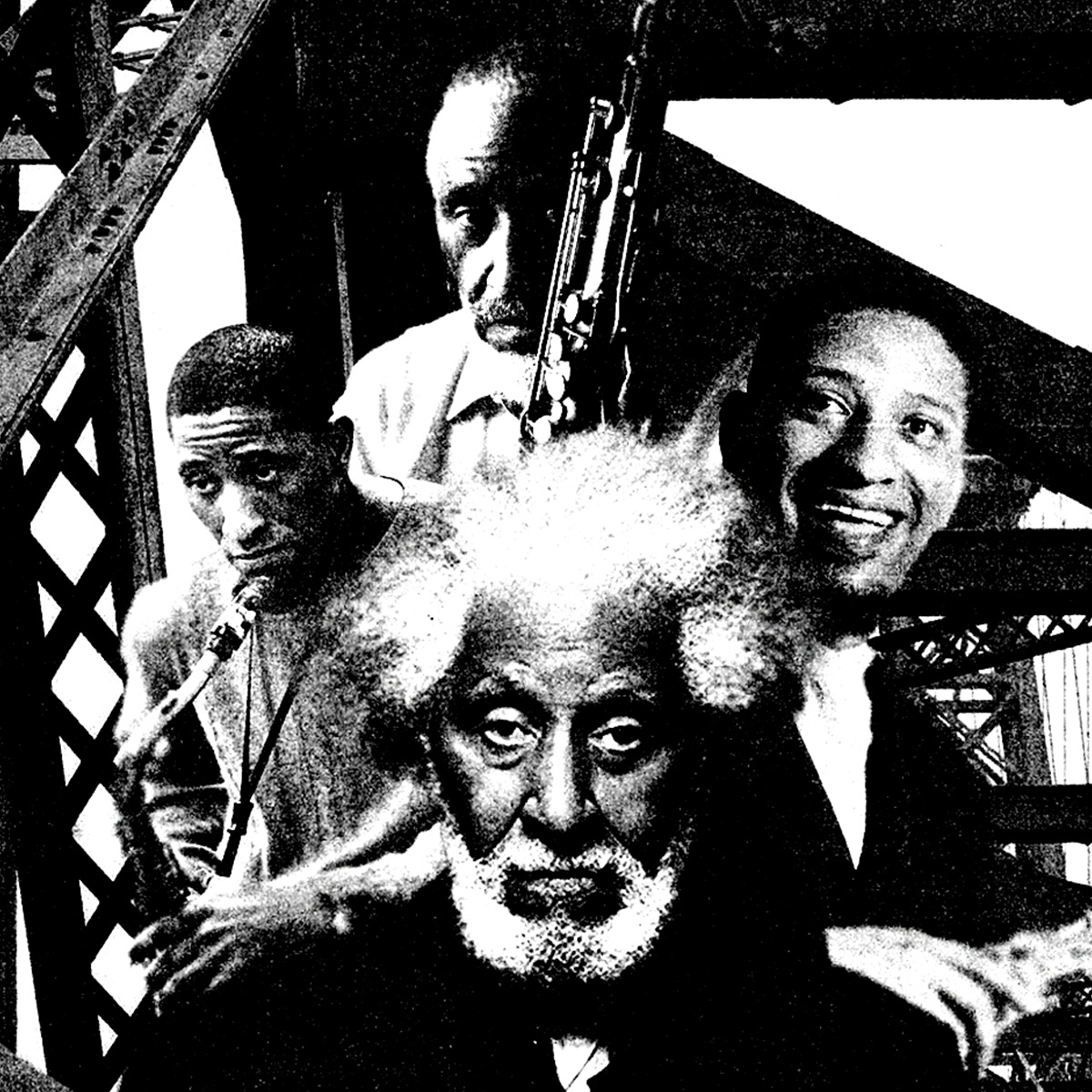
That’s how ‘Sax Men’ begin. For the first time they lay eyes on that curved shiny beautiful-looking piece of metal, it makes them feel proud and strong and important. Yes, important! If you had that sax you would really be somebody important. You would make people dance and be happy. Yes, you can see yourself now, standing in front of those people and filling them with tones straight from your sax, handsomely groomed and dressed, horn gleaming like the sun as you perform in front of the crowds. So you start playing the saxophone.
—from The Notebooks of Sonny Rollins
On August 12, 1958, Sonny Rollins, along with 56 other jazz musicians and a number of neighborhood children, posed on a Harlem stoop for Art Kane’s iconic photograph, “A Great Day in Harlem.” The picture, which appeared in a 1959 issue of Esquire, tells the rhizomatic history of jazz through the biographies of its subjects. The swing era heavyweights Count Basie, Gene Krupa, and Lester Young; the pioneering beboppers Dizzy Gillespie, Mary Lou Williams, and Thelonious Monk; Rollins and his hard bop peers Art Blakey, Charles Mingus, and Horace Silver—these were the faces, and stories, of capital-J Jazz.
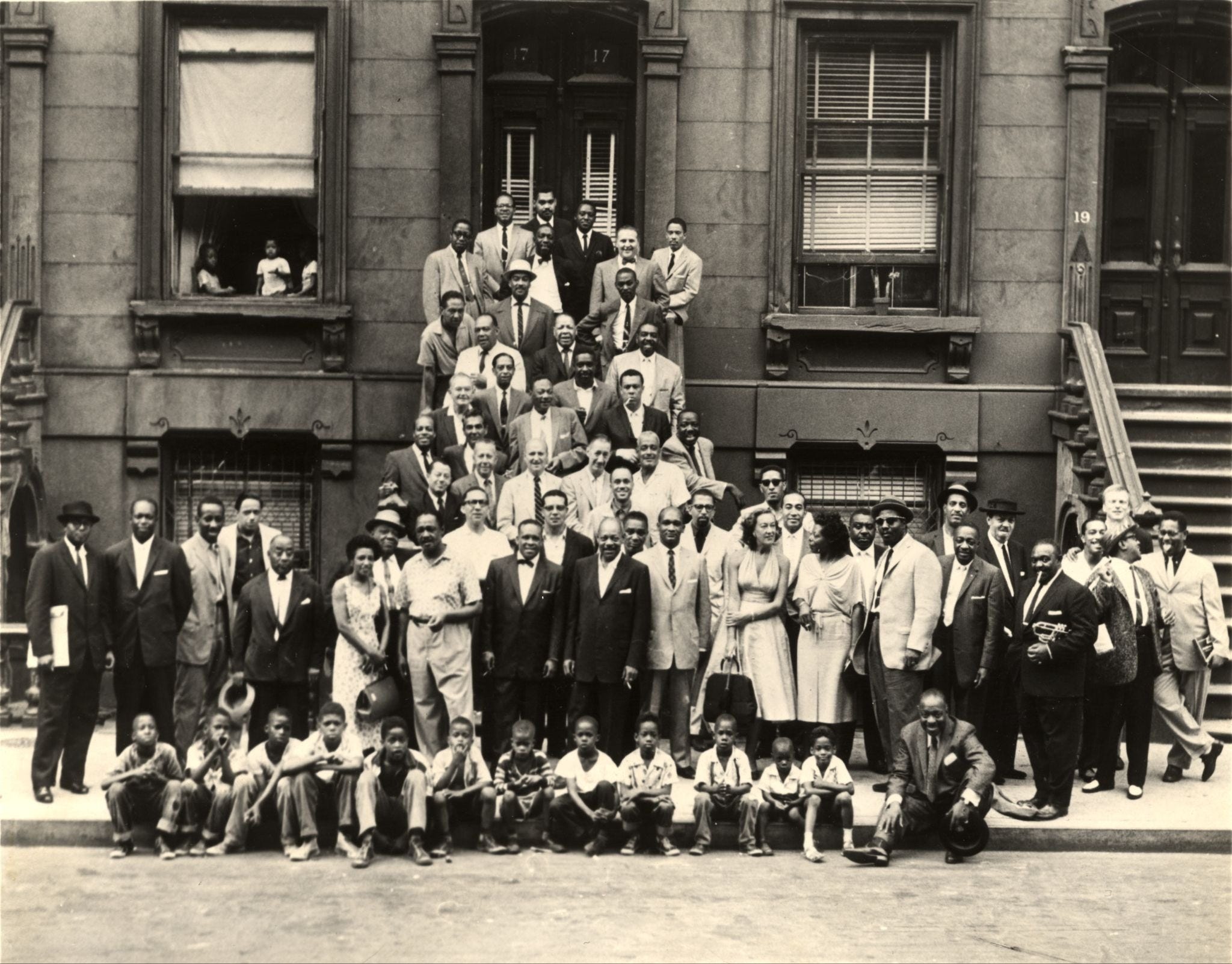
Rollins, who died at the age of 95 on Monday at his Woodstock, New York, home, was the last surviving musician from “A Great Day in Harlem.” With his passing, a chapter has closed on jazz history. Rollins was the final major figure with direct ties to the storied days of Harlem and later 52nd Street when each was the center of the genre. Known as the “Saxophone Colossus”—and by his more down-to-earth nickname, Newk—Rollins was a legend in his own time, one of the greatest instrumentalists, and musicians generally, of the 20th century.
Walter Theodore Rollins was born on September 7, 1930, and grew up in Harlem. He began playing the alto saxophone at 11 and switched to the tenor at 14. Only seven years later he released his first album as a leader and began recording with Miles Davis. Over the next 61 years, Rollins made a number of monumental albums, took two lengthy sabbaticals, changed his style, and at times confounded critics and audiences with uneven strings of LPs and live performances.
The dozen-plus albums he made under his own name just between 1956 and 1958 outpace most people’s careers. Among these, Saxophone Colossus (1956), A Night at the Village Vanguard (1957), Way Out West (1957), and Freedom Suite (1958) stand out as essential works of the hard bop style. Rollins debuted his song “St. Thomas” on Colossus; the calypso paid homage to his parents’ Caribbean heritage and went on to become his unofficial theme song, an indispensable standard. That album also featured “Blue 7,” which composer and conductor Gunther Schuller famously analyzed to demonstrate that Rollins’s jazz improvisation was as technically and musically significant as any piece of composed classical “art music.” A Night at the Village Vanguard is a scintillating double live album against which all subsequent recordings at the storied nightclub are measured. On Way Out West, Rollins mixes country and western tunes (“Wagon Wheel,” “I’m an Old Cowhand”) with jazz standards. Freedom Suite is Rollins’s most explicit musical statement about racism and the civil rights struggle.
Although superbly gifted, Rollins was highly self-critical. In August of 1959, just days before his 29th birthday and only year after “A Great Day in Harlem,” unhappiness with his playing and general disillusionment with the music business led him to take a voluntary sabbatical. It’s a story that has been told and retold: Though he risked throwing away his career when he had reached the top of the jazz world, Rollins spent most of the next two years practicing, sometimes for as many as 16 hours a day, alone on New York City’s Williamsburg Bridge. George Avakian, producer of Rollins’s aptly titled comeback album The Bridge, compared Rollins’s decision to take a step back to “a pitcher on a pennant-winning team announcing, after he had had a twenty-game season, that he was quitting for a while to learn how to pitch.”
Rollins ended his bridge sabbatical in the fall of 1961 and signed with RCA Victor. The Bridge featured guitarist Jim Hall, bassist Bob Cranshaw, and drummers Ben Riley and Harry Saunders. Rollins’s tenor sound had gained a rounder, warmer tone. On The Bridge he played with nuance and patience, a perfect match for Jim Hall’s understated elegance. The album was not agenda setting or paradigm shifting in the ways that recent albums by Ornette Coleman, Cecil Taylor, and Miles Davis had been. But it was masterful, heralding a new period in his career. Rollins recorded six albums with RCA, each different. What’s New?, which also featured Hall, Cranshaw, and Riley, jumped on the bossa nova, samba, and Latin jazz craze; Sonny Meets Hawk paired Rollins with his childhood idol, Coleman Hawkins. And the live album Our Man in Jazz found Rollins in the company of avant-garde trumpeter Don Cherry. Rollins then moved to Impulse! Records, recording the film score for Alfie, an album of standards, and the most outre album of his career, East Broadway Run Down, which featured John Coltrane’s former bandmembers Jimmy Garrison and Elvin Jones.
Recorded in 1966, East Broadway Run Down was the last studio album Rollins would make for six years. He did, however, continue to tour. The 2020 release Rollins in Holland is a wonderful collection of live performances from ‘67. In 1969, Rollins—again disillusioned with music—took another two-year hiatus. This time he was a recluse, neither performing nor recording between 1969 and 1971. Writing in the June 24, 1971, issue of Downbeat, Gordon Kopulos speculated on the saxophonist’s whereabouts:
Once again Sonny Rollins has disappeared from the public jazz scene. No one has heard the saxophonist-composer play in person for almost two years now. No one seems to know where he is. Rumors there are galore, of course; some frivolous and some serious. The darkest one has it that this time he’s put down his horn for good and is living on bread, water and agony, the most likely that he is in the Far east, meditating. At least twice before he’s disappeared. But this time a morbid air of finality seems to be lingering. For this time, unlike in ’59, he just disappeared without any fanfare, without any announcements of intentions to ‘do some more studying.’ Silently, he just dropped out of sight and sound. . . . In any shape or guise, though, the return of Sonny Rollins would be a glorious event.
Not long after Kopulos’s article appeared, Rollins decided it was time to come out of retirement. He made his return at the 1971 Kongsberg Jazz festival in Norway and released the long-awaited comeback record, Next Album, the following year.
On Next Album Rollins incorporated the use of electric instruments and adapted rock and funk styles, which he increasingly used in future sessions. He even played a Moog synthesizer at some concerts. Nucleus, from 1975, is an unadulterated jazz-funk-R&B crossover album that divided fans and critics. Throughout the 1970s and ‘80s, his listeners were split on his direction. The tone of his saxophone was still big, but it had taken on a bolder, edgier sound. He played more calypsos and turned toward playing longer lines with fewer passages of rapid-fire notes. He also started playing long solo introductions and closing cadenzas in which he might quote “Pop Goes the Weasel,” reinterpret a fragment from a Charlie Parker solo, or call up part of another jazz standard. Some listeners resented that he was embracing trends in popular music, maybe hoping that he would sound like the Sonny of old, or emerge from his second sabbatical ready to seismically transform the music.
This period of mixed reception did not lead to a decline in Rollins’s popularity or jeopardize his standing in the jazz pantheon. He continued touring the world, now mostly playing concert halls rather than clubs. In 2000 he released This Is What I Do, which earned him renewed critical acclaim and a Grammy Award. He celebrated his 80th birthday in 2010 with a concert at the Beacon Theatre in Manhattan with a blockbuster lineup. In addition to his working band, he was joined on stage by his fellow legends: Ornette Coleman, Jim Hall, and drummer Roy Haynes. While Rollins had lost some physical command of his saxophone—age and 70 years of playing will do that—his warmth of spirit and generosity were overflowing. That night was one of the last times Rollins would play in public.
Even though Rollins stopped performing in 2012, it seemed as if he was one of those figures who would live forever. He was the Saxophone Colossus—a solitary, unseen figure blowing note after note into the bridge’s superstructure and above the East River, reforging himself from the fires of self-discipline and sacrifice.
Jazz, like baseball, tends to be stubbornly dogmatic about lionizing its heroes. There is no shortage of hagiography or iconography. This comes at the risk of calcifying the music. It reifies its innovators while marginalizing the contributions of almost all others. It also sucks all of the air out of the room for the jazz being made today. I don’t think it is possible for Downbeat to go more than a year without putting Miles Davis or John Coltrane on the cover, (although they get a pass this year, as 2026 is each icon’s centenary). It has taken decades of jazz scholarship and criticism to work toward pointing out who and what is left out with such canonization and to replace the great-man shorthand with more three-dimensional accounts.
The day before Rollins passed, I happened to finish reading the recently published The Notebooks of Sonny Rollins, which is a collection of miscellaneous notes, reflections, aphorisms, diaristic fragments, saxophone exercises, and memories from the notebooks Rollins kept from the start of his first hiatus in 1959 through 2010. Even though my academic training and much of my writing emphasizes and acknowledges the extra-musical dimensions of musicians, I strangely had never thought about Rollins’s life beyond his contributions as a saxophonist and artist. Except for the inexplicable photo of him mowing a yard from the September 16, 1971, issue of Downbeat, he rarely seemed like a real person with a life beyond his horn. Sonny Rollins doesn’t mow the yard. In his Notebooks, the reader gets glimpses of the human beyond the myth. He talks about his diet and his yoga practice, his feelings on race and American society. He notes that he intentionally ate a sweet so that it could remind him how bad sugar makes him feel. He writes about his struggle to quit tobacco. He recalls an instance where he and his wife Lucille share an illness. There are notes about difficulties in his personal life—the things that each of us, no matter our occupation or hobbies, deal with at one time or another.
As a saxophonist, I am particularly drawn to the reminders he wrote to himself to fix certain tics that would appear in his technique. Basic things like making sure to keep the right hand still when not using it to play a note. Learning that something as minor as that afflicted one of the greatest saxophonists in the same way it turns up in my playing made him relatable in a way listening to his records never could.
When I think of the music and life of Rollins, I think of his generosity as a person. I never met, let alone got to see him play. I was, however, able to interview him for a book I am writing about the history of the Blindfold Tests in Downbeat. Rollins was at the top of my interview wish list. There was no reason for him to make room in his schedule for me, especially when he had just finished doing a bunch of press for an album release. I wasn’t writing a major profile of him or asking him to do a longform interview. Beyond writing reviews and a couple of minor pieces for Downbeat, I do not have an impressive collection of bylines. I was simply on good enough terms with his publicist, who was kind enough to set up the interview.
In his three Blindfold Tests he refrained from making negative or overly harsh comments about the music he was listening to. In one of those Tests he specifically declined to give a star rating. I asked him why he did not criticize the music as so many musicians who have done the exercise do:
I don’t like to say too many negative things about music and musicians playing music because I know how damn hard it is. It is difficult being a professional player and to have your work criticized. So I’m very loathe not to engage in that. I would always try and be as positive as I could about a person’s endeavors so that whatever it was, I wouldn’t tend toward the negative. So I think I would do that, I have done that. But there’s always something positive about everyone’s work. I would tend to gravitate toward that assessment rather than what’s wrong with their playing, or something criticizing their work.
It is easy to find faults and to put others down—just read Miles Davis’s Blindfold Tests. It is another thing entirely to do the hard work of looking for the good in everything and holding up the community of musicians.
Later in the interview we talked about how critics had the power to influence a musician’s career. He emphasized that “it was very important for young musicians to get good press. It was an economic thing, really. If I got good press I’d get a nice gig and a raise in salary. Somebody would be happy to have ‘oh Sonny Rollins, yeah he’s got a big review.’ It was like that. That was really why it was important for musicians to get a good review.” He then mentioned that the first time he made the cover of Downbeat it helped him “make a lot of progress with a young lady” he was interested in. I mentioned that I showed off a Downbeat review I had written to try and impress a young lady (my future wife). After a laugh, we talked for another few minutes, and then the interview was over. In those 15 minutes Rollins showed himself to be generous with his time, helped me to understand his outlook on music, and shared a personal moment—not as a legend but as one guy connecting with another.
Even though Rollins’s greatness has been known since the early 1950s, his legacy and impact are different from those of his peers. Unlike his former employer Miles Davis, he did not fundamentally shift the direction of the music multiple times. Unlike his friend and “Tenor Madness” sparring partner John Coltrane, he did not develop a religious following; there is no Church of Sonny Rollins. Although he wrote a number of tunes that became jazz standards (“St. Thomas,” “Oleo,” “Doxy,” “Airegin,” and more) he isn’t known as a composer in the way that Thelonious Monk or Charles Mingus are. While he did have longtime collaborators like bassist Bob Cranshaw, for much of his career Rollins didn’t have a regular working band that was heard across live and studio albums, like Keith Jarrett or Bill Evans. But if every studio album featured a different cast of characters, many were a murderer’s row. Take his 1957 Blue Note album Volume Two: It featured J.J. Johnson, Horace Silver, Thelonious Monk, Paul Chambers, and Art Blakey. Try and find a better combination of six players.
Yes, Rollins wrote tunes, led bands, influenced generations of countless players, and left behind a vast discography. Ultimately, however, as a musician, Rollins was the ideal archetype of the improvising jazz soloist. One could not design a better soloist on paper, though perhaps that’s fitting. His tireless work ethic and raw natural ability gave him an almost unparalleled technical facility. But technique only goes so far. He had an extraordinary ear for rhythm and melody and the ability to pick out melodic lines, develop and reframe them, draw connections between seemingly disparate themes, and pull from his imaginative powers at will. No matter what band was backing him on stage or in the studio, whether it was one of Blue Note’s best all-star groups or two random Dutch musicians he had never met, Rollins showed up and threw down.
Combine this technique and musicianship with his deep study of music, spirituality, society, the body; with his tendency toward introspection, self-assessment, and self-improvement; with growing up in the right time and place and having a strong support system; with being able to, unlike so many of his generation like Clifford Brown, live a very long life; with any number of other factors—what you get is an endlessly creative and vital artistic force who created a body of work that is almost too much for one listener to fully absorb.
While introducing trumpeter Roy Hargrove onstage at his 80th birthday concert, Rollins shared his belief that “in the world of jazz and music, people are not doing it by themselves, there’s a higher force that takes people and picks people and says ‘you are the one, you are the one.’ And that’s my next guest. Somebody picked him from high above and said ‘you are the one.’ I’m talking about Roy Hargrove.”
Sonny Rollins was one of those people who was called from above, and he met that calling with everything he had. As he wrote in his Notebooks:
Nature take me back.
I am yours.