


Art by Evan Solano
Michael McKinney is the Anthony Edwards of electronic experimental music journalism.
Early into That Moment, the debut LP from Sopa Boba, a boy steals a bit of cash from his father’s pocket. In response, the father severs one of his son’s fingers with an axe. The story is one of sharp escalations, of minor cruelties suddenly turning to something much larger. That Moment, which takes its title from a 2013 text by Moldovan author Nicoleta Esinencu, follows as a long-form exploration of corruption and power, a pitch-black and blood-soaked oratorio for spoken word, strings, and electronics.
In the world of That Moment, everyone carries a handaxe.
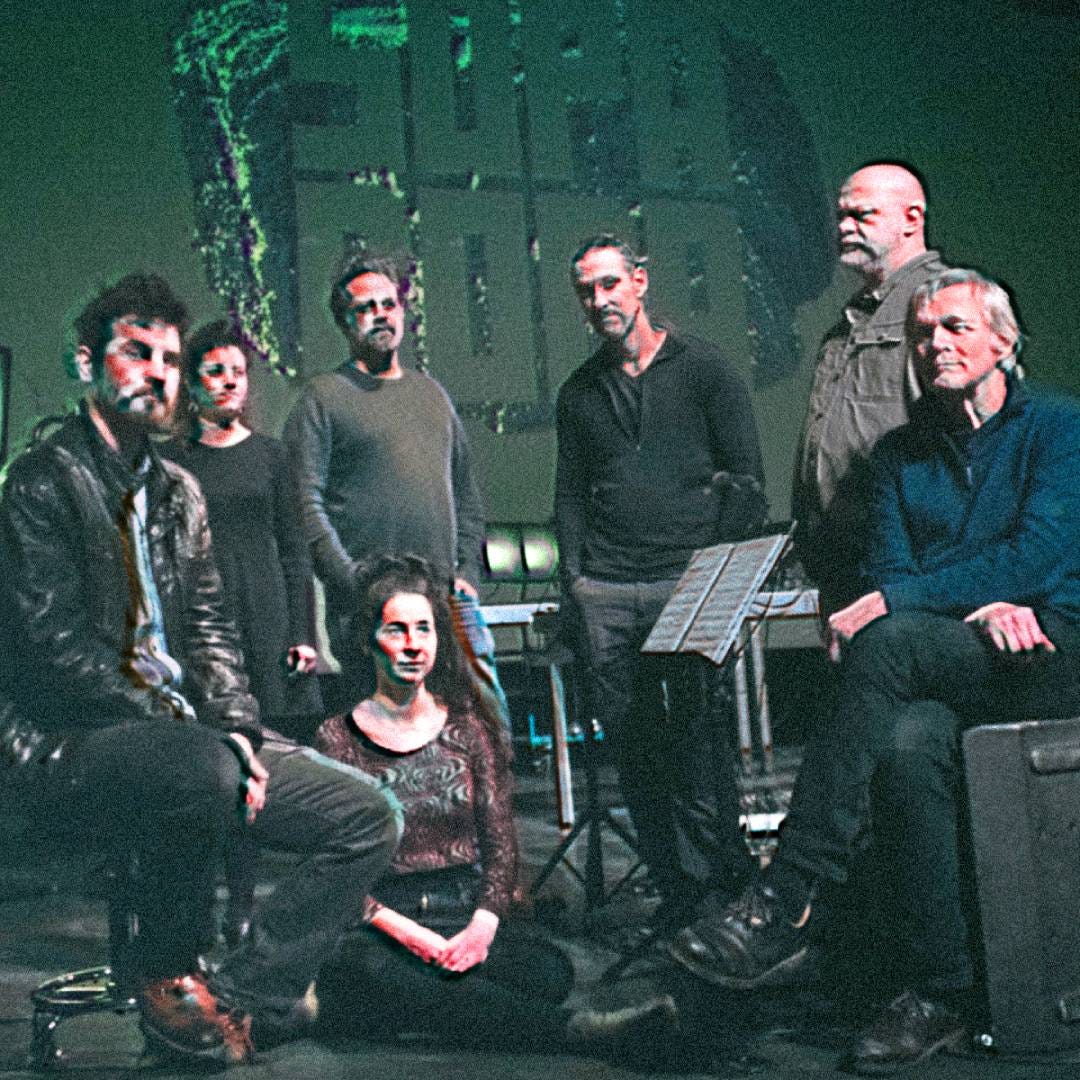
In the early 2020s, when the members of Sopa Boba—sound artist Pavel Tchikov, experimental-rock titan G.W. Sok, and dramaturgist Jean Vangeebergen—started work on what would eventually become That Moment, their eyes were focused on Eastern Europe. But then history lurched forward. In 2024, “we looked at the last chapters [from Esinencu], and we thought, What the fuck?” G. W. Sok recalled in conversation with POW. “It’s prophetic, in a way. I hide my fingers. It’s right under your feet.”
What might have started as an exorcism of sorts suddenly turned towards a new kind of urgency. With That Moment, Sopa Boba take a pile of artistic traditions— everything-at-once modern classical, screaming gabber and hardcore dance musics, hair-raising street-corner sermons—and defy them all. History doesn’t repeat itself or rhyme, it plays in a hundred registers at once. There’s dissonance everywhere if you know where to look.
In June of 2025, POW sat down with Tchikov, Sok and Vangeebergen to talk about That Moment, about decades of governmental collapse and frayed social fabrics, about radio plays and dirty cops, about opera and the value of a little insanity, and plenty more.
(This interview has been condensed and lightly edited for clarity.)
How are you all doing?
Jos Kleij (a.k.a. G. W. Sok): We are preparing for two weekends of three shows with Sopa Boba. It’s nice to play six times so we can get a bit used to the theory of playing it live. I think it can still develop. We did three, four shows, maybe, in February [of 2025].
With the live show, are you hoping to play the songs straight? Are they improvised in any way?
Jos Kleij: There is a score, so to speak, and we more or less follow the score.
Pavel Tchikov: Yeah, it's the same arrangement as the record — very close to the record. We have some deviations and elasticity inside of it, but the idea is to stay close to the record.
Is the whole record throughcomposed?
Pavel Tchikov: Actually, yes. The strings are completely written. The electronics are half-written and half-improvised. I work with a lot of modular [synthesizers], so the way you do it is, sometimes, you make a patch that can work on its own. Then you record it, and there is probably no way to patch it back the way it was. So in the live situation, I had to recreate some of the sub-patches from the record, but we are still close to the original thing. It’s not the same pattern, because it may have been generative in the recording, but it’s similar.
The strings are one on end; the electronics are in the middle; and Jos is the most free of us all. [laughs]
Jos Kleij: I have my cues, of course, but I don’t understand any of what he just said. [laughs] But I have my cues, and I know where to be or not, more or less. Sometimes, the feel is different, and then I go slower or faster, or some other nuances in the text make it go faster or slower. I have to stay alert to recognise the cues. In the beginning, I didn’t know where to focus, because when you hear a new thing, you have no idea where you are. I’ve started to recognise certain patterns after practicing, though. In the excitement of playing, sometimes I get lost a bit and have to find my way back. But it usually goes well, because they know I’ll be a bit off; they are prepared to adjust a little bit if possible. The strings [players] are more classically trained, though. It’s totally logical, because they are used to that: everyone has their pattern, and that’s the pattern. You cannot deviate from that.
How did you all end up connecting? How did Sopa Boba form in the first place?
Jos Kleij: That’s a good question for Jean.
Jean Vangeebergen: I'm not a musician, you know. I work in theater. One day, I found the text: “That Moment.” I fell in love with this story, but I wanted to try to make it without the system of classical theater: on a stage and everything like that. One day, I’m reading the text, and reading the music and the rhythm of the text. I say to myself, “Working with a musician could be a good idea.” I knew Pavel a little bit, so I phoned him and proposed working on this. He fell in love with the text too—no?
Pavel Tchikov: Maybe not really “loved.” [Vangeebergen laughs] But it reminds me a lot of my childhood in Russia. [laughs] I grew up in Russia until I was 12; [“That Moment”] was all the stories from there.
Help me understand what you mean.
Pavel Tchikov: The little stories you find in the text from Nicoleta Esinencu, who is Moldavian, so it's still an ex-USSR country. So the things that I saw and I lived in Russia were similar to the story of “That Moment.” It was familiar.
Jean Vangeebergen: I worked a little bit on the text to make it right for an album. I cut it into seven parts: what are the important parts of the story? I talked to Pavel like I talk to an actor or a comedian: with a dramaturgical idea and a picture [in my mind].
Pavel Tchikov: It was notes like “make this part slow and depressive,” or “make this elevator music,” and I had to deal with that.
Jean Vangeebergen: It was a first step to understand the story. Pavel put it into his musical language. There was quite a lot of back-and-forth.
Pavel Tchikov: At first, we didn’t really have an intention to make a record. We wanted to make a show. Not really a concert: something between a theater performance and something else. We also thought about making an audiobook or even a short film. We kept on going with this “spectacle” idea: a micro-opera. The first idea was to have five speakers, and Jos would be one of them. We reached out to him, and he said yes.
Jos Kleij: I thought, “This is a crazy idea, so why not?”
What drew you towards the text?
Jean Vangeebergen: I only work on political stories. It's my core business — especially themes like violence and marginalization. I discovered this text in French, and I like the way Nicoleta Esinencu tells the story: like a [fairy] tale, with all this humor and cynicism. [laughs]
Pavel, you mentioned some familiarity in this text. When I listen to this I hear a lot of absurdism. Can you help me understand the familiarity you’re feeling?
Pavel Tchikov: This text is structured as a blend between reality and imagination. At the beginning of this story — when the little boy steals money from his father's pocket and [the father] cuts his finger off — this is a real story that [Esinencu] discovered in the Moldovian newspaper. I love this characteristic of the work: sometimes, the parts of the text that seem to be ridiculous are real.
When I was a kid and I had an appendicitis operation, the doctor proposed three different sizes of scars to my parents. If you wanted to get the smallest one, you had to pay more. They do it for everybody: rich or poor people. If you’re poor, then maybe you would like to find the money to make a smaller scar for your kid. The larger one was [laughs] I don’t know, 20 centimeters. To do the job, they only had to cut three.
These situations — this corruption — is on every stage. My parents never had to do this, but you can give gifts to teachers in order to pass exams or get good grades. This is a children’s level, but it goes further. I lived there in the ‘90s. It was very chaotic then — more chaotic than now. When you are going from one town to another, you can meet the police in between. The police will stop you and, if you want to continue your journey, you have to pay. Otherwise, you go back, or you have complications.
Even if it’s two parents with two kids, it didn’t matter. There wasn’t any pity.
My parents left because of things like this: where you can’t trust the people around you. For every step, they had to pay or bargain.
I can see why something this dry would resonate in that case.
Pavel Tchikov: Yeah. Even the last chapter of “That Moment,” when the guy becomes powerful and just thinks, “There is that country, why shouldn't I buy it? It wouldn’t be bad if it was my country, but I don’t want to give any money for it” — He is able to buy a country. [laughs] It’s awful how it reminds me of the current state of the world.
In the ‘90s, after the fall of communism in Russia, that’s exactly what happened. Some of the people became president of other countries, but it also happens on the economic level, where some people became extremely rich in the petrol industry: somebody bought the petrol industry for one ruble. [laughs] Another guy became the boss of the car industry, and so on. This is the similarity we were all aware about. We saw some people become so powerful and able to do whatever they wanted, just like in the story.
When you say “we,” who are you speaking of?
Pavel Tchikov: [laughs] Oh, normal people. Those who were not able to do it. [laughs]
I’m curious: more broadly, what’s your relationship with capitalism as an ideological framework? This record engages seriously, and cynically, with what money does to people.
Jos Kleij: When we started this project, four years ago or so, I read the text, and it was about Eastern Europe. Pavel says, “That’s the way it goes there.” Then we finished the album [in 2024], and we looked at the last chapters, and we thought, “What the fuck?” It’s happening, but it’s not Eastern Europe. It’s fucking Western society. Donald Trump wants to buy Greenland. Why not? Oh, we’re going to put some pressure on China by raising taxes. Suddenly, some people got a lot of money by buying stakes, and then they lowered the taxes and they sold them again. Some people made a lot of money there. In two days’ time or so, 20 people got really rich.
It’s happening in the Western world — the “civilized” part of it. It’s insane, what’s happening now. It’s not only in the U.S.A.; it’s the same bullshit almost everywhere. It’s scary, in a way — it’s prophetic, in a way. I hide my fingers. [laughs] It’s right under your feet.
Pavel Tchikov: I think, at first sight, the story is speaking about the shock between capitalist society and post-Soviet society: money and corruption. It’s a meeting of both.
But, nowadays, I think there is a boomerang effect. The Communist societies in the East inspired the politicians in the West. I think people like Putin are an example for politicians in [democratic governments] who are fed up with democracy, because democracy is difficult. It’s work. What Jos says about this — it’s what Nicoleta [Esinencu] writes about the shock between East and West, but, nowadays, it’s total.
Speaking of culture shocks, I’m curious about the record on a more purely structural level. When I listen to this, I hear “modern classical”; there are points where I hear Dutch hardcore; there’s spoken word. Talk to me about the sonic framework for the record.
Jos Kleij: Shall I first give the easiest answer?
Pavel Tchikov: Yeah.
Jos Kleij: And then you continue. I would say, why not? Why not put them together? Because if it's possible, and it seems like a good idea, okay, let's do it. That's the easy answer, but [laughs] I didn't have to write the music.
Pavel Tchikov: As Jean said, he first divided the text in chapters — the songs. And he told me what atmosphere he was hoping for. So I already had these elements: the rhythm of the words and the suggested atmospheres. When I start a new project, I always want to do something I’ve never done before. At the moment when I started working on this, I was shifting from instrumental music to electronic music. I was exploring synths. At the same time, I had a dream,for a long time, about composing for a string quartet.
So, with those suggestions from Jean about the atmospheres, I tried it out, and it worked. I did several loops with MIDI strings and the ideas matched, so I thought it would make a good compositional frame for the project. While trying to imagine how the voice would sound on it, I thought, straight away, about Jos’s voice. Since he said yes, he came and we made a demo. And, actually, the three things worked together.
At this point, we wanted to make this project bigger, and Jos would have been just one of the protagonists. We didn't find enough budget [for the work], and we had scheduling problems, and it took more time than expected, so we decided we should think smaller: make a band, get a record, and not do a “micro-opera.”
Jean Vangeebergen: At this point, we decided to work with Jos on the color of each piece to make something...
Pavel Tchikov: Subtle?
Jean Vangeebergen: Subtle. I didn’t want Jos to make theater on the record. I wanted to keep the project in the frame of music. With Jos, we worked on making each voice have different color without changing his voice.
Pavel Tchikov: Just small things.
Jean Vangeebergen: Changing things like [his] pronunciation for the voice of the mother, the father, or the teacher. We also decided to make a choir, too.
Pavel Tchikov: It’s like backing vocals. Layers.
Jean Vangeebergen: Yes. But it’s taken from the notion of antique theater.
On his paper, Jos made a blue character, a red character, and a green character. It was code to change things in his spoken word. Jos, perhaps you have more information about that.
Jos Kleij: At first, when I was going to do all the voices, and I did the mother’s voice — do we have to pretend to have a female voice there? That would feel uncomfortable for me and, I think, for the listener, because I would have to change my voice into something that is not me, and I can’t be convincing when I do that. So we found ways. The father has a rough voice, and he’s raspy; the mother speaks urgently, with a bit of staccato, because she’s the boss at home; and the boy would be just me. I didn’t have to do too many different things, and it was easy to switch from one to another when necessary. The father dies, so that’s easy [group laughs], and then the mother also dies [Pavel laughs], so it’s a piece of cake. Then I turned into Trump, buying all the land. [group laughs]
How did the text inform the composition? When looking at the text, did you say, “These are spots we really want to emphasize?” Were they in dialogue throughout the process?
Pavel Tchikov: So, with Jean’s atmospheric suggestions, I would compose several riffs or patterns — just a few measures. Sometimes, I would have a clear idea of what the strings would be doing, so I would start with that. At first, we did five songs, and we put Jos’s voice on top. When I had the demos, we started to see what was missing: in this part, we should slow things a bit, and in that part, it should go faster. From those demos, the second stage was to get more into the details and listen to what the text needs for a musical background. At this stage, when the vocals were put on the demos, we started to become aware of the whole shape of the record. Sometimes we realized there was too much noise, or that we needed to calm down and write a beautiful string part.
Also, for me, I didn’t do this intentionally, but I’m happy with how it turned out: the parts [of the text] that are about childhood are the harsher ones, and the more violent ones. I realized it makes a lot of sense: the protagonist of the story — to be in that world, it’s so violent for him. I think the music suits the emotional charge of a kid being in the world and experiencing all this violence. Then things shift after the fourth song, when he goes into teenagehood, starts to get corrupted, and gets a bit of power. Then the music gets more under control. I didn’t do it on purpose, but I’m happy with how it turned out.
Were there any moments in the production of this record where it surprised you?
Jean Vangeebergen: For my part, no. [laughs] In my usual job, it's the story of each project. There is an important part of random[ness] in the work and the story we are talking about in political theater. There is also [the matter of] who crosses the work. Things that happen on the stage make sense, and we recycle those things for the next step of the project. For me, it’s normal in an artistic project.
Jos Kleij: In the beginning, you said something about this odd combination of strings and this “techno” kind of music. What I find interesting is that I have never had these limitations on a specific genre of music. I have never been surprised by the fact that what Pavel comes up with is “techno” music, so to speak, and that there are strings. For me, it was a normal possibility of what could be there. In that sense, what happened doesn’t surprise me at all. When I joined the project, we did demos, and the music was very basic: almost no strings.
After coming back a few months later for other demos, the compositions weren’t demos any more. That was my moment: “Okay, we’re going somewhere.” You could feel it grow into something. Also, for myself, finding the right way of doing the voice. In the beginning, it was very clumsy. I didn’t understand the text so much. So: what is the essence of the text? What am I saying?
At first, I just read the lines, but after a couple of times, I realized she meant something else. I started to feel the cynical underlying thing of it. For me, that’s the small surprises: Now I found something that better suits the music.