

Growing up in East Tennessee, it wasn’t uncommon for your neighbor or grocery cashier or mailman to ask, unprompted, if you’d found your “church home” yet; my devoutly religious first-grade teacher once stood me up in front of my classmates to accuse me of being a witch. It was the 2000s, when televangelists and Harry Potter fanatics both saturated the culture—you do the math. These warped doctrines wedge shame into the most vulnerable crevices of the soul. Artistic practices, usually a space for divination, are clouded and corrupted.
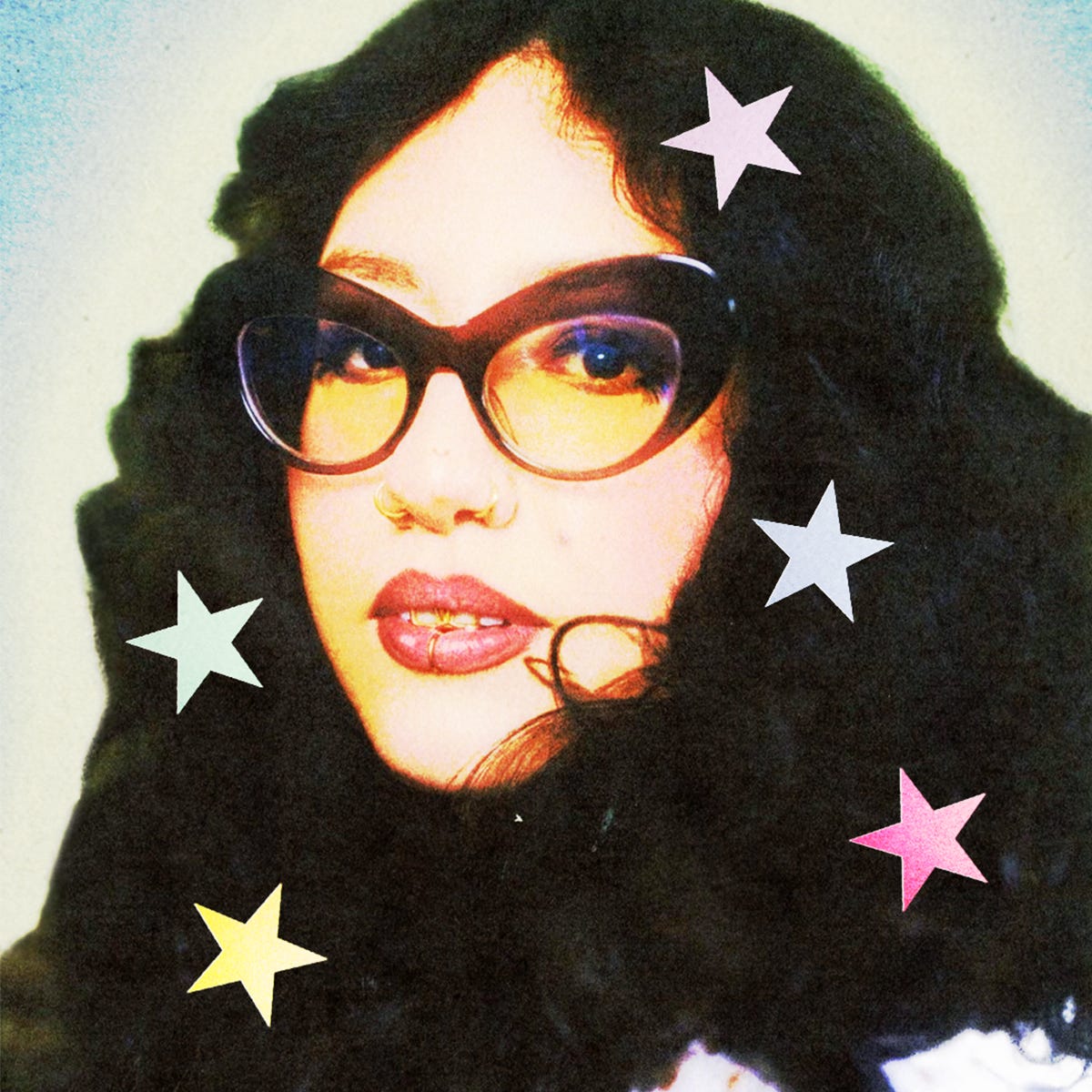
Though separated by a few states, Sparklmami and I immediately connected over the religious traumas of our youths spent in the South, and our respective Chicago-based extended families that exposed us to an artistic life beyond them. On her debut album, in this body, the musician, visual artist, and creative director examines the impacts of her Texas upbringing; it’s a defiant neo-jazz return to her own vessel.
“I grew up in the church, and that was my formal introduction to singing,” Sparklmami says. “I used to be in the church band with my cousins and my youth pastor. When I left the church, I didn’t sing for ten years. I was making visual art, and had stepped away from music.” Fortunately, that interlude was clarifying, an expansion rather than an end. “While I wasn’t making music, I got to really learn what I liked, and got to cultivate my taste, and spend a lot of time just collecting music, finding things.”
Studying visual art in high school and later earning a BFA from the University of Illinois Chicago, Sparklmami began to forage references that encapsulated core memories from her childhood, imagery she would later synthesize on the album. “A lot of my work at the time was about processing my own lived experience through Mexican television and soap opera aesthetics,” she says. “I was dabbling in everything. My visual practice was very much world-building, thinking a lot about utopia, and trying to reimagine things that were inherently me processing my childhood. That world developed on its own, and I made my way back to music.”
Backyard bandas on warm summer nights; a CD collection surreptitiously toted in her mother’s car; lush Brazilian jazz and silky disco—this is the alchemy of in this body. “A lot of making this record was from coming across artists like Flora Purim, and being super enamored with how she was so ahead of her time, and really embodied her voice as an instrument,” she says. “I was really inspired by a lot of the Brazilian sounds that were coming from the ‘70s, like Marcos Valle, Sandra de Sá. Azymuth, Cortex, and the freeness that they embodied.”
Sparklmami’s retro-utopia is replete with enchanting vocals sung in both English and Spanish. Rediscovering herself through meditative, subconscious character work inspired by the poet John Giorno, much of the album was recorded in singular takes. “I’m just trying to get free,” she explains. “Seriously: Just get as free as possible.”
I read somewhere that you did a stint as a DJ. How did that help shape your taste in curation, having grown up surrounded by a specific church music sound?
Growing up, I wasn’t really allowed to listen to secular music, is what they call it. It was more my own moral dilemma as a teenager, [feeling like] I’m guilty for wanting to find music. I learned how to DJ over the pandemic, and prior to that, I was always finding music. I had 10,000 songs in my Spotify library or some shit like that, [going] down the YouTube holes. I didn’t grow up going to music school, I had no formal training, didn’t really grow up with jazz in the house or anything like that. It wasn’t until college when I really got to further the taste. The way I think about my work, whether that be visual projects or music projects, is that I’m a student, and I’m interested in a subject, and I’m researching my way through it.
I grew up in the South, and it was a very, very religious place, so I definitely understand the conflict of moral dilemmas and internalized guilt as a child.
I’m 12, feeling guilty for listening to Coldplay. Like, what?
I’m curious if you have any sort of grounding practices that you integrate, or if the creative process is your meditation in itself.
The creative process is my meditation and is my landing place to freely feel. So much of this is intuitive to me, and I want to protect that. My intuition is what got me here to begin with. While growing up in the church wasn’t always the most positive experience, I learned very quickly the feeling of spirit. I experienced that same feeling in the church, and I experienced that same feeling again ten years later when I started to sing again. That is my gospel, not [coming] from a place of shame.
I stepped away from Christianity as a whole, and I associated that with my voice for so long. I always had this inherent desire to make music, but I was too scared and was not there within myself to do that. I remember my family always [telling me] I have such a nice voice. I was always around musicians, and when I was in college, [my friends and I] used to host DIY shows in the basement. I was just always around. I was also a makeup artist for a while. I used to do makeup for other artists in Chicago, and sometimes artists that were touring through Chicago, and I feel like that was my footing. I believe it takes time to cultivate community.
That moral dilemma really came about when I was a preteen, and more so understood the conditions of my environment. Visiting my family in the summer in Chicago, they put me onto house music, block parties, and bandas playing in the backyard on the south side. That was very formative for me. My mom also was a music collector, and she had this huge binder that [held] hundreds of CDs that she used to collect. I remember when she became committed to religion, that was the last thing that she really had a hard time letting go of. It makes me really emotional. She would just carry it in her car, and [say] I know I have to throw this away. But, you know, I think flipping through that [binder] as a kid was also just so formative for me. Seeing a lot of, like, Spanish rock and house music. She loved a lot of techno from the UK, things like that.
The whole process of making this album was coming back to my voice. That and the title itself, too. It’s literally coming back to my body on all my own terms, and knowing that I have agency. I tell my friends, I’m just trying to get free. Seriously, just get as free as possible. Your body does hold on to shame.
It’s really intense to come to terms with that, too.
Yeah, but it gives me a lot to make [art] about, so…
I love that you use characters to express yourself; were you involved in theater, or did these characters develop in private?
When I was younger, I used to go to drag shows. I would just, like, wear a wig, and do my makeup really crazy, and just go about my day like that. I’ve always just been interested in the idea of an alter ego, you know? And now I’ve gotten to develop it through sound.
Who is your alter ego? What’s her vibe?
Well, I’d like to say she’s my confessional subconscious. [She] is informed by me, but for some reason, she has an English accent. She’s unapologetic, and calling out her own shit, and is also inflecting stories through a more third-person perspective. There’s also a character named Dr. Laura that I’ve gotten to develop more, and she’s my therapist. I’ll go on stage, and I’ll modulate my voice, and I’m having a therapy session with both characters, and so I’ll have two mics, and so one is me, and then the other one is the modulated voice.
It was inspired by this show called Caso cerrado, which is on Telemundo. It’s kind of like Judge Judy, but [with] a therapist. But yeah, I don’t know. I really don’t know how it came about. I remember being inspired by this poet named John Giorno, and I think that’s where I initially got the idea. I remember watching some of his earlier works, where he would literally just go up on stage and just start speaking from subconscious, and then there would be someone transcribing what he was saying in real time, and that would then become published poems. So I kind of took that approach. I just started talking. I would like to say that whatever spirit is channeling through me becomes that. I don’t know how to explain it.
How did you get into visual arts? It sounds like you were interested in music, and then you shifted gears.
The BFA program that I was in was pretty open-ended, and was actually more, like, conceptual than technical, so I just got exposed to a lot of different shit.
I was painting, and then I took a bunch of video classes, and that’s when I learned that I was interested in early 2000s, ‘90s, Mexican soap opera television aesthetics, so I stuck to that, and developed that. I was really interested in the green screen as a motif of worldbuilding, and then moved on from the green screen as a background to making that into the foreground. I [would] paint my body green, and was thinking about how a green screen is often used as a tool to render space, so what does it mean to render my body? I was thinking about these different things, and was doing a lot of different performances where I would dress up as a patient, and had my friend dress up as a nurse, and he was painting my body green. [I was] critiquing or speaking to, like, the notion of feeling like there is something that needs to be changed about myself.
How did you get comfortable with the performance aspect of all of this?
That’s been new. That’s something I’m still navigating, figuring out my stage presence. I don’t even want to be thinking about it that much. I know who I am, and I know what my energy is. I’m not really trying to choreograph or dance in that kind of way, I am interested in pushing the boundaries and really seeing something that I just haven’t seen before, bringing more of that conceptual-driven, performance art on stage. Stage design, and bringing live green screening on stage, and what that would be like.
I definitely am a creative director. I’m definitely creative and directing everything, and I know what I want, I know what I see, and [I’m] spending more time growing that. I make decks, I love a deck. I love a storyboard. I’ll shotlist things out [for my videos]. I’m very involved in the process. It is very much what I see.
Do you have any movies that you love? Was anything super influential to you?
Holy Mountain was a very life-changing movie for me when I was in college. It changed my whole understanding of what film could be. Watching David Lynch films in college as well, like, Mulholland Drive, I remember watching that in class. Video artists, like Shana Moulton, Jacolby Satterwhite, a lot of video artists that I liked. Alex Da Corte, that’s another one that I really liked, he does a lot of critiquing consumerism. He actually directed a video for Tierra Whack, most recently. So, that realm, those are more my references. Not so much straight-on films, but video artists and performance artists.