


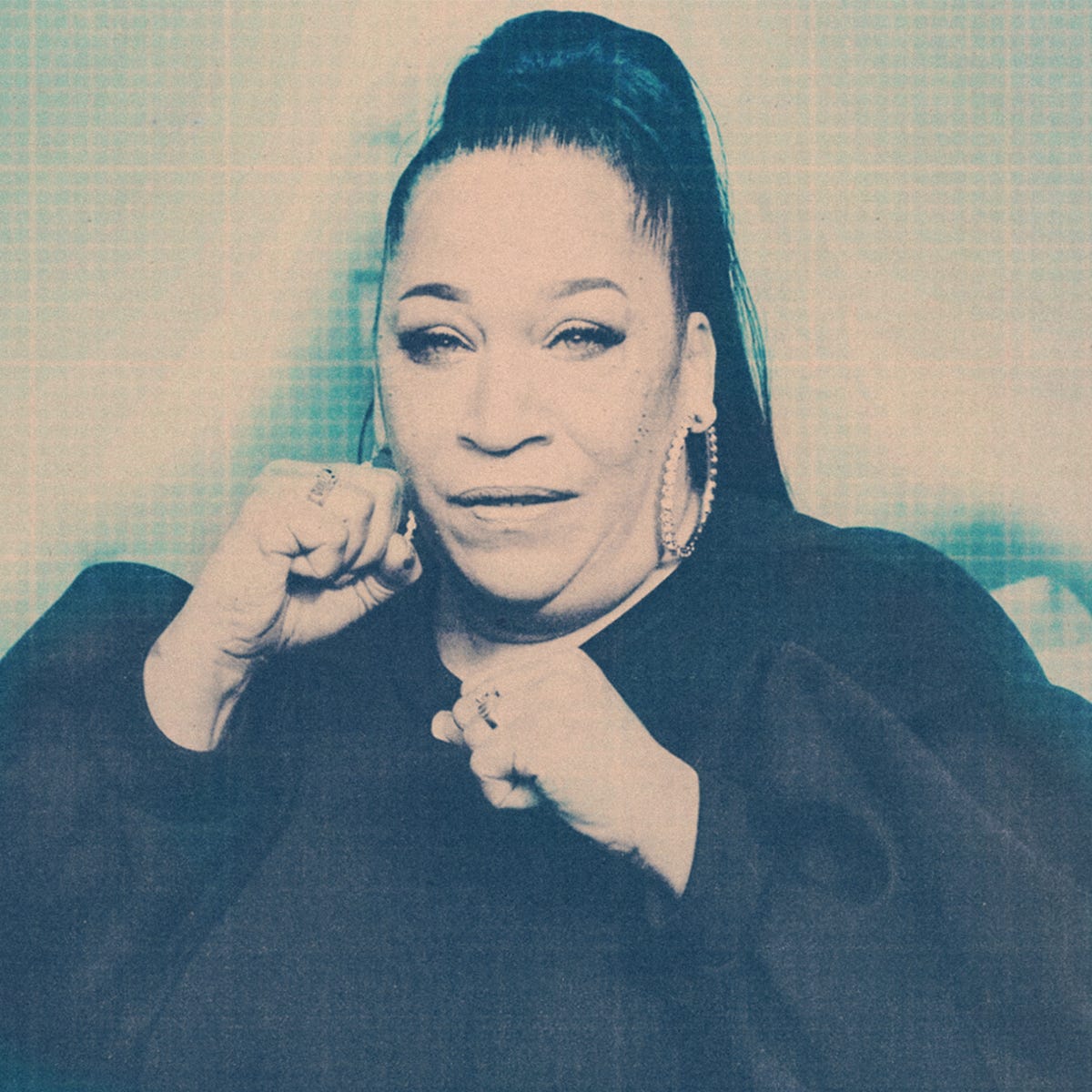
Doreen C. Broadnax was born on June 2, 1965 in the Van Dyke Housing Projects in Brownsville, Brooklyn. At the time, Brownsville was a predominantly Black and Puerto Rican neighborhood, as many of the white residents had fled during to New York’s public housing development in the 1950s. Broadnax was in the middle, with a white mother and a Black father, a situation she described as pushing her to look towards the streets in search of a more homogenous community. By the time she was a teenager, hip-hop culture was exploding in the streets through park jams, DJ battles, and breakdancing, something she found solace in as a burgeoning dancer herself. Emcees like MC Sha-Rock of Funky Four + 1, Pebblee Poo of The Smoke-A-Trons and Kool Herc’s Herculord Crew, and Dimples D became her north stars, and proof that hip-hop was a unisex sport.
Rapping found Doreen in the walls of her project building. One day in 1983, two neighborhood girls by the name of City Slim and Mo Ski were banging homemade beats onto the hallway walls. She joined in and was quickly invited to the group, and thus, The Playgirls were born, and Doreen was rechristened as Sparky D. The trio didn’t waste any time, quickly cutting their teeth in New York’s battle culture and clashing across boroughs with anybody that wanted the smoke.
At the time, Harlem rap superstar Kurtis Blow was in the midst of working on the Penitentiary III soundtrack, and reached out to fellow rapper/producer Duane “Spyder D” Hughes to help search for a female group to add to the soundtrack. Spyder put the word out and got put on to The Playgirls through a Brooklyn producer. The girls visited Spyder at Power Plays Studios in Long Island, where he was immediately struck by their talent. “I told the girls I wanted to sign them, and I wasn’t really sure what [Kurtis Blow] was doing, but I was not going to give Kurt these girls,” Spyder recalled to Unkut in 2013. “Kurt and I were friends, but we were rivals as well. Nobody had offered me any money for the soundtrack, so I signed the girls and brought them into the studio.”
That session made Spyder D The Playgirls’ producer, and was also the beginning of a romance. Sparky and City Slim had both slid Spyder their numbers, but it was Sparky he called, a choice he described as causing dissension amongst the group. That romance came with perks; at 18 Sparky became Spyder’s A&R, and by 1984 when The Playgirls began to fall apart, a stage was already set for Sparky to be a star.
New Year’s Eve of that year would prove to be one of the most consequential days of Sparky D’s life, and subsequently the history of hip-hop as an artform. At home, the newly coupled Sparky and Spyder were listening to Mr. Magic and Marley Marl spin on WBLS’ Rap Attack, when Magic premiered a new record right at the stroke of midnight. Blaring through the speakers was a squeaky but determined fourteen year old Queens girl by the name of Roxanne Shanté, spitting viciously over a Marley Marl beat on a song titled “Roxanne’s Revenge.” Shanté was aiming back at a Brooklyn Crew that included Sparky’s former classmate Shaun Fequiere, now known as Kangol Kid of UTFO.
He wears a Kangol, and that is cute
But he ain’t got money, and he ain’t got no loot
And every time that I see him, he’s always a-beggin’
And all the other girls that he’s always tryin’ to leggin’
Every time that I see him, he says a rhyme
But, compared to me, they’re weak compared to mine
“UTFO were our boys,” Spyder D recalled. “You gotta take her for their honor!”. The duo wrote a response record the next day, and on January 2nd, “Sparky’s Turn (Roxanne You’re Through)” went to tape. Spyder brought the first mix to Tony Humphries, a club DJ for KISS-FM who premiered it on his show that Friday night. The diss caused widespread commotion in the streets of New York, enough to catch the attention of TaharQa and Tunde Ra Aleem, a pair of twins that got their musical chops playing alongside Jimi Hendrix in the 60’s, and now ran NIA Records. They cut a deal with Spyder to remix the record, adding production flavor and the sub-hook that gave the song its sub-title: “Roxanne, you’re through!”
The remixed version was cut the following week, and by that Friday 10,000 copies were pressed to accommodate for the massive buzz brewing around the burgeoning Roxanne Wars. “Three days later,” as Sparky says, “I became gold.”
What followed was a Roxanne Industrial Complex of sorts. Shante retorted with a flurry of her own records, lobbing shots at Sparky, UTFO, a sea of Roxanne clones, and what had become a swarm of opportunistic emcees. By mid-1985, estimates of between thirty to a hundred answer records had flooded the market. Fictional versions of Roxanne’s parents, brothers, sisters, her doctor, and more all popped up in mythologized disses coming from every corner of New York and beyond, many from artists whose only contribution to music was their part in the battle. A majority of these tracks predicated less around Shante herself and more around an idea; after all, “Roxanne Roxanne” was never a real woman in the first place. DJ Red Alert and DJ Marley Marl had chosen their sides in the battle; Red Alert repping Sparky D on KISS-FM, and Marl repping Shante on rival station WBLS. The two DJs, already radiowave gods at that point, taunted each other on air, and fanned the flames that were igniting all over the city.
After a flurry of tracks, a fatigue began to set in around the city. By mid-1985, a group called The East Coast Crew put a de facto end to The Roxanne Wars with a ceasefire record titled “The Final Word - No More Roxanne (Please)” that essentially ended the beef dead in the water, at least on wax - A real, tangible friction still remained between Shante and Sparky.
The relationship between the rivals remained tumultuous, but human. Despite several verbal and physical altercations, Sparky and Shante went on tour to capitalize off the notoriety of their diss records, with precautions in place to ensure minimal friction. This culminated in an onstage battle in Raleigh-Durnham, North Carolina, hyped as a Frazier-vs-Ali-esque clash that had lines wrapped around the corner. The girls went head to head in an astonishing display of off-the-dome snapping, lyrical exercises, and brutal diss renditions. The show was so successful it spawned a collaborative EP, “Roxanne Shante vs Sparky Dee: Round 1,” that saw the two foes trading diss records in what became hip-hop’s first on wax battle compilation.
Things slowly mended between Roxanne and Sparky, and they eventually became lifelong friends. But Sparky’s battles weren’t done. Post-beef, she released a string of releases, most notably her sole studio album, 1988’s “This Is Sparky-D’s World,” released on B-Boy Records. Success was limited, and her life slowly began to unravel. Her relationship with Spyder D ended just a year later, and she soon fell victim to crack cocaine, an addiction she struggled with for nearly two decades. In 1998, she married a fellow addict in what became a horrifically abusive relationship that at one point left her with a head full of stitches. Lost, she turned to God in moments of hopelessness, praying for safety and protection from the enthralls of drugs. These prayers and restored faith led her to leave her husband and flee to Atlanta, where she was quickly reborn as an Apostolic Pentecostal and got clean from drugs.
In the 2000s, Sparky founded Treasure Ministries, a faith-based organization where she spread The Word and leaned into gospel rap. She kept a day job as an EMT/CNA, and in 2007, her sacred turn paid off with a Gospel Choice Award for her song “This Is For The Church.”
Since The Roxanne Wars, battles have become responsible for some of the biggest moments in hip-hop, and popular culture at large. They have propelled rappers into God emcees, and cast others into forgotten shadows (Where is Ja?). Not a day goes by on Twitter where I don’t see digital bullet fragments from 2024’s Kendrick Lamar and Drake battle. “Ether” has become a verb. The Roxanne Wars was the first recorded rap beef of it’s scale, and 40 years later, the impact of two teenage girls from New York still reverberates through our everyday culture.
Last month, Jay-Z performed a trio of sold-out shows at Yankee Stadium in celebration of the 30th and 25th anniversaries of Reasonable Doubt and The Blueprint, respectively. Of the litany of guest performers Jay brought out, perhaps most important was Nas; his once heated rival turned friend who joined him on night one for a medley of “Dead Presidents,” “The World Is Yours,” and “NY State Of Mind.” The first of those records is famously built around a sampled Nas vocal, one of the original timbers in their beef. As I watched the duo trade verses through a pixelated TikTok live, I couldn’t help but think of the parallels between Jay-Hova and God’s Son, and Sparky D and Roxanne Shante; two pairs of competitors in the longstanding Brooklyn vs Queens conflict, once engaged in verbal clashes of seismic proportions that forever shifted the culture of hip-hop.
Jay-Z’s trio of shows were about flowers, for himself but also for the slew of collaborators that helped propel him to heights few emcees could ever dream of. I think about the emcees, like Sparky D, whose legacy should also be a bouquet of accolades, remembrance, and the near-deification reserved for the lucky few able to achieve cultural ubiquity. Nas himself reflected this sentiment on his recent track “Bouquet (To The Ladies),” giving flowers to everyone from Doechii to Sparky D herself. Still, and not to the discredit of Nas, it never feels like quite enough. Sylvia Robinson pressed hip-hop’s first hit records, MC Sha-Rock built a template that every woman with a microphone after her drew from. The Sequence showed women’s strength in numbers, Princess Loko, Gangsta Boo, and La Chat proved Memphis had something to say. From hip-hop’s inception, women have contributed to the genre’s prototypes.
At Yankee Stadium and through blurry livestreams, millions worldwide joined hip-hop’s motherland in celebrating The Blueprint. I wonder when we’ll celebrate the blueprints that sparked it all.