

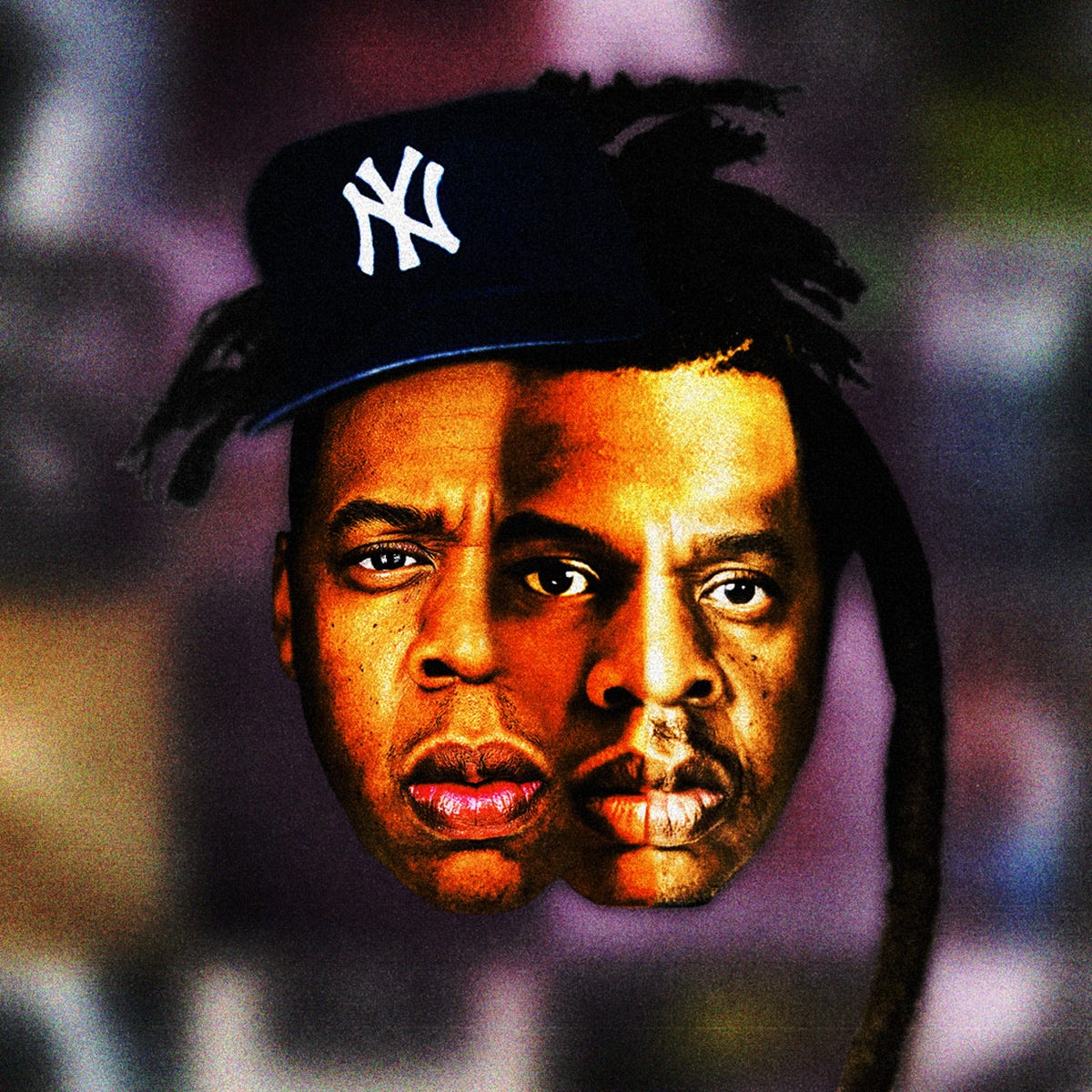
This coming weekend, Jay-Z will play a trio of shows at Yankee Stadium, one celebrating the 30th anniversary of his beloved debut album, Reasonable Doubt, another dedicated to The Blueprint, his signature album from 2001 that was somehow not written out of history despite dropping on the bloodiest day in his hometown’s modern history. (The third was dubbed “Extra Innings.”) Later this summer he’s got gigs in Paris and Los Angeles; in March he sat for an expansive interview with Frazier Tharpe at GQ. There’s a docuseries coming to HBO in the fall. Maybe something—an album, a full tour slate, a Super Bowl performance—is in the works; maybe this is, in fact, simply a celebration to mark the passage of time.
In either case, we’re making the days leading up to those Yankee Stadium shows Jay-Z Week at POW. Later we’ll be publishing definitive essays on the two albums Jay will play in full this weekend; we’ll also be taking a look into the courtroom and ranking his solo LPs. Today, we present the 99 greatest Jay-Z songs, ranked and considered by some of the best critics alive today.
99. Empire State of Mind f/ Alicia Keys
prod. Al Shux, Janet Sewell, and Angela Hunte
The Blueprint 3 [2009]
Jay’s the “new Sinatra”? Yeah right. But this June, opening a season of mega-watt New York pride—Knicks victory, a historic rent freeze, DSA’s primary sweep—the people decided. Right after the clock ran out on Game 5, the song spread through the city’s streets fast as a final-second tap-in at the hand of God. It was neither “N.Y. State of Mind,” nor “New York State of Mind,” nor “New York, New York”—it was the schmaltzy big-apple platitudes of CONCRETE JUNGLE WHERE DREAMS ARE MADE OF THERE’S NOTHING YOU CAN’T DO that no New Yorker was above. I was in Von King Park in Bed-Stuy, about 10 blocks from Marcy Houses, and three different congregations of hundreds if not thousands of people were screaming BIG LIGHTS WILL INSPIRE YOU NOW YOU’RE IN NEW YORK in an adrenaline-fueled delirium (conveniently drowning out the song’s more embarrassing bars) like the city’s win depended on it. Jay didn’t craft that made-for-Broadway chorus—it was written in London by two native Brooklynites, Angela Hunte and Janet Sewell-Ulepic—but he took it to the top of the charts, and brought it home. —JENN PELLY
98. Blueprint (Momma Loves Me)
prod. Bink
The Blueprint [2001]
The extended block party that is “Izzo” aside, The Blueprint has always been, for me, a winter album, and that’s never felt more acutely than on its eerily intimate, downbeat closing song. For someone so practiced, by this point, at moving through pop song formats, it’s fascinating how Jay unspools toward the very end: pleas to two proteges to trust him a little bit longer, his mother’s love wielded like a revolver. But what it’s really about is the one line in the Jay-Z catalog placed at an artificial distance through a brief shock of Autotune: “I was brought up in pain, y’all can’t touch me.” —PAUL THOMPSON
97. Get Throwed
prod. Mr. Lee
Bun B’s Trill [2005]
In 2005, Jay-Z ascended to a corner office while Pimp C stayed stuck in a cell, Audemars Piguet partnerships toasting the newly minted Def Jam CEO as Sweet Jones counted the days on rosary beads.
Intersecting both worlds was J Prince. The Rap-A-Lot founder was tasked with steering solo careers for the incarcerated Mack and his partner, Bun B. Flying four hours to New York, Prince personally played Bun’s solo debut for the Purple Label poet laureate. “Pushin’” piqued Jay’s interest, but ultimately it was “Get Throwed,” a late-’90s UGK outtake salvaged from a hard drive by Mr. Lee, that landed the feature.
Reproduced on Lee’s laptop with aggro guitars, live drums, and a spaced-out soundscape, Southern rap’s rubric shifted for years to follow. The clock-in, pour-up posse cut solidified Bun’s solo start, broke Mike Dean disciple Z-Ro beyond an Ozone audience, and elevated an emergent Young Jeezy. More importantly, it built buzz for a soon-to-be-free Chad Butler, allowing President Carter the rare chance to touch soil and grip grain. —IAN STONEBROOK
96. Can I Live II f/ Memphis Bleek
prod. K-Rob
Reasonable Doubt reissue bonus track [1998]
On “Coming of Age,” Bleek plays his part perfectly. But in the ecosystem of Jay-Z albums, his identity became almost exclusively that of the archetypal protege, useful for the threat he allegedly posed, an extension of empire. So it’s a relief to hear him here, cutting loose, the strain in his voice misdirection for how comfortably he sits in the pocket. And to think he “knew all about a dope fiend before reading Donald Goines.” —PAUL THOMPSON
95. Blue Magic
prod. The Neptunes
American Gangster [2007]
I know what happened: Kingdom Come was Kingdom Come, Wayne blotted out the sun. People were rightfully a little leery of late-middle period Oliver Stone. But while Jay’s American Gangster was well received by critics and treated, in the last decade or so, to some light canonization, that rehabilitation did not extend as far as the album’s lead single, which was bizarrely shunted into bonus-track purgatory. In any event: “Blame Reagan for making me to a monster/Blame Oliver North and Iran-Contra/I ran contraband that they sponsored/Before this rhyming stuff, we was in concert.” —PAUL THOMPSON
94. Flip Flop Rock
prod. Big Boi and Mr. DJ
Outkast’s Speakerboxxx/The Love Below [2003]
This sneakily foreboding cut from deep into Big Boi’s half of the strangest Diamond-selling rap album finds Jay at wonderful tonal odds with the Atlantans. Where he has always been comfortable pulling from soul or Blaxploitation or the Panthers with a wink, Outkast seems ready to embody those or any other sociocultural factions in three-minute bursts. And so Jay’s “shout out to public housing” is made to seem just that much grimmer, a stubborn tether to objective reality. —PAUL THOMPSON
93. Seen It All
prod. Cardo
Jeezy’s Seen It All: The Autobiography [2014]
A year after Magna Carta Holy Grail was written off as safe and staid, Jeezy pushed Jay out of complacency, formally and substantively. Jay’s verse on “Seen It All” apparently brought the billionaire to tears as he wrote. It’s easy to see why. Confidants get locked up or shot, but Jay eludes both fates, the sole survivor of a fallen empire. “Now the Nets a stone throw from where I used to throw bricks/So it’s only right I’m still tossin’ ‘round Knicks,” he raps with evident pride. —JOSH SVETZ
92. Is That Yo Bitch f/ Missy Elliott and Twista
prod. Timbaland
Vol. 3... Life and Times of S. Carter [European edition] [1999]
Tempting as it may be to pair this with the portentous last line of the Nas verse on “Takeover” as solely a precursor to “Supa Ugly,” “Is That Yo Bitch” is in fact a dispatch from the outer reaches of Timbaland’s hip-hop vision, a song governed by a single musical idea: the catharsis of Missy saying the title phrase. The thunderous drums and rubberband-taut flows (Twista is a sincerely brilliant bit of stunt casting) are simply foreplay. —PAUL THOMPSON
91. Fallin’
prod. Jermaine Dupri and No I.D.
American Gangster [2007]
Whether it’s Tommy DeVito walking into that empty room or Tony Montana grimacing at his white-stained CCTV monitor, every classic gangster movie has a pivotal scene where the male protagonist finally realizes the jig is up. “Fallin” is that capitulation literalized and condensed. Staggered strings and Bilal’s bittersweet harmonies create a regal if slightly morose atmosphere, as Jay-Z toasts to a lifetime of lessons gleamed from the criminal underworld. “You see what that last run did to De Niro” he raps—with genuine sadness, as if it was his own flesh and blood that got clapped at the end of Heat. —THOMAS HOBBS
90. Crazy in Love
prod. Beyoncé and Rich Harrison
Beyoncé’s Dangerously in Love [2003]
For a song ostensibly about the psychic torture of infatuation, Jay and Bey sound utterly exultant on “Crazy In Love.” The bombastic, brassy follow up to their 2002 collaboration “03 Bonnie & Clyde” booms with the feverish exuberance of finally finding someone who matches your freak. Anchored by the nearly regal horns of the Chi-Lites’ “Are You My Woman (Tell Me So)” and Beyoncé’s universally singable “uh-oh” refrain, “Crazy In Love” is the sound of a power couple declaring their dominance: Bey, the counterintuitively sensitive diva; Jay, the casually confident muse. —ARIELLE GORDON
89. Breathe Easy (Lyrical Exercise)
prod. Just Blaze
The Blueprint [2001]
As someone whose interviews are hotter, I approve. —PAUL THOMPSON
88. Moment of Clarity
prod. Eminem & Luis Resto
The Black Album [2003]
Legacy and self-reference have always been twin obsessions of Jay-Z the writer; those concerns reached their zenith on the faux-retirement boasts and blues of The Black Album. “Moment of Clarity” embraces this duality with twisty name-drops of his entire pre-2003 discog and proselytizing for the Roc, in that Jay himself is the synecdochic nucleus of the label. The stiff melodrama of the extremely of-the-era Eminem beat makes perfect bedfellows with the regal record-setting—if this is the last time, it might as well be honest. Jay saves the rest of his regard for family, blood (forgiving his absentee father and recognizing the systemic causes) or chosen (mourning Beanie’s incarceration and the still-burning wound of Biggie’s passing). He’s a disciple of his own history, rarely more devout than here.—ALY ELEANOR
87. Best of Me, Part 2
prod. Trackmasters
DJ Clue?’s Backstage: A Hard Knock Life [2000]
On the surface, “Best of Me (Pt. 2)” is a quintessential if unremarkable R&B teamup plopped within yet another DJ Clue mixtape. With no offense to Mya, it lacks the crossover flirtatiousness of past and future Jay features on hits like “Heartbreaker,” “Crazy in Love,” “Drunk in Love,” and “Frontin.’” Yet none of those songs have Jay rapping with this much flair, force, and, oddly, annoyance. “Have an affair, act like an adult for once,” he huffs on his bravura second verse. That impatience even extends to the song itself; he’s almost pissed that he’s there to begin with: “High school crossover, waved away picks/Music is the same shit, gave away hits.” That unexpected tension–talking this reckless on a playful love song, overtures discarded for demands and dismissals–makes these two verses unforgettable. (Also unforgettable: Mya pioneering the jersey dress in the video). —JACKSON HOWARD
86. Money, Cash, Hoes f/ DMX
prod. Swizz Beatz
Vol. 2... Hard Knock Life [1998]
On most of these songs that comprise Jay and DMX’s on-wax rivalry, Jay steps into X’s lane, mustering his most aggressive rhymes. (This was before Jay vacationed with Gwenyth Paltrow and the guy from Coldplay.) “Money, Cash, Hoes” is the apotheosis of Jay’s durag-and-throwback jersey era, a bouquet of ignorance over a pounding Swizz Beatz production tailored to the 1999 Summer Jam stage. But DMX does not and cannot pantomime Jay-Z, so X’s verse is oblivious to the fact that this is a song about money and sex. In 2019, X told GQ that he did not make songs for the club. “You give me a beat that people can dance to? I’ll spit some shit that a motherfucker can beat somebody up to. It’s a good combination.” —EVAN NABAVIAN
85. Time to Build
prod. Irv Gotti
Mic Geronimo’s The Natural [1995]
There’s a lot to be written about Mic Geronimo specifically as a natural link between eras who has retroactively been made to sound unstuck in time. And on “Time To Build,” it’s particularly disorienting to hear Ja Rule sound as if he’s a rapper from 1991. But this is Babe Ruth calling his shot, an untreated schizophrenia-era Gucci Mane level of artist A&Ring. —PAUL THOMPSON
84. What More Can I Say
prod. The Buchanans
The Black Album [2003]
There’s nothing to say sometimes. You just have to listen to those drums: Bum ba bum ba buuuuum. And the melody in lockstep with the rhythm. And at the time, maybe he wasn’t ever going to say anything else ever again, although of course he always was. —WILL HAGLE
83. Blackout
prod. Swizz Beatz
DMX’s Flesh of My Flesh, Blood of My Blood [1998]
Though “Blackout” opens with a Platonic-ideal Jadakiss line (“I used to have bad luck”) and no one on the song is less than actually great, this belongs to Jay, the monster who sleeps whole winters, wakes up spits summers, the “ghetto n—— putting up Will Smith numbers.” What he takes from Kiss is the trick of using a switch in the rhyme scheme to give a verse forward momentum, as if each minute shift in what Elaine May would call the ecology of the thing is a cataclysmic event—because of course it is. —PAUL THOMPSON
82. December 4th
prod. Just Blaze
The Black Album [2003]
This is the rare Jay-Z song that’s not really about Jay-Z. That sounds insane—the first vocals are “Shawn Carter was born December 4th, weighing in at ten pounds, eight ounces.” But our protagonist, the diamond skyscraper emcee, suddenly feels so small here. He’s swaddled by the careful Gloria Carter and cries for the wayward Adnis Reeves. He’s a redshirt freshman under DeHaven Irby, then Spanish Jose. Bike and boombox become foreground. Just Blaze’s majestic Chi-Lites flip towers over the flow. All together, it’s a cufflinked sleight of hand that turns subject to object. It’s not the life he chose, but the life that chose him. —STEVEN LOUIS
81. Beware of the Boys (Remix)
prod. Panjabi MC
single [2003]
With “Beware of the Boys,” Jay-Z forever earned some goodwill with (and exasperation from) the 21st century desi diaspora. It started in the late ’90s, when the England-born Panjabi MC roped folk singer Labh Janjua in to an innovative sonic cocktail: a loop of clattering dhols and a tumbi, fused with a rework of Busta Rhymes’ “Fire It Up” beat that turned the Knight Rider bassline all the way up. It was a combo so irresistible, so thumping, that it became a sleeper hit in dancefloors across Europe—including in Switzerland, where Jay-Z happened to hear the track. His remix singlehandedly brought Panjabi MC’s greatest hit into the States, complete with some corny Orientalism (“Move your body like a snake, Mama!”) and a bit of international consciousness (“We back home, screaming ‘Leave Iraq alone!’”). Decades later, you’ve probably heard it everywhere, from your college pal’s sangheet, to your favorite movie soundtrack, to some of the strangest TikToks on the web. —NITISH PAHWA
80. Heartbreaker
prod. Mariah Carey, DJ Clue?, and Ken “Duro” Ifill
Mariah Carey’s Rainbow [1999]
What a gift it was to Jay-Z when the English language osmosed the word jacuzzi. —PAUL THOMPSON
79. N——s in Paris
prod. Hit-Boy, co-prod. Mike Dean & Kanye West
Watch the Throne [2011]
Now that we’re well over a decade removed from its ubiquity, the thing that strikes me most about this song is that it’s one of the weirdest beats Jay has ever flowed on, and this is a guy who once rapped over a Cake sample, multiple M.I.A. songs, and whatever Timbaland’s beat for “Ghetto Techno” was. This one is all staccato minimalism, keys and whichever random non-musical samples the cocaine in Kanye’s brain told him to toss in there, with a completely unnecessary coda that finds Yeezy elbow-dropping the sub-bass button for damn near a minute. It was also probably the last time Jay was able to flow over something so futuristic and not come across as “How do you do, fellow kids?” style, yet he still felt like he needed to throw in a couple bars gesturing to how him being a billionaire is politically progressive, which Kanye quickly offsets by rapping about getting his dick sucked in a bathroom. If these guys weren’t on the same page, that’s fine, this is also a song that prominently features dialogue from the Will Ferrell/Napoleon Dynamite guy ice skating comedy Blades of Glory, which may have only been seen by Kanye when it first came out. It’s no “Otis,” but this song was a moment, countless memes to come embedded within it, and if Jay wasn’t 100 percent in on the joke, well, that was his role and he played it perfectly. —DREW MILLARD
78. Regrets
prod. Peter Panic
Reasonable Doubt [1996]
Jay-Z can seem cold and overly calculating—a billion dollars doesn’t come from being sentimental. But on the closing song from Reasonable Doubt, we hear him more pensive than ever before or since, yearning for a real life that isn’t measured in delusional rivals and night-time police raids. The first verse is a screed of his own bad deeds, a countenance of villainous behavior. He has never sounded more unguarded, even using a racial slur that’s shocking to hear now that he’s become a friend of Presidents and Prime Ministers. The second verse is an apology to his mother. Yet, it’s the third—one of my favorites of his career—that embodies the soul underneath the mystique. The veneer of respectability comes off when talking to the soul of a departed hustler that he looked up to (“When he was here, he was crazy nice with his, son”), claiming that a mutual friend of theirs is annoying Jay so much that he’s going to send him a roommate in hell. Before too long, though, he composes himself: “I’ve been talkin’ to your spirit a little too much.” And just like that, he’s gone. —JAYSON BUFORD
77. Ignorant Shit f/ Beanie Sigel
prod. Just Blaze
American Gangster [2007]
Even in Roc-A-Fella’s final years, as their collaborations grew less frequent, Jay and Beanie were always a perfect match. If Jay was the don, Beans was his most trusted capo. On “Ignorant Shit,” Just Blaze brilliantly reworks The Isley Brothers’s “Between the Sheets”—the same sample used to convey languid luxury on “Big Poppa”—in a way that suggests, counter to its original form and prior repurposings, confrontation and urgency.
The track doesn’t contain Jay’s best double entendres, and his defense of Kingdom Come on the intro feels even sillier two decades out, but “Ignorant Shit” is a testament to the power of great delivery. Bragging about hustling since CHiPS was on doesn’t make Jay sound like an old fogey, but a distinguished veteran. The uncharacteristically blunt threats of violence on the second verse feel real because you can hear the loathing in his voice. The same is true for Beanie, who dubs himself “the ‘07 Ice Cube.”
Does “Ignorant Shit” have tight internal logic or individually iconic bars? Not really, but it’s a great song from Jay and one of his most gifted proteges. It’s a record so good even Mixtape Lil Wayne couldn’t make the beat his own. —GRANT RINDNER
76. Bring It On f/ Big Jaz and Sauce Money
prod. DJ Premier
Reasonable Doubt [1996]
The least discussed Primo track on Reasonable Doubt; the one with the Fat Joe sample and mournful horns, where Big Jaz says “Fahrvergnügen.” Jay comes in on the word “mannerisms” and it’s almost suspenseful, opening the verse in that way: what is this word coming out of his mouth and where will the line go? He stutter-steps all over the place, taking unexpected pauses that culminate in his memorable pronouncement: “I am…two-point-two pounds.” The human kilogram is talking and wouldn’t expect any of us to understand this money—a recurring theme in his art and life. —ROSS SCARANO
75. American Dreamin’
prod. P. Diddy, Sean CLV, and Mario Winans
American Gangster [2007]
Jay handles a Marvin Gaye sample like the wheel of an S-Class Mercedes, capturing the sentiments of strivers everywhere. Opening with innocent, stoned dreams of glitz and glamor, the song takes on a cinematic narrative of its own, as Jay Christmas Carols us through getting into the drug game, moving up the ranks, and finally touching the success you craved, only to wind up in the back of a squad car. Anyone who thought Jay’s skills had atrophied for good after the mature-rap misfire of Kingdom Come only needed to hear the first three tracks of American Gangster to know that all he needed was the right muse. —GRANT RINDNER
74. 7 Minute Freestyle w/ Big L
prod. Mufi [Miilkbone’s “Keep It Real”]
From “The Stretch & Bobbito Show [1995]
Before his murder in 1999, the on-record persona Lamont “Big L” Coleman crafted confessed to crimes against humanity in such diabolically vivid detail that his only literary opponent was Stephen King. That was until L brought “the guy who ran with Kane and Jaz-O” to the sacred backpacker proving ground, The Stretch Armstrong & Bobitto Show. For the next seven minutes, L unleashed bars of hellfire and brimstone, freestyled and pre-recorded, while Jay used his air time to manipulate pockets at will. The clash of untapped titans was dubbed to cassette and bootlegged across the globe, lo-fi hiss and all, but wouldn't be appreciated by one of its creators for decades. “We were just happy to be on the radio.” —ANTHONY SEAMAN
73. Grammy Family Freestyle
prod. Kanye West, co-prod. Jon Brion [DJ Khaled’s “Grammy Family”]
From “The Funkmaster Flex Show” [2006]
Where the “Poppin’ Tags” beat is the apotheosis of Kanye West’s early production style, “Grammy Family” is the evolution: urgent, paranoid, would plausibly be at home on the era-defining LP he’d finish nearly five years after the fact. And still, Jay’s freestyle over it on Flex’s show (repurposed in a few different forms on subsequent mixtapes, never to the same effect) renders it mere scaffolding. In a career full of it, this piece is perhaps the most persuasive bit of self-mythologizing, precisely because it treats, on a syntactical level, the canonization as arbitrary, tenuous, human. The peers are ghosts and the IPOs are just rumors. —PAUL THOMPSON
72. In My Lifetime (Remix)
prod. Big Jaz
single [1994]
Camus said that the meaning of life is whatever keeps you from killing yourself. On the glitzy and motivational “In My Lifetime (Remix)” Jay-Z seems to derive that meaning from embracing groupies, firing off rounds from a black Mac-10, and sporting diamond-cut gold in the Tunnel. And when he raps “Is it just a mirage, all these girls? Is this world, my world?” in a skippy flow, it sounds like he’s genuinely pinching himself; consequently, the bars carry a refreshing humility, far from the Picassos that would come later. —THOMAS HOBBS
71. Show You How
prod. Just Blaze
The Blueprint 2: The Gift & The Curse [2002]
Speaking chronologically, this is the last time Jay betrayed such utter contempt on record—for those who drive BMWs instead of passing them to baby mothers, rap about the watches they hope to get, “eat off per diem on the low like a caesar,” sure, but most of all for Diesel Jeans. —PAUL THOMPSON
70. I Just Wanna Love U (Give It 2 Me)
prod. The Neptunes
The Dynasty: Roc La Familia [2000]
At the dawn of the millennium, Jay-Z was unparalleled in his ability to shape where hip-hop would go next, identifying rising producers and turning them into superstars. By the time he linked up with The Neptunes, they’d already helped NORE, Ol’ Dirty Bastard, and Mystikal transition from grimy to shiny. But it’s “I Just Wanna Love U (Give It 2 Me)” that turned the duo into pop’s hottest producers. It almost didn’t happen: Jay had planned to use “Parking Lot Pimpin’” as the lead single for the Dynasty album, but after a last-minute studio session with Chad and Pharrell, he scrapped those plans, pivoting the rollout to showcase their clipped guitars, shuffling drums, and falsetto hooks. The result? One of Jay’s sweatiest club bangers, kicking off an incredible early run of Neptunes classics. —SON RAW
69. Dear Summer
prod. Just Blaze
Memphis Bleek’s 534 [2005]
This elegiac, post-“retirement” letter to the rap game fits so perfectly over Just Blaze’s chipmunk sound that it’s easy to forget “Dear Summer” never started there. New York first heard these bars in a Hot 97 freestyle, accompanied by extra disses and Funk Flex bombs, before Blaze pushed Jay to put it on wax. Sure, El Presidente already sounded like a tired veteran (“I ain't none of these half-assed newcomers”), but there was still a hunger, that broiling desire to show and prove (“You gon’ make that boy Hov put your name in a song/If you that hungry for fame, motherfucker, c'mon”). In retrospect, Shawn Carter could never have left it all behind for corporate America; he was too spiteful, too competitive, too eager to steal the show. But if “Dear Summer” had indeed been his coda, his legacy would have stayed assured. —NITISH PAHWA
68. Jigga My N——
prod. Swizz Beatz
Vol. 3... Life and Times of S. Carter [1999]
In 1998, DMX changed New York’s temperature, depicting the streets without glamour or sentiment. Caravaggio by way of Yonkers. Jay-Z asked Ruff Ryders bosses Waah and Dee for Dame Grease, who produced much of X’s debut. They sent over their nephew instead. Jay initially balked at working with young Kasseem, who produced as Swizz Beatz, but their session yielded a suite of songs including “Jigga My N——,” a muscular anthem unique to late 90s New York where Jay briefly entered the Ruff Ryders universe, allowing us to imagine an alternate reality where he leads a phalanx of ATVs and motorbikes down the Bruckner Expressway. —EVAN NABAVIAN
67. 4:44
prod. No I.D.
4:44 [2017]
The howled, yearning anguish of the vocal sample, chopped into stuttering uncertainty by No I.D., carries the principal sorrow of “4:44.” UK vocalist Hannah Williams’s looped mourning—fittingly also embodying a cheater’s regret—is a pure distillation, whereas Jay’s bars are couched in caveats and shrunken defense. Raps about guilty ménages à trois, missing out on vacations, and how it took his children’s birth to “understand” women show the limited depth of Jay’s soul-searching, though fortunately, vulnerability carries the majority of the lyrics. The desperation of his pre-mogul lifetime still fuels his lamentation. Poetry blooms in the sidewalk cracks of his typical bravado, making a startling switch off autopilot on 4:44 and “4:44.” —ALY ELEANOR
66. Only a Customer
prod. Irv Gotti
Streets Is Watching OST [1998]
One imagines this was deemed a little too glittery for the studio albums, a relic of the days when Jay, Dame, and Biggs were trying to get “In My Lifetime” to pop. But the lushness makes Jay sound younger, all while he’s getting all wizened and promising to shoot through the city “like a rumor.” Ironically, is there a more specific way to refer to a Lexus’s paint job than “grayish bluish”? —PAUL THOMPSON
65. Reservoir Dogs f/ The LOX, Beanie Sigel, and Sauce Money
prod. Erick Sermon, co-prod. Rockwilder and Darold “Pop” Trotter
Vol. 2... Hard Knock Life [1998]
I mean, the polo shirt is right there on the cover: Jay’s whole thing was being unbothered. But “Reservoir Dogs” is unique in that it finds Jay the most animated, staccato rapper on the track—an effect best captured in the headfake “Locked in the slammer? Nope, popped up in Atlanta,” where the little hesitations do not quite add up to a measure-long syncopation, but still have the effect of making each detail feel like a discrete aside. Smooth and delightfully jagged at once. —PAUL THOMPSON
64. Who You Wit II
prod. Ski
In My Lifetime, Vol. 1 [1997]
Two years later, the Waffle House reference on “Do It Again” would retroactively make the handwave dismissal of Denny’s here seem like Logan Roy bit of corporate maneuvering. What a joy to see America’s business minds at work. —PAUL THOMPSON
63. La-La-La (Excuse Me Again)
prod. The Neptunes
Blueprint 2.1 [2003]
Before Justin Timberlake made your ears bleed in the name of Trolls, before every C-quality movie assembled a grab bag of C-list rappers for forgettable posse cuts, we used to get songs like this on movie soundtracks. And goddamn was Bad Boys II lucky: flowing effortlessly in the pocket over one of the Neptunes’ greatest beats (fight me), Jay channels Mike Lowery’s Miami in its cigar smoking, money flaunting, bottle popping, jet skiing glory, while also managing to riff off Big Daddy Kane. The main event—The Black Album—arrived seven months later. Luckily he already had music for the afterparty. —JACKSON HOWARD
62. 99 Problems
prod. Rick Rubin
The Black Album [2003]
There’s a well-documented phenomenon where, as musicians age, many of them drift toward the styles that were popular in their formative years. So for what was marketed as his final music video (complete with a bullet-riddled corpse that gets qualified by a PSA at the clip’s end from an unharmed star), it’s fitting that Jay got a little Reaganish. The sparring with his critics over how he particularly and Black artists generally are read in bad faith, which began in earnest on “Money, Cash, Hoes” and continued through “Come and Get Me,” “Renegade,” and so on, bookends “99 Problems.” But the song is really a vehicle for its second verse, where Jay voices (like Biggie on “Warning”) both sides of a conversation between himself and the cop who pulled him over. The 4th Amendment gets waved around like a bottle of Cris. —PAUL THOMPSON
61. Brooklyn’s Finest f/ The Notorious B.I.G.
prod. Clark Kent, co-prod. Dame Dash
Reasonable Doubt [1996]
Forget, for a moment, the long-raging debates over Jay-Z’s penchant for reusing Biggie’s bars; forget, if you can, the fallout from the infamous “two … Pacs?” quip; forget, even, about Puff’s forced presence. Take a few minutes, instead, to bask in the joy and glory of “Brooklyn’s Finest,” an accidental meeting of the two MCs who could lay claim to that title, a friendly toe-to-toe escalated to ecstasy over the Ohio Players’ rambunctious pianos. B.I.G. still runs away with it, his malicious, delicious flow conveying the most vivid mob cosplay you’ve ever heard (“The M.A.F.I.A. keep cannons in they Marc Buchanans!”). Yet Jay still holds his own, riding off his compadre to run up and stunt silly while assuming the hustler image he’d sport all the way to superstardom. —NITISH PAHWA
60. People Talking
prod. Ski
Jay-Z: Unplugged [2001]
There’s a conflation, here on the lone studio track hidden at the end of Jay’s superb live album, between poise and fatigue. The song’s magic trick is that from line to line, it’s never quite clear which he’s trying to project and which is creeping out from under the surface. —PAUL THOMPSON
59. What We Do
prod. Just Blaze
Freeway’s Philadelphia Freeway [2003]
Memphis Bleek might have been the rapper who Jay had planned on handing the dynasty to once he hung it up, but Beanie Sigel ended up being the guy who did the most to keep the Roc alive as more than a Jay-Z vanity label, both through his excellent albums The Truth and The Reason as well as through forging a Philly-to-the-Roc pipeline that would give us the mighty, mighty State Property and its associated members/sub-groups (this is not the time to litigate the Young Chris flow allegations). By the late ‘90s, Jay might have been sitting atop the mountain and a full-on commercial juggernaut who could sleepwalk his way through pop hits if he’d wanted to, but one can only assume that having a crew of scrappy, hungry Philly kids nipping at his heels gave him reason to keep his sword razor-sharp, not only for personal pride but to justify the brand of rap he was releasing under his imprimatur. The finest example of the Roc-A-Fella/Philly connection comes on Freeway’s “What We Do,” which unites Free, Beans, and Jay with an urgent, beatific Just Blaze beat that makes everything sound frantic and bittersweet. Though Freeway takes the song with the verse of his life, Jay comes away with the best line on the track with, “Gotta kill witnesses because Free’s beard’s stickin’ out.” Thus began a chain of events which led to Eminem rapping about hiding in Freeway’s beard and then Freeway sampling that line and making an entire song about his beard. This, we can all agree, is the God MC’s ultimate legacy. —DREW MILLARD
58. Murder to Excellence
prod. Swizz Beatz and S1
Watch the Throne [2011]
If Watch the Throne is but a gold-plated monument to rap’s two biggest egos, then we might consider “Murder to Excellence” a posse cut for its inclusion of the superego and id. To describe the conceptual cut as among Jay-Z’s most overtly political songs is not to suggest that its politics are coherent as much as it is to say that they are his. Consider “Murder to Excellence” a sort of ideological roadmap charting the course of the mind that birthed Reasonable Doubt as it transformed into the one responsible for “The Story of O.J.” And yet, at the risk of sacrificing evenhandedness: it is hard, upon hearing Fred Hampton’s self-appointed successor espouse a Black excellence not of free lunches but of Maybachs, to shake the sense that the FBI won. —OCK SPORTELLO
57. My 1st Song
prod. Aqua and Joe “3H” Weinberger
The Black Album [2003]
In conception and in naming, “My 1st Song” is overdetermined and on-the-nose: it’s the last song on his last album (get it?) and tells the story of Jay’s life in the rapid fire flow of his early years. Yet the obvious scaffolding of The Black Album’s closing track never gets in the way of the magic. As much as we see Jay’s wheels turning, “My 1st Song” is far more than the sum of its parts. The determination, the careful swagger, the gratitude: it’s all here, over a wistful guitar sample from the 1960s Chilean band Los Angeles Negros (“My 1st Song” is the only track produced by a previously known producer on the album, in this case Nicholas “Aqua” McCarrrell), Jay comes to terms with “second major breakup” of his life. The cherry on top is the outro, where Jay sounds earnestly unburdened, and thanks everyone who helped along the way. —JACKSON HOWARD
56. Otis
prod. Kanye West
Watch the Throne [2011]
Hidden a little deeper into the comment section of the official music video for “Otis” on YouTube is my favorite line from Funkmaster Flex’s infamous premiere rant: “THEIR MONEY IS YOUR MONEY AS OF RIGHT NOW.” What tickles me every time I hear that part of the rant, one uttered in a fit of euphoria and excitement, is how much Jay and Kanye would categorically disagree with that notion (at least out of context). In the museum of Watch The Throne, one filled with various opulent and gaudy displays of musicality, the piece adorned with Otis Redding’s wails and bounding organ crashes is among its most stunning. Everything that the old friends boasted about felt purposely unattainable, delivered with an air of certainty that you would never reach their levels. Yet when Jay momentarily lowers the intensity of his first verse to muse about rolling through the city with his arm out the window, you’re flooded with the foolish belief that you can do this too— a sliver of a Jay’s old allure that was becoming a faded memory. —MATTHEW RITCHIE
55. One Minute Man (Remix)
prod. Timbaland, co-prod. Big Hank and Missy Elliott
Missy Elliott’s Miss E... So Addictive [2001]
It’s not the version you think of, but it’s the one you need. —ANDREA DOMANICK
54. Marcy Me
prod. No I.D.
4:44 [2017]
On his 13th studio album, Hov auto-crucified, finally shedding his impenetrable, bulletproof persona, as exemplified on the opening track “Kill Jay-Z.” He emerged simply as Shawn Carter, presenting a figure as close to an everyman as a billionaire hip-hop legend can attempt to be. “Marcy Me” is an extension of that ethos, reflecting on the days before Jay and the Marcy projects that a young hustler once called home. He pays attention to the man behind the curtain, and is better for it.—DJ SHORT
53. Hey Papi f/ Amil and Memphis Bleek
prod. Timbaland
Nutty Professor II: The Klumps OST [2000]
En route to undercut Sherman Klump’s nine-figure youth serum sale, Buddy Love exits a cab playing “Hey Papi” as he leaves a ten-cent tip. For the first half hour of The Nutty Professor II, Love’s id possesses Professor Klump at every attempt to be vulnerably triumphant while courting commitment.
It’s this same Iceberg Slim chauvinism Shawn Carter confronts on “Hey Papi,” the Timbaland-produced plea for forgiving a life of shrewd fuckboy behavior in favor of being the Jiggaman’s lone mami. It’s the epilogue to “Big Pimpin’,” perhaps a promise to Beyonce, and a key cog in one million soundtracks sold. Whether righting his own wrongs or writing from the perspectives of Foxy Brown, Bugs Bunny, or Buddy Love, Jay juggles characters with Eddie Murphy’s malleability. —IAN STONEBROOK
52. NYMP
prod. Rockwilder
Vol. 3... Life and Times of S. Carter [1999]
Throughout the first four albums, Jay-Z retraces his steps, returning to familiar names, places, ideas: “Can I Live,” “Coming of Age,” “Who You Wit,” the Too $hort features, Jaz-O before the beef. “NYMP” concludes a trilogy begun by “Where I’m From” and “You Must Love Me”, where the Marcy Projects loom as a breathing “ghost-like” spirit brought to life by the crack epidemic, a presence that warped and devoured your ambitions.
“You could smell it in the hallways,” he would tell Bob Simon in a 2002 interview with 60 Minutes. “You was doing it, or you was moving it.”
In the same segment, Simon dubbed him “the son of Marcy” bringing “hip-hop to the heartland,” a conduit for “white suburban teenagers getting jiggy wit it.” Before he went national, global, federal, political: Jay couldn't leave Marcy. —GUS TURNER
51. Guess Who’s Back
prod. Kanye West
Scarface’s The Fix [2002]
“Guess Who’s Back” is Scarface’s song, but really it’s a showcase of when Roc-A-Fella operated as rap’s pre-eminent perpetual motion machine. Jay shit-talks his way through the intro and delivers a scorching opening verse, Kanye does some brilliant manipulation of The Originals’ “Sunrise” and handles hook duty for the legends, and a young Beanie Sigel proves he can bring home a track with verses from two of hip-hop’s best.
Jay’s verse is a showcase of varied styles, from stupidly brilliant one-liners (“I’m on the block like I’m eight feet tall”) to emotional appeals (“You can blame my old earth/For the shit she instilled in me, still with me, pain plus work/Shit, she made me milk this game for all it’s worth”) to vivid visuals (“Came from the dirt /I emerged from it all without a stain on my shirt”). —GRANT RINDNER
50. Pressure
prod. Prolyfic
Lupe Fiasco’s Food & Liquor [2006]
They met in 2002 at the Peninsula Hotel. Before the mixtapes, the deals, Jay-Z just wanted to see if Lupe Fiasco could rap: “You’re nice,” he said. From there, Lupe briefly resided in Jay’s orbit: Free Gucci pants, AF1s, and S Dots—eventually, an offer for a $50,000 advance and a Roc-A-Fella deal. He declined, ultimately deciding to build 1st & 15th with Chilly, before industry tectonics pushed the three back together for a possible reunion at Atlantic.
Instead, L.A. Reid made Jay a Godfather offer at Def Jam. No hard feelings: Jay exec-produced Food & Liquor, even as a leak forced Lupe to revisit his material—ultimately to the benefit of "Pressure." Eventually, they sent the beat to Jay, who liked it, but offered one suggestion. Somewhere, between the free shoes, the de facto mentorship, Lupe must’ve forgotten: “Yo, man, you know I do hooks, too?” —GUS TURNER
49. Encore
prod. Kanye West
The Black Album [2003]
When Jay-Z raps near the end of his third lengthy verse on “Encore”—the early continuation of an effortless skill to wrap up his soliloquies in a neat bow without feeling trite or corny—that he’s in the midst of a victory lap before his eventual exit from the game, there’s a tinge devilish glee. At least a part of him clearly believed it, as though he can’t wait to grant himself a respite from the game. But the sigh at the beginning of the second verse, buoyed by a legion of trumpets that capture the vigor of a live marching band, before Jay spits, “Look what you made me do/Look what I made for you,” betrays his true urges. He knows that he can’t walk away. Not when it feels like immortality is within his grasp, with the crowd chanting his name after nimbly blistering through another 16 bars with ease: he might as well make them beg for more. —MATTHEW RITCHIE
48. It’s Like That f/ Kid Capri
prod. Kid Capri
Vol. 2... Hard Knock Life [1998]
For all the examples, throughout his catalog, of the outright sorrow Jay’s endured, few songs strike such a spiritual minor key as this one, furnished by the legendary DJ Kid Capri. Maybe it’s the way the substances (base for the fiends, chasers for Hennessy) are first presented as salves for an impossible world, then consumed as a show of force or abandon—as Pyrrhic a victory as you can score in front of bottle girls. —PAUL THOMPSON
47. Diamonds From Sierra Leone (Remix)
prod. Kanye West, Jon Brion, and Devo Springsteen
Kanye West’s Late Registration [2005]
No Jay guest verse wields the simple power of his presence like this one, released during the disintegration of Roc-A-Fella. With Dame Dash and Jay on the outs, the world wondered how the allegiances would shake out; as West parrots the public speculation on those events, a commanding voice interrupts him. “I got it from here, Ye, damn.” From there through “I’m not a businessman/I’m a business, man!,” Jay makes the obstacles in his past and present seem monumental, but his conquering them a mere fact of nature, like the sun rising. When he declared the Dynasty would weather the storm, it was as if it had never been in doubt in the first place. —JOSH SVETZ
46. Some How Some Way f/ Beanie Sigel and Scarface
prod. Just Blaze
The Blueprint 2: The Gift & The Curse [2002]
