

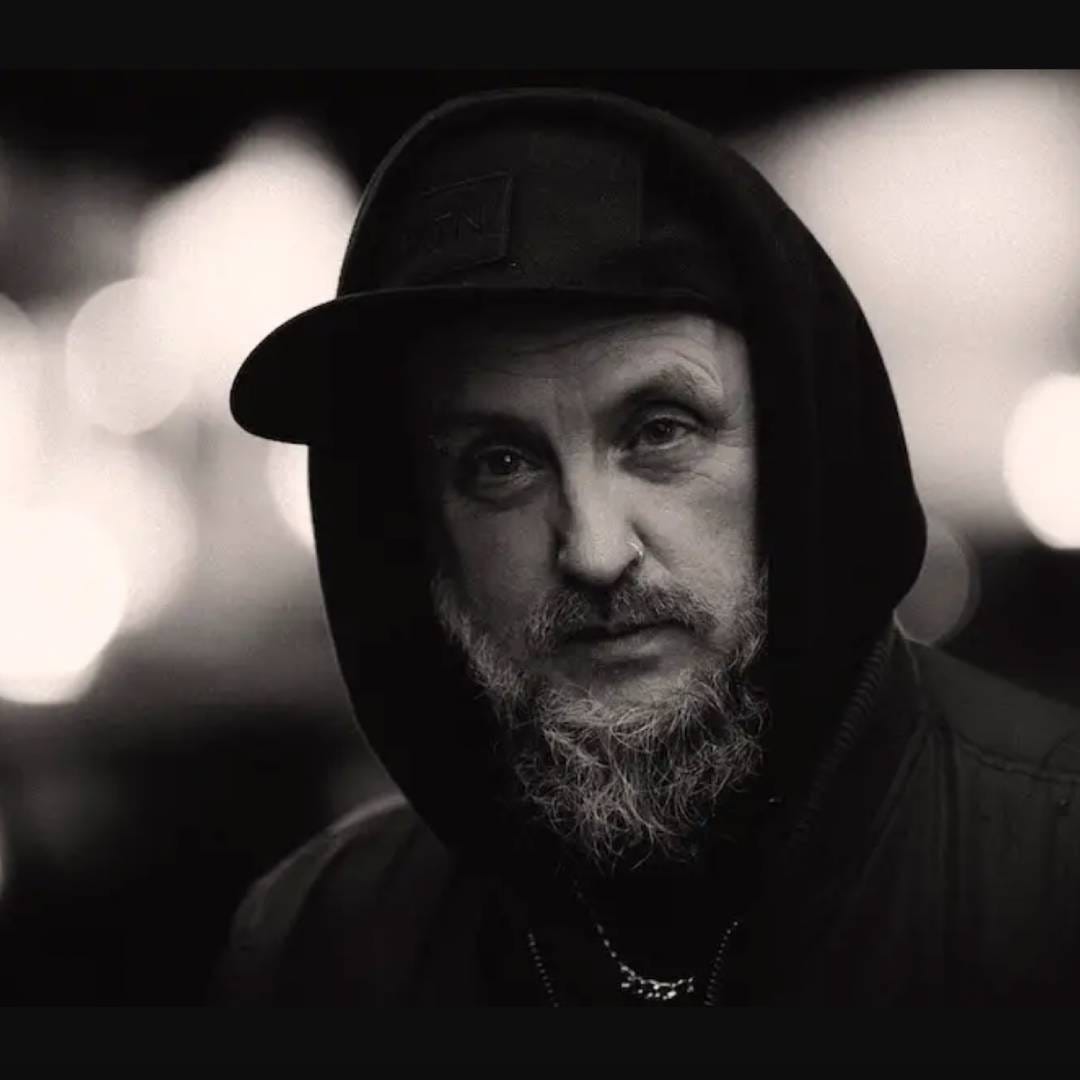
Image courtesy of the artist
Son Raw witnessed the fitness.
Kevin Martin, the man behind The Bug and a half-dozen other projects and aliases, knows his music. Whether championing dub and dancehall for The Wire, Muzik and Melody Maker, writing liner notes for experimental music compilations, or collaborating with an incredibly diverse roster of vocalists, the London Zookeeper (get it?) zags where most artists would zig, always landing upon a fresh new take on the concept of musical intensity.
First emerging as part of the industrial-Noise band/collective GOD with Justin Broackrick, Martin’s work immediately stood apart from his heavy music peers’ thanks to his affinity for dub and free jazz, influences that complimented GOD’s fuzzed out intensity while allowing the group to thumb its nose at metalhead orthodoxy.
This disregard for ’90s genre purism and Martin’s fruitful collaboration with Broadrick continued via Techno Animal, which was all illbient bass and bombed out dub, rocketing past the limits of the subdued tip-hop dominating the mid ’90s. This aesthetic dovetailed with an interest in the darker strains of independent hip-hop and breakcore developing on either side of the Atlantic, leading to work with iconoclasts such as El-P and Alec Empire and further experiments combining electronic rhythms to the wild frontiers of free jazz.
Martin’s work as The Bug that has drawn the most acclaim. Breaking through with 2003’s Pressure, the moniker became a shorthand for Martin’s work at the margins of dancehall, combining roughneck ragga vocals to rhythms that retained all of Jamaican music’s swing and groove, only alloyed to industrial’s dirt and distortion.
This musical marriage proved prescient, as emerging London communities of grime and dubstep experimented with similar fusions, leading The Bug’s London Zoo to be informally adopted by a younger generation of producers and emcees.
Ever since, Martin has continued to defy expectations, releasing music at a dizzying pace, covering ground that’s mournfully seductive, crushingly experimental, and fine tuned to reduce ravers’ knees to jelly (just about anything he’s done with an emcee). Ahead of the release of “Burials/Mud,” his latest single with Grime trendsetter Logan and African emcee Magugu, as well as an upcoming collaboration with at Mat Ball from Canadian metal band Big Brave, I linked up with Kev for a wide-ranging discussion on his musical influences, and how he’s navigated an extraordinary, uncompromising career in underground music.
One of my pandemic rabbit holes involved reading all of [’90s dance magazine] Muzik’s back issues and I was pleasantly surprised that you were reviewing dancehall singles for them back then. Where did your love of dancehall start?
The Bug: The funny thing was, when I got into dancehall, it was sort of untouchable, because Shabba went on national prime British TV quoting the Bible and why everyone should basically hate gays. After that, it was a big no-no to logical middle-class types. You couldn’t touch dancehall. But at that time, I was getting into it, and it was just me and a guy called DJ Scud, who was a breakcore DJ, a very, very good one. He was the only other person I knew that was into dancehall. I lived in northwest London, which was heavily Caribbean and you were hearing dancehall everywhere. I went from being like a dub snob to suddenly hearing Capleton on Street Sweeper - that was me realizing that I've been a prick for just ignoring this music or thinking it's cheesy, because it was heavy as fuck, just next level, futuristic production like nothing I'd ever heard.
https://www.youtube.com/watch?v=FZEFoa22DF4
It was quite a dividing line among non-Jamaican fans of that community’s music. You meet most older dyed in the wool reggae fans and they can’t stand anything with a drum machine. Highly resistant.
The Bug: I was, to an extent, too. I got into Dub music but not particularly reggae. I still don't particularly like Bob Marley. Obviously, you have to appreciate his life, but at the same time, I went to too many student parties where people were blasting shit Bob Marley tracks. So for me, I felt I was more into Dub than Reggae, and that stuck with me for a long time. I was just being sort of snobby. My problem was that I hated melody for a large amount of time. I used to give Justin Broadrick hell anytime he tried to creep a melody into a Techno Animal track. I had to overcome my own prejudice against melody. Maybe I'm still fighting it!
Today, there's a whole different set of problems in music, but at the time, things were moving so fast that whenever you'd get a new genre or style, you'd have of lose something. Everyone would switch to dancehall so you couldn’t get the older dub sound. Or when the Korg Triton would come in, you wouldn't get the dirty samples like Wu Tang anymore. Today, I almost feel like music's a buffet where everything exists at the same time.
The Bug: I think things have shifted dramatically. For me personally, COVID was an extremely difficult period. I ended up going the opposite to what current trends are. I ended up making single track, full length albums. So whilst all the club music ended up getting shorter - play no more than one minute of a track, zap, zap, zap, zap, zap, I was feeling compelled to go the other way because I just wanted to get lost in sound with no distraction. I think it's interesting how things are in terms of dance music and how it's played in a club, and what people are expecting in a rave. There’s a short attention span. I think it's partly connected to drugs as well, the drugs of choice, which were weed when I was growing up. I think the smoking ban [in England] had a massive impact on music, lifestyle, psychology, everything.
Our weed system here [Montreal] is weird. You have to buy it from government stores so it feels like going to the DMV. And yeah, you can’t smoke indoors so it does mess with the vibe.
The Bug: I haven't smoked weed for decades. So for me, I just felt the impact on audiences, on social interaction: there was a difference. When I was a teenager, I was getting beaten up by drunks. My father was an alcoholic, my grandfather was an alcoholic. They were both abusive characters. So for me, I was always a bit more paranoid about dealing with drunks and feeling a bit more comfortable dealing with weed heads.
Alright, let’s talk beats/tracks/tunes/riddims that impacted your music. First up…
The Bug: I want to connect two: A Tribe Called Quest’s Low End Theory album and Jacob Miller’s Baby I Love You. Baby I love You, I could play every day without a shadow of doubt, no problem, and have done so many days of my life. That track has got a King Tubby Dub [the title track to King Tubby Meets the Rockers Uptown], which is one of the most famous Dub tracks ever. I heard that a long, long time ago, and it's still so beautiful. Both that and Tribe Called Quest aren't necessarily what people would expect to be particularly influential on my sound, but they're both just medication to me. Jacob Miller’s voice is the same as when I hear Q Tip’s voice. I personally choose to make music to get shit out my system. But I also need the opposite. That's why I love so many female vocals and female vocalists. I've never been anti pop, my mum played music non-stop in my house when I was a kid, she was obsessed by music. For me, I grew up with pop all the time, and I still fall for pop music, generally miserable pop music, but nevertheless.
Beyond that, King Tubby productions are a massive influence in every way on so much of what I've done, and just the core of the dub music that I got hooked on as a kid. It was sort of impossible to avoid Dub because of [legendary UK radio DJ] John Peel: he'd be playing the Fall Next to Misty In Roots or Prince Far I next to The Undertones, like it was the same thing. And because I grew up in a tiny town, pre internet, I sound like a dinosaur saying you didn't have access to music unless you went into a shit record store or unless a good one happened to open, which it did in my town. So for me, when I heard Dub for the first time, it literally sounded chaotic, messed up. I didn't understand the logic, but knew that there was a heavy baseline at the core of it. And I was really into punk music, as a kid, that was my first port of call. A lot of post punk music was led by bass lines, so for me to find out that a lot of those bass players were massively into reggae, it’s no coincidence. And when you hear King Tubby productions and that attention to texture, tonality, the heavy filtering, all of that is totally at the core of what I do.
That music also sounds great on a system – both Tribe and King Tubby. It’s totally different hearing it in earbuds than on a massive wall of speakers.
The Bug: The modern ways of consuming music are the antithesis of how I enjoy music. I enjoy music through a huge reggae sound system. Or as I say: oversized sound system in an undersized room. That’s my idea of heaven, that's how I want it, what I'm literally addicted to. It’s insane how loud I play on stage! it's because I want that bass massage. My body craves it. I'm working on a split album at the moment, which is going to be The Bug VS. Ghost Dubs, and I was listening to the tracks that I've been sending him on my cell phone today, and realized half the [sonic] information just isn't there. There is just no low end. And that's, that's modern style of listening to music. Clubs and venues have got so many problems with gentrification and getting shut down that they're not able to play the tracks at the volume they should be heard.
I feel the average person might hear just an average song on laptop speakers, and it just becomes a commodity in their life, the same way that someone might watch a 32nd reel on their phone. But then you're going to have ~10% that are real music fans that go out, and they'll seek deeper experiences. Same with cinema and other art. I'm wondering if, for you, it changes how you view the audience, because you're getting maybe more of a hardcore following who's still committed.
The Bug: That's a good question. I've been worrying about [audience composition], but the funny thing is, I've solely been touring with Machine [a recent solo album series, sans-vocals] tracks for the last while. Normally, I was using those tracks as intros for the before the emcees took the stage at Bug shows. But, obviously promoters prefer the fact that they can book me on my own without my sound man, without my emcees, because it's cheaper. So basically, I accepted bookings for “The Bug presents Machine” not knowing how it would go down. One of the first shows involved playing to 3,000 metal heads at an alternative metal festival.
I played this festival before, it's an incredible event in the Netherlands, but I'd done it the first time with Dylan Carlson of [luminary experimental band] Earth. So I got away with it that time. Then, this year, I went down to play the main stage in front of 3000 people, without any emcees, without any guitarists, without any other musicians, just me and that sound. By the end, people went off, and it was crazy. But then walking around the festival, I noticed that the demographic was, on average, 30- to 60-year-old white dudes dressed in black. And that one of the main reasons [Justin and I] split Techno Animal: I was bored of white dudes dressed in black who looked like me. It wasn't representative of what I wanted in my life, what I wanted in my face, and just the struggle we were going through.
So then two weeks later, I'd been booked to play the Machine set at this very commercial Dance Festival in Belgium. To the point I almost didn't take the booking with no emcees. I get there and the crowd is like 2000 young ravers, and I'm saying to friends, even at the sound check: “I'm going to clear this stage so quickly you're going to laugh”. Not that I'd wanted to, there was a time in my life I would happily have done that, but just because I thought that I'm playing this slow, relentlessly heavy, twisted, futuristic dog shit that's going to make all these kids puke. So, all I could see, because this stage was so weird, all I could see was 10 people in front of me, because everyone else below was in a pit. It was so dark that I couldn't see shit. Plus I had loads of technical problems. It wasn't till the very end, when I ended with this wall of “fuck you” noise, and then stopped it dramatically, that there's just this huge roar. And later on, through videos, clips, messages, I realized that people fucking loved it, which for me, was just absolute, total relief. Because it was a really young audience, a really mixed audience, loads of women, not a sausage fest.
Now, knowing that suddenly the same set could knock out a room full of metal heads and a field full of ravers was crazy. You'd have to pinch me. I'm still surprised and getting too used to the dynamic of this type of set, because it is really alien. I’m trying to create a futuristic form of Dub that I’m not hearing anywhere else, because so much Dub music I hear sounds really retro, and I'm drawn, really, to a future shock. I want to hear shit I've never heard before, where my jaw hits the floor, or I can't quite get my head around it. That's really important to me.
That really brings me back to the King Midas Show I first interviewed you at [way back in 2010] at Mutek. It was divisive but the girl I was going out with at the time, a young art student, she was so absolutely in love with it. It was the black turtleneck techno crew that had a hard time. I think things are a bit better today though: we grew up with record stores and so I think genre divisions take up space in our minds. Nowadays the divisions are blurrier.
The Bug: That was a funny show. Mutek had booked us on the back of The King Midas Sound record, which was million miles away from what we did live. But when I say I'm the enemy of modern consumption of music, trust me, I'm not in any way [talking about new music itself, just how it’s consumed]. As people get older, they generally get more cynical about their past because they've lost nostalgia. I'm as excited about music now as I ever was. I love change. I embrace it. So for me, of course, I think there's many pluses in how people's relationship to music has changed. When I meet young kids now, they're turned on to such an eclectic mixture of music. It's amazing. And I'm just happy that there's any relevance at all in what I do for them. I love it.
What’s the next track you’ve got?
The Bug: Here’s two: Haunted by Coki and Roots Manuva’s Witness. Both are irresistible to me. Both are deeply indebted to reggae and dub. Coki’s a complete dancehall fiend and Rodney [Roots] is a massive reggae head and dub head. I respect them both incredibly and was lucky enough to meet them both regularly, and Roots Manuva came to my studio. I finally got to work with him. But what was funny was, we’d arranged the date, the night he came over, he didn't record anything. He just talked for the whole night and it was almost like he was trying to suss me out, trying to find a connection. And he said, “Okay, we'll come back the next day and we'll do it.”
And that's how we ended up recording a track together. But Witness, that bass line is just so irresistible. Bass lines are my bloodstream. In a way, it's what I crave most, and those two artists, they've both got that swing where your hips will just move side to side. They don't sound like the disgusting thing where dubstep went when America grabbed it, particularly where it sounded like nu-metal and every every change had to happen, every 20 seconds. Coki’s sound, I felt, was the one that was pilfered, was bastardized in such a horrible way. Whereas the beauty of Coki beats for me, was the swing and the groove. Women would dig them as much as guys. It wasn't just testosterone, macho rhythms.
Roots Manuva, I would put him up there as high as any rapper. From any country and certainly any American rapper. I don't really give a fuck about national boundaries, to any degree. But I just love the fact that Roots Manuva's lyricism is incredible. And his choice of beats, particularly on the first two albums, was just stunning. Both for me… London is, or was, at the core of my inspiration for three decades. Haunted and Witness the Fitness are so London to me. I remember cycling through London all the time, listening to them. Just hypnotic and druggie in a good way.
I’m glad people are able to look back at stuff like those Coki riddims with fondness now. For years, it was taboo to enjoy anything in that space, except among diehards. And I get it, to have a sound or scene you’re associated with change around you, with no say in it…
The Bug: For me, I was always an outsider within Dubstep. I was the freak but my tunes were adopted by that scene. It was intriguing how a scene started off with a huge range, when you think of Shackleton to Burial to Kode9 to Digital Mystics to Skream and Benga, to me being tolerated... that was a massive range, sonically. And then suddenly it just got narrowed fast. And it was the first time I'd been at the core of a scene and seeing how it would shift and how it was used, abused, digested and spat out, it was crazy, voyeuristically. To see what happened with it. But at the same time, I still felt like an outsider looking in. As much as I've huge respect for so many of the producers in it. I had amazing nights at DMZ. That lit my fire because it was connected to [the energy I see] when I look at punk, dancehall, grime. Just the straight “fuck you” energy: antisocial, question everything, trust no one.
It’s amazing how things go out of control. A metaphorical butterfly flaps its wings in London and now [Bug affiliate] Flowdan has a Grammy with Skrillex, 20 years later.
The Bug: Quite a few people have asked me how I felt about that, as if I should be offended in some way. I'm not offended at all. Flowdan’s happier than he's ever been because he's finally paying his bills without worrying and he hasn't in any way watered his style down. He's still a great lyricist with killer hooks. Skrillex came to Pressure, my party in Berlin. Someone brought him there. And he saw a Flowdan Bug show and a couple of years later, he gets Flowdan on board. So, Skrillex has made it known that he digs my shit. Boom. If Flowdan won a Grammy, it's through talent. It's got nothing to do with just being the link to Skrillex. And Skrillex wrote a beat that catapulted Flowdan. It’s a good beat!
It’s not surprising to me you’d feel that way just because of how different your own output is. No two of your own records sound the same and so it makes sense you’d appreciate just as wide a range of music and approaches.
The Bug: Obviously I've chosen to keep throwing tangents to keep myself interested, I know that the element of surprise is a good one to keep to avoid your sell by date. The industry pressures you to make a record a year and if it's a successful one to remake the same record. Ninja Tune, although they didn't like London Zoo at all, this was corroborated later on, they still wanted me to make another one because they knew it had done well critically and to an extent, I guess, sales-wise. But I couldn't make it: I felt that I was being sucked into the Dubstep stream and everyone kept talking to me about my album in terms of Dubstep and that felt wrong. I was also going through really difficult emotional times.
So instead of doing London Zoo MK II, I jumped to the opposite and went full steam into King Midas Sound. I spent three years working on a King Midas sound album, which is commercial suicide, of course, but I had to keep that feeling of inspiration in me, because any time that I feel I have to do something, I fuck it up. I have to feel excited about something I'm working on because that's going to get the best results from me as opposed to “I have to do this because of the cash”. We all have to accept the fact that money pays the bills but at the same time, somehow I've managed to keep going without releasing stuff I would regret. And every time I feel I've gone one way, there's a temptation to go the opposite way. It's quite weird, I'm sure some psychiatrist would have some smart idea, description for me.
The creative process still has to be almost sacred.
The Bug: It’s a miracle that I've been able to do what I do for as long as I have, without compromise - and I'm generally seen to be a fairly uncompromising individual. Beyoncé and Jay-Z played me and Flowdan's track in the middle of their show. Before that happened, I'd say you're fucking insane even thinking of that, but you just never know anymore.
You almost have to keep an open mind because moments like that will surprise you – discovering something that resonates from an unexpected source or vice versa, something you love no longer hitting the same way.
The Bug: In the last ten years, reggae has been a problem for me, because I just heard so little that's inspires me. Hip Hop went through a phase like that, but then over the last couple of years, I think hip-hop's become really vibrant again. I've heard a lot of great stuff mostly from a more alternative area. It’s funny how that always seems to happen from in the time. I started hearing Sugarhill Gang at school and then hearing Public Enemy and LL Cool J. Then my big swing down across to Company Flow and Anti-Pop Consortium - the whole New York DIY Fat Beats thing. Now it's swung back to Elucid, billy woods, Armand Hammer. But reggae hasn't done that lately and I've been craving it, but it meant that I had to look elsewhere. So, since COVID, I just burrowed down into Bandcamp and found loads of incredible experimental drone, left-field music to bury myself into. I'll go to find the enthusiasm and freshness.
Speaking of which, I’ll mention another two singles together: Schooly D’s “PSK” and Clipse’s “Grindin’.” For me, both tracks are pivotal and just irresistible. I actually ripped the Schooly D tune on London Zoo’s Warning. That's my version of PSK.
I can see the link between those and your music: a minimal drum machine but with a lot of reverb so it creates space.
The Bug: Just rhythm and noise. Yeah. There’s also a link to Public Enemy. That inspired everything I ever did with Godflesh and certainly with my band GOD. The three artists that probably united my band was Miles Davis, particularly in the 70s period, Public Enemy and Bomb Squad Productions and probably Swans. Those three things were just pivotal for that band and stayed with me. As a producer, Hip Hop is just insane in terms of how many incredible producers there are. When the Neptunes came through, I'd been heavily into the indie as fuck Hip hop sound. And then suddenly it was mainstream Hip Hop that was making the underground stuff sound stale and boring. Hearing Neptunes beats and Clipse albums just blew my head off.
The crash sound on “Grindin’” has almost become its own version of an 808. It’s on so many records. Generations down the line, it’s part of the common musical vocabulary. Let’s talk about your own new record: “Burials/Mud.” How did you come together with Logan and Magugu?
The Bug: As The Bug, all my productions have been made very much with the vocal in mind. I work to the vocalist. But this time I invited the vocalists to come in after the beat had been released, in both cases. It was a swerve again. Magugu, I hadn't worked with before. Miss Red played me his stuff a couple of years ago and to be honest, his early stuff, I felt was a bit derivative of Flowdan in terms of tone and flow. But then Mala dropped a track by him just about a year ago. As soon as I heard that, I was blown away and I contacted him straight away. It turned out he knew me and he was up for it.
The track is not a million miles away from Schooly D as well, although honestly that track wasn't directly inspired by him: the idea was just some sci-fi rhythm, a beat that doesn't sound like anything else where people will still be aware that it's me. That's the challenge as a producer: wow you can make electronic music reflect you? How can you give electronic instrumentation your signature? That’s always been my challenge.
Then, Logan, he relates to another single that you asked about, which is "When I'm Here" by Roll Deep. I still drop the Wiley mix of that one in my Bug sets. Virtually every show that Flowdan has done, he begs me to drop in the set because he loves it so much.
The vibrancy of working with Flowdan, then being able to work with [fellow Roll Deep veterans] Riko, with Manga, knowing how much that track meant to me when it dropped and how much I was completely besotted by it – it means a lot. I went out looking for Flowdan and Riko, very early on because I happened to be in the right place at the right time, in London, when Roll Deep began. I was there watching fights break out on stage and off stage; seeing 13 dudes trying to grab a mic but each one would have a different voice and identity, same as Wu-Tang. For me, Logan and Magugu were the new generation of grime emcees. Whereas a lot of grime emcees tend to sound a bit similar, I feel that Magugu and Logan are very singular and original in their deliveries and that was really important to me.
The Wu-Tang connection is interesting. I always thought that POW and When I’m Ere, they're kind of like Scenario and Protect Your Neck, for London music.
The Bug: The funny thing was, when some madman booked Roll Deep’s first European show ever, in Amsterdam, he also booked me as The Bug. When I was doing my soundcheck, Wiley was checking me out and coming over, asking a load of questions. Because at that time, I was basically bringing a studio on stage and he was asking about everything. He was so on it. And then I watched him with his crew, with Roll Deep, just seeing how he marshalled everyone in very much the same way I would imagine RZA would have had to with Wu-Tang. With that much potential chaos, there had to be one person who would somehow channel all that disparate intensity.
Alright, last single: something contemporary that isn't looking back.
The Bug: Greentea Peng dropped a track called “Stone's Throw” off her new album. It's an incredible piece of music. Sonically, it feels like three different genres being played at the same time: jazz, jungle, and trip-hop. Normally that would sound disgusting, I wouldn't even want to go near something like that but actually, it's incredible. For me, her voice is just stunning. I've been obsessed by Erykah Badu for a long time and before that, Billie Holiday and Nina Simone. With that in mind, when I heard Greentea Peng's voice on this track in particular, it just blew my head off. It’s, again, a very London thing. At the moment, it's my track of the year and it's not brutal, it's not noisy. It's just very textured, very multi-layered. And blue as fuck. I'm drawn to extremity. And if something's on fire on one side or the deepest blue on the other, that's where you'll find me investigating. I'm sure it never charted in any way. But if I could put the charts together, it'd be my #1.
https://www.youtube.com/watch?v=AyHiWgmw9-c