

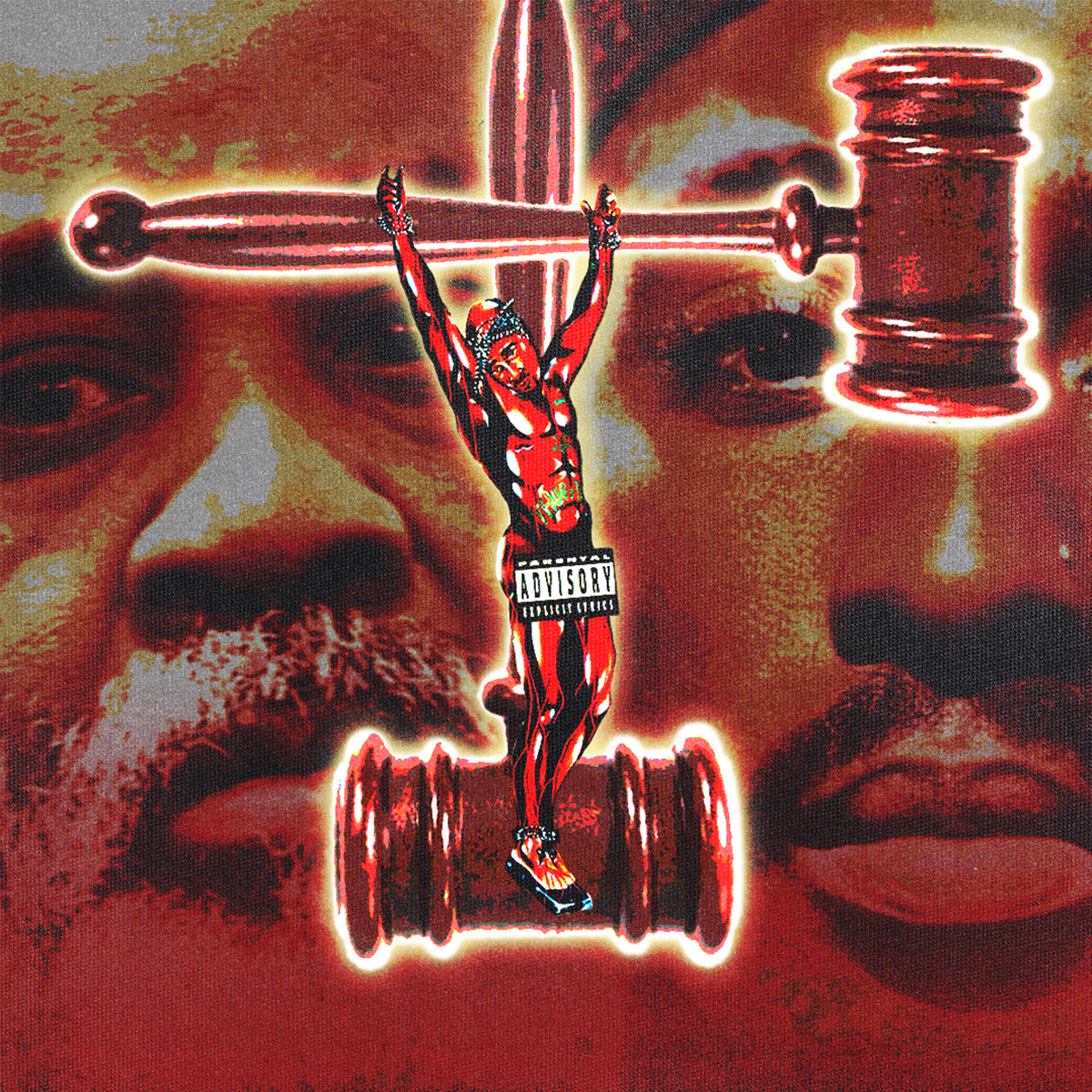
The next-to-last moments are embalmed. Mike Tyson struts into the MGM to the rumble of “Let’z Get It On,” the anthem that 2Pac recorded specifically for the bout. Makaveli sits ringside, a third rail draped in orange silk and Armani denim, surrounded by Suge Knight and Death Row’s most imposing henchmen.
In 109 seconds, Iron Mike incinerates Bruce Seldon to win the WBA belt. The crowd boos, shocked by the short duration. Some allege the fix was in. None of it matters to Pac, high off the fight and the multi-platinum domination of All Eyez On Me—and maybe weed, Alizé, and Hennessy. It’s September 7, 1996. He’s 25 years old. Out on bail. For all the afterlife premonitions of the music, he feels untouchable.
In the backstage arteries of the arena, Pac shouts euphorically, “We back!!” He throws mini-uppercuts, Guerra shirt almost fully unbuttoned, Euphanasia chain dangling, looking for a target to direct his adrenaline rush. “When Tyson gets in the ring he knocks motherfuckers out! That’s what 2Pac gonna do!”
The BET cameras catch him for comment:
“Y’all see that? 50 punches! I counted it!” 2Pac crows. “Everybody that goes to jail, they come out and got good luck!”
Suge prods Pac out toward the gaming floor. We next spot him as a jumbled blur on surveillance footage: He punches and tackles Orlando “Baby Lane” Anderson, a member of the South Side Compton Crips, who allegedly stole a Death Row medallion from an entourage member a few months ago. In hush puppies, Pac stomps him out in full view of the stunned gamblers and boxing fans. The whole crew joins in. Then the cameras capture a horde of onlookers zombie-staggering after Pac and Suge, out of the casino, toward Las Vegas Boulevard.
Pac pops up next at the Luxor, the ersatz tomb of the pharaohs where he’s booked a suite. Slipping on a green Nike basketball jersey, he tells his fiancée Kidada Jones—daughter of Quincy—about the brawl with the Crips. For safety reasons, she stays in the room. Outside, shaky ‘90s Camcorders catch a crush of fans milling around him while he waits for Suge to swoop him in his black 1996 BMW 750iL.
Everyone knows where they’re going. Pac name-checked the final destination in his Tyson tribute that boomed over the Grand Garden Arena’s loudspeakers:
Aight this ain’t goin’ last long, y’all know how Tyson do it
So what, we gon’ watch him beat this boy silly
And then we all go party at 66-deuce, mob style
After a brief detour to Knight’s mansion on the city outskirts, the caravan again takes off toward Club 662, the venue owned by Suge, named after the telephone keypad initials that spell “Mob.” Suge takes the wheel. Pac rides shotgun. Around 11 p.m., a bike cop pulls them over for loud music and missing plates. After finding the plates in the trunk, he lets them go.
There is one last image, taken by a film student, capturing the two of them at a red light. Suge locked in, clad in outlandish Versace, staring dead ahead. Pac unsmiling, the window all the way down, staring straight into the flash.
The light flips green. The cars pull forward and turn right onto East Flamingo Road. From there, everything goes dark.
Thirty years later, Duane “Keffe D” Davis will stand trial for murder with a deadly weapon—with the intent to promote, further or assist a criminal gang. Opening statements begin Monday morning, August 17, at the downtown Las Vegas Regional Justice Center. The alleged motive is a matter of Occam’s razor: Davis was Anderson’s uncle, a reputed shot caller of the set. According to the prosecutors and Davis’s own admissions—which he now claims were made for money and sheer entertainment value—Keffe D procured the gun and handed it to his nephew to seek retaliation for the MGM beating.
“We live in a more skeptical world than ever before,” says Michael Sanft, the defense attorney for Keffe D. “I don’t think because someone just says something, we treat it as the gospel truth. It’s one thing to say something on camera or in a book, it’s another to prove that it’s true.”
Sanft is speaking in response to a question about Keffe D’s confessions in his 2019 autobiography, Compton Street Legend—as well as interviews on BET, VladTV, and the Art of Dialogue. These clips have been viewed millions of times and became a veritable cottage industry for the 63-year-old grandfather, who repeatedly boasted about his close ties to Sean Combs and the millions of dollars that he once made running a transcontinental drug ring.
Sanft doesn’t dispute that Keffe D’s memoir places his client in the white Cadillac that allegedly fired on Shakur. His argument hinges on what can actually be proved.
“We can’t jump to the conclusion that he was in the car,” Sanft says. “Why? Because he said it? Well, how can you prove that?”
After Sanft and I speak, Keffe D gives a final pre-trial interview to a local Las Vegas TV news station, claiming that he wasn’t even in Vegas the night of the murder.
Hovering above the proceedings are the allegations that Puffy offered Davis a million dollars to wipe out Suge “Big CEO” Knight and 2Pac. Despite this long-standing speculation, the prosecution’s theory claims that the most infamous unsolved mystery in music history was primarily a matter of Compton Crips seeking vengeance for a humiliating attack from only a few hours earlier. But the three-decade odyssey from murder to trial has been astonishingly complex.
At the 2011 White House Correspondents’ Dinner, 15 years after 2Pac’s death, Barack Obama equated Donald Trump’s birther falsehoods to conspiracy theories about what really went down in Las Vegas. But while the public couldn’t agree on one coherent explanation, the streets rendered their own verdict within days of Pac’s death. In a ten-day shooting war between the Pirus and South Side Crips, at least three were believed to have been killed and another 11 wounded. For the prosecution, this is some of the most damning circumstantial evidence that Keffe D and company were behind the slaying.
About three weeks after 2Pac’s demise, more than 300 officers drawn from 11 law enforcement agencies descended on the greater Compton area, in an attempt to obtain more information about the murder and the subsequent killings. During the October ’96 raid, the police seized a fantastic quantity of rifles, handguns, and machine pistols, $17,000 in cash, and two pounds each of coke, meth, and weed. Twenty-three arrests were made, including Anderson. But no one was willing to talk about the only crime that mattered. Anderson was set free.
To further complicate matters, Anderson testified in defense of Suge Knight at a November ’96 probation violation hearing connected to the Death Row honcho’s role in the MGM brawl. According to Anderson, Knight was a “peacemaker,” the only one attempting to break up the melee. No one bought it. The judge revoked Knight’s probation, sentencing him to five years in prison, and effectively ending the Death Row dynasty. In that same month, Yaki Kadafi of the Outlawz—the only person who publicly claimed to be able to identify the shooter—was murdered in a New Jersey housing project.
Back in Compton, Anderson was suddenly flush with cash from a benefactor Keffe D later identified as Knight, whom Davis says paid Anderson $60,000 for the testimony. With the cash, Baby Lane opened up a lavish recording studio for his fledgling rap imprint, Success Records. From what I can gather, they only released the 1999 label compilation, Platinum Heat, featuring a cameo from Gangsta Dresta of “Real Muthaphukkin’ G’s” fame. The record dropped after Anderson was killed in a 1998 shootout at a local car wash, an incident deemed unrelated to 2Pac’s murder.
That is, if you even believed 2Pac was dead at all. Millions didn’t. 2Pac sightings became the new Elvis sightings. He was said to be alive in Cuba, or sub-Saharan Africa, or maybe hiding in plain sight, which explained the practically unlimited posthumous recordings. The rumors compounded due to the unusual circumstances surrounding his death. With a large crowd gathered in front of UMC, Afeni Shakur quickly directed the corpse to be ferried out the back.
The autopsy was conducted before his death was even announced. The only photographic evidence of 2Pac’s death came from a homicide detective who snapped a Polaroid of him lying on the coroner’s table, which he later sold to the Daily Mail. Within hours, the mortician cremated him. To college dorm room theoreticians, the compressed sequence seemed like a cover-up; they chronically noted that Pac was shot seven times (it was four), died seven days afterwards (it was actually six), and had already subtitled his next album, The 7 Day Theory.
There was no funeral. No adulatory city-crossing corteges in L.A. or the Bay. No gravesite for pilgrims to visit and bump “How Long Will They Mourn Me.” For the next two decades, convoluted theories flourished. In 2015, Vice asked me to figure out which hypothesis seemed most viable. I kept hearing the same phrase used to explain the lack of an arrest: “politics at the highest level.”
No one stated the paradox more succinctly than Chris Rock: “2Pac was gunned down on the Las Vegas Strip after a Mike Tyson fight. How many witnesses do you need to see some shit before you arrest somebody? More people saw 2Pac get shot than the last episode of Seinfeld.”
If you’ve ever smoked weed and rappelled down a 3 a.m. YouTube rabbit hole, you’re likely familiar with some explanations. Plenty believed that Suge Knight and his attorney, David Kenner, masterminded an intricate plot to kill 2Pac to stop him from leaving Death Row. Others fulminated that the FBI assassinated 2Pac as part of a modern-day COINTELPRO to eliminate Black radical rappers. Russell Poole, the former LAPD detective, had become convinced of a scheme between Suge Knight’s estranged wife, Sharitha, and Reggie Wright Jr., the head of Death Row security, to take out both 2Pac and Suge, and thus assume control of the label. According to Poole, one of the three shooters was Lil Half Dead (of “Lil Half Dead put his dick on her head” fame), who allegedly hated 2Pac for stealing “Brenda’s Got A Baby” from him.
As crazy as Poole’s thesis seemed, it was impossible to dismiss him outright. Until severe disputes with the LAPD brass forced him into early retirement, Poole was widely regarded as an honest and rigorous investigator. He was instrumental in uncovering the Rampart Scandal, and for many years, his theory that corrupt police officers David Mack and Rafael Perez had helped murder Biggie was considered the most credible explanation. But a decade and a half of simmering in the minutiae and dead ends of the Biggie and Pac cases had left him prone to believing almost anything—to the point where I had to write emails to Lil Half Dead asking if he was willing to comment on the accusation that he had shot 2Pac as part of a Macbeth-like coup to seize Death Row. He never returned my emails, rightfully so.
After the story ran in June 2015, Poole kept calling at all hours of the day and night. On the surface, he didn’t seem particularly unhinged or illogical. It was more that he had assumed an Ahabish monomania to solve cases that had long consumed his waking life. And he had decided that I was the right journalist to help him uncover the truth. I didn’t exactly agree with his thesis, but he was personable and smart, and I was susceptible to the flattery. Then, about two months later, Poole dropped dead of a heart attack at the L.A. Sheriff’s homicide bureau. He was there to interview a captain for a new book he was writing about the Biggie murder. Another victim of the curse.
Most theories pointed back to Orlando Anderson and the white Cadillac full of South Side Crips. In 2002, Los Angeles Times investigative reporter Chuck Philips published an exposé that alleged that Biggie was in Vegas, and offered a million dollars to the Crips to shoot Pac with Wallace’s .40 Glock. The reporting was widely discredited after Biggie’s family produced receipts and studio logs placing him on the East Coast the night of the killing. Still, it’s hard not to listen to “Long Kiss Goodnight,” released six months after 2Pac’s death, without hearing all the subliminals aimed at his West Coast rival (Biggie sneering about his “team in the Marine Blue,” Puffy’s “the shit that y’all done started is never gonna stop!” outro rant).
Six years later, Philips was forced to retract a major story about 2Pac’s 1994 Quad Studios shooting after it was discovered that his reporting relied on forgeries from a jailhouse con man. He resigned from the paper the following year. One more would-be code cracker down.
Combs was never very far away from these suppositions. In his 2011 book, Murder Rap, retired LAPD detective Greg Kading revealed the results of a federal task force into Biggie’s murder, which had been formed as a result of Voletta Wallace’s federal wrongful-death suit. Using Poole’s claims as evidence, Wallace alleged that LAPD officers were involved and the department covered it up. Fearful that the lawsuit would potentially bankrupt the city of Los Angeles, Kading has said that his mandate was to solve the crime once and for all.
Early in the investigation, he deduced that the killings of both rappers were somehow intertwined. But by then, a decade after the shootings, many of the suspects and witnesses were either dead, unwilling to talk, or hampered by faulty memories. His breakthrough only arrived after he built a federal narcotics case against Keffe D. Facing potential life imprisonment, Kading struck a bargain with Davis, whom he suspected may have had something to do with Biggie’s death.
“That wasn’t us,” Keffe D said, according to Kading. “But what I do know will blow your fucking mind.”
