

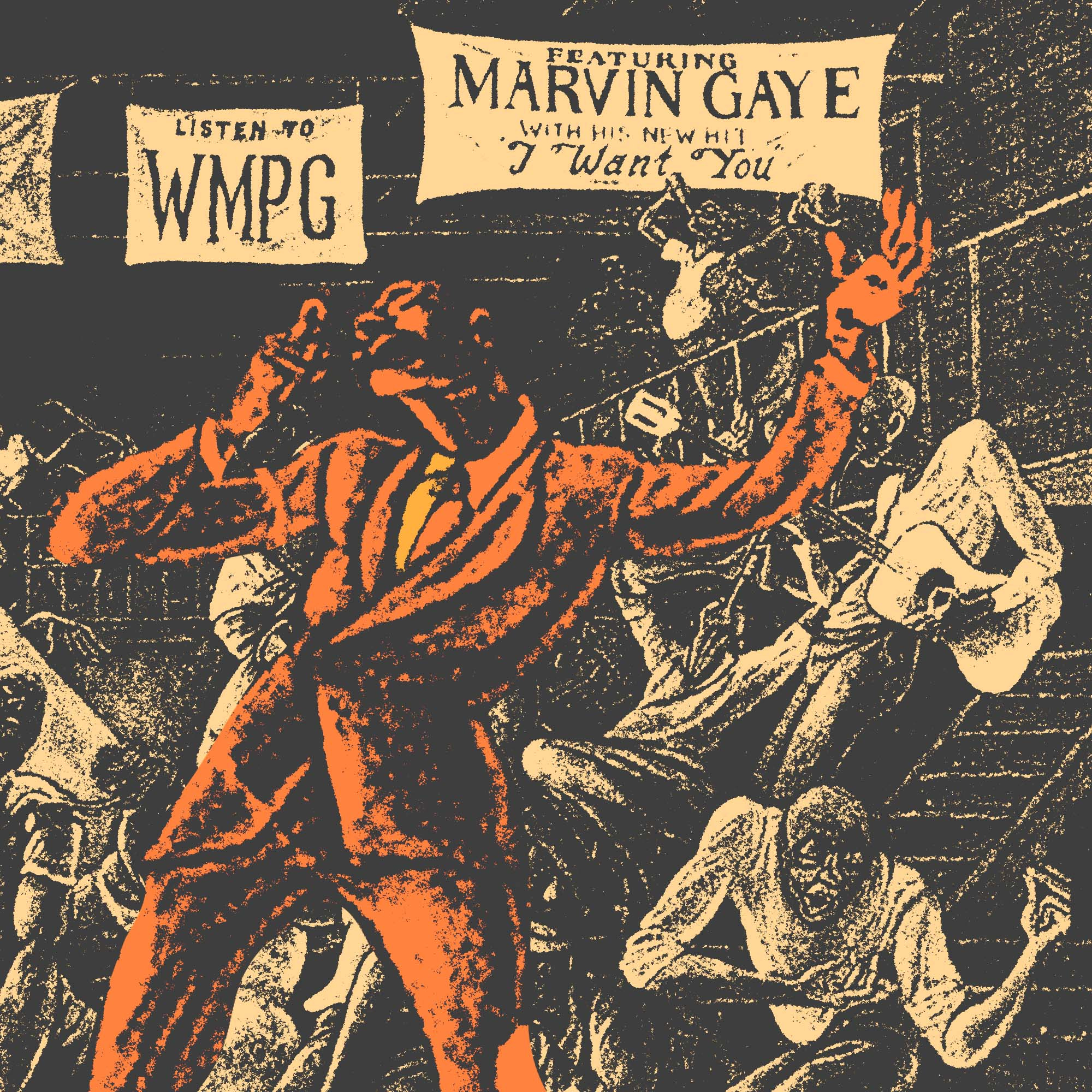
Marvin Gaye was rarely happy. His career, at times, seemed to only serve as a launching pad for prying eyes to uncover the secrets of his dark private life. In an era when tabloid coverage was pervasive, but only in its early stages of flagrant populism, Gaye’s issues—drugs, debt, self-imposed exile and eventual shocking and tragic death—were covered with a notable strain of intrusiveness that often overshadowed the trailblazing American pop music itself. But the mid-‘70s were the exception. Gaye was, for the moment, basking in the afterglow of his two most acclaimed albums, 1971’s What’s Going On and 1973’s Let’s Get it On. His cocaine addiction was still a source of creative productivity and had not yet reached dangerous heights; he was at the zenith of his creative powers, consistently innovating beyond the realms of his own genre. It would only be a few years until his habit hit an inflection point and began to destroy his body and mind, and financial and legal troubles overshadow his pioneering output.
Estranged from his wife Anna—the sister of Motown head honcho Berry Gordy—he met 17-year-old Janice Hunter, who would become the muse and inspiration for his eagerly awaited follow up project. Ill-fated in most of his personal endeavors, this relationship would inevitably be ravaged by addiction, infidelity, and violence, but its honeymoon phase was a welcome break of bliss and ecstasy. Despite their problematic age gap, Hunter made him happy, gave him a sense of purpose and steeped the trials of his life in a pervasive sense of mature passion. Moved by these ephemeral moments of joy, Gaye recorded an aurally ambient album about love, rapturous and sexy and horny and dignified, fueled by his steamy affair that would soon become a tumultuous marriage. It was called I Want You. Though commercially successful, it fell flat in the eyes of critics, and became regarded as the ugly sibling of his more lauded albums.
Having grown up with a sexually confused and abusive preacher father, Gaye’s best music often found its home in the cross-pollenation of sexuality and spirituality, the two not simply coexisting but building off one another. Let’s Get it On is carnal and desirous, supplicating in its very fiber. But it’s an album that searches for answers and purpose. In “Distant Lover”, Gaye wonders how things fell apart so quickly when he laments about an intimate fallout after a happy summer: “All of a sudden, everything seemed to explode/Now I gaze out my window, sugar, down a lonesome road.” In “Keep Gettin’ it On,” years before he would eschew a strain of societal shock and sink into the dark recesses of his own mind, he pleads, “Would you rather make love, children, as opposed to war?/Like you know you should? Don’t you love to love somebody?” In between the brooding Let’s Get it On’s release and its unlucky follow up, it seems—at least momentarily—that Gaye found whatever he was looking for.
I Want You was recorded over the course of 13 months in Los Angeles at Motown’s “Marvin’s Room Studio” after the singer returned from a religious sabbatical. He collaborated with Leon Ware, a songwriter notable for his work with Michael Jackson and Minnie Riperton, in an effort to give the album a laid-back coital bedroom warmth. Their intention was to make the album sonically consistent. They had to fight for it. Gordy was fond of his own “production line” method dating back to Motown’s heyday, which included a gaggle of writers and producers and, ultimately, his own final say. To give Gaye creative carte blanche and the green light to use the same writer throughout the whole project was not just a testament to Marvin’s success, but the trust he inspired in Gordy. The concept album’s mission statement was laid bare throughout the process—from the late night in which the album’s idea was born to Gaye recording the vocals while laying on the couch to the silken arrangement of strings and horns that, at times, drown out the singer’s voice itself, it was always about one core idea. “Being two men sincerely dedicated to sensuality,” Ware said in a 2016 interview, “that was all we ever discussed.”
The clear vision resulted in an album bereft of fear and uncertainty, an embodiment of something completely different from the abstract primal nature of Let’s Get it On. It’s passionate, mature and erotic, sure, but it is confident in its clarity. It is horny without being greasy, covetous without being wretched or embarrassing. With lyrics like “Just you and me locked up for days/After we eat breakfast in bed/Turn on the music for our head,” it seems we are privy to the cave writings of a man who feels he has finally found what he’s been searching for his whole life. It manages to be desperate in a way that feels earnest and respectable: it teems with gratitude for newfound fulfillment, basking in the light instead of groping for something vague in the darkness.
Let’s Get it On is like the stimulated shrieks of foreplay, I Want You the svelte and assured essence of la petite mort. It’s what comes after consummation, the comfort of post-nut clarity beside the one of which you’ve always dreamt. Its vocals are liberated and tender; detractors at the time felt the vocals were tepid and uninspired, but with the gift of hindsight, we’re able to see that they aren’t devoid of emotion. The emotion is just different, happy, content, assured, like in the track “Since I Had You,” when he croons, “Since I had you girl, I haven’t wanted no other lover.” In other words, they are the musings of a man who for one fleeting moment in his irredeemable life believed he knew where he was going.
Beyond its fresh perspective, the album sounded different, too. What’s Going On marked the final transmissions of Gaye’s ‘60s soul era, employing groovy subterranean bass lines paired with a percussive soundscape of primarily congas and triangles, making for an album as appropriate for morning commutes to early shifts at automotive factories as a smoky nights in jazz clubs. Let’s Get it On was solidly funk, a pure relic of its time. I Want You is something else entirely. Sure, it’s R&B, but its influences and innovation lie elsewhere. It’s more disco than anything he’d done up to that point. Its rollicking, intoxicating breeze seems, perhaps, pedestrian in hindsight, but without its imprint on culture, we wouldn’t have the entire quiet storm subgenre that ruled the rhythm-and-blues radio waves in the eighties with the likes of Luther Vandross and Teddy Pendergrass.
It was also revelatory in its mixing choices. The vocals, at times, are barely audible over the percussive backing tracks, a bold choice given that Gaye’s voice was always the hallmark of his work. It was one of the first major popular albums to use a synthesizer, too, particularly on the brooding and galactic grooves of “After the Dance,” a four-minute amphetamine comedown of strobe lights and dried sweat that sounds like nag champa for the ears. It was a portent of things to come, from ambient music to shoegaze to dream pop. One can never truly know if the likes of My Bloody Valentine or Brian Eno or Mazzy Star were really keyed in on an underrepresented mid-seventies Marvin Gaye album, but without this innovatively mixed album entering the public conscience, it’s difficult to think that its offshoots could ever exist in the zeitgeist.
I Want You was and is widely considered a flop, known more for its lack of passion and lust than for its innovation and sonic breakthroughs. In his original review, Rolling Stone’s Vince Aletti criticized the album’s passivity compared to the urgency of its predecessor, calling the vocals and production “too pleasant, low-keyed and subtle for its own good.” He also argued that it didn’t work as pillow talk, the stylized lyricism reading as “unenthusiastic foreplay” instead of his usual tantalizing sexuality. But the further we get from its release, the more it seems like an essential part of Marvin Gaye’s discography, an album that eschewed its funky soulful expectations for something more willowy and atmospheric, bold in its mere rejection of expectations and exemplary of Gaye’s willingness to evolve. It’s also comforting to have a compelling piece of work from one of America’s most tortured artists in a time of fleeting happiness, tranquility and gratification, a nod to the goodness of things to come and an artifact of possibilities, a doomed hopefulness, an idealistic manifestation of one of our all-time greats, and a peek into where things could have gone in his career if the Trouble Man’s life took a different path—if things, maybe, for one glorious moment, were untroubled.