


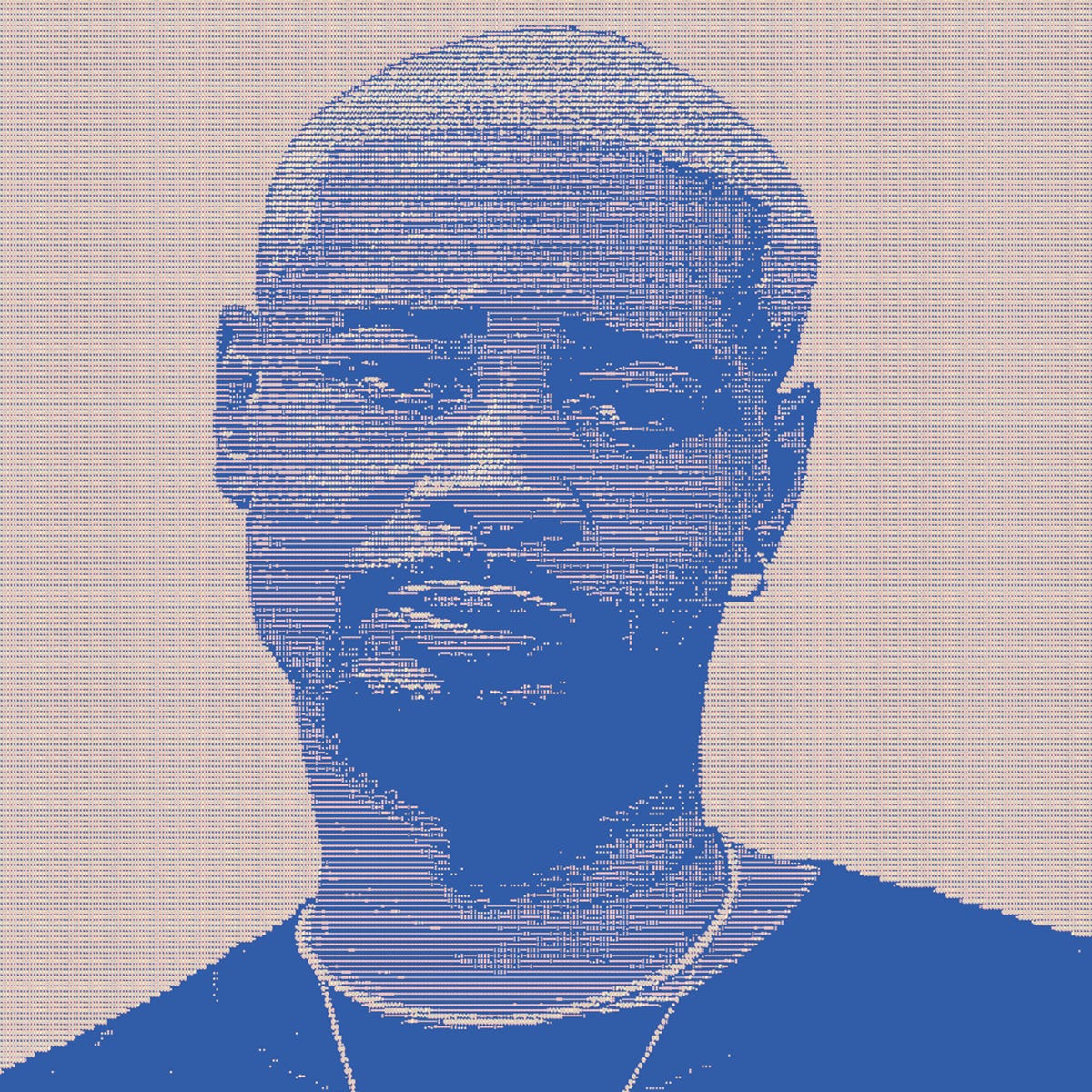
The makeshift asylum was about a thousand yards from the 18th hole. In this catacomb-black basement studio, no windows allowed even a bar of ashen winter light. The only serotonin boosts were artificial. And the carpeting was so dark and matted that you wouldn’t notice the layer of Newport silt.
In the winter of 2014, Danny Brown exiled himself to this dungeon, abutting the Farmington Hills Golf Club, to record what would become his Warp Records debut. He’d become obsessed with Joy Division, especially “Atrocity Exhibition,” a pagan death march where the British post-punk band’s epileptic lead singer Ian Curtis casts himself as a writhing mental patient gawked at by ghoulish pilgrims, a gladiator cheered by bloodthirsty hordes, and a tour guide showing “mass murder on a scale you’ve never seen.” Two months before the song’s release, Curtis hanged himself from the washing line in his kitchen.
Brown could relate. Over the previous three years, he had fulfilled every rock-star cliché: the cocaine orgies, porn-star flyouts, and thousands of dollars hemorrhaged on Rick Owens outfits to be worn once. His lean habit turned his stomach into a cauldron, and withdrawal made his moods so volatile that his managers threatened to abandon him. He lashed out at his label on Twitter, walked out of interviews with the Guardian, flubbed lyrics onstage, and torpedoed a six-figure deal to write a children’s book on self-esteem for young Black girls.
His breakthrough mixtape, 2011’s XXX, was a semi-fictional account of a 30-year-old addict trying to reach stardom before his self-destructive tendencies laid him out on the coroner’s slab. In reality, the Danny Brown who wrote his first project for Fool’s Gold had never even tried coke. He didn’t drink excessively. And outside of a few rolls at a local party called Scrummage, his MDMA use was modest. As far as amphetamines, the Adderall Admiral initially used the ADHD medication for work. It supplied the unruly voltage that allowed him to become “Neo with the Matrix code.” His only true dependency was smoking blunt after blunt.
Fame made the hedonistic fantasies and tortured nightmares prophetic. “I Will” air-cannoned him to the freak-rap rafters alongside Too $hort, Akinyele, and all the electro jheri curl giants. Right as EDM peaked, hordes of tank-topped, glow-sticked goons flocked to his festival sets. They saw a circus ringleader, not the cerebral son of a Detroit DJ, raised on techno and ghettotech, who first blew up locally off a Model 500 flip. Brown balanced blunt rotation bangers, Def Jux complexity, and a Lord of the Mics fixation. But it was the hyperactive molly Pied Piper persona that made every show an excuse for bad decisions.
The crest arrived in April 2013, when Brown popped a molly before a performance at Minneapolis’s Triple Rock Social Club. It was his regular pre-show routine, timed perfectly to kick in once the show ended and the after-party began. On that night, though, the drugs hit fast and hard. A few girls at the front of the stage began grabbing at his dick. Too high to properly assess what the crowd could and couldn’t see, he somehow concluded that his extra-long T-shirt would provide ample cover to “take it out.”
Forty-four years earlier, Jim Morrison was hit with a felony charge for lewd and lascivious behavior—alongside misdemeanors for indecent exposure, open profanity, and public drunkenness—for allegedly giving it a little air. But Danny Brown upped the sex, drugs, and rock ’n’ roll ante by getting an impromptu mic check in the middle of his “Monopoly” verse. The next morning, Kendrick Lamar tweeted at him: “u really just got the head on stage stanny???” Brown replied, “and didn’t miss one bar bruh bruh.”
Within a few hours, the story dominated social media. In what now seems like the most 2013 sentence conceivable, the artist formerly known as Kitty Pryde, the Old & Reckless Tour’s opening act, wrote a Noisey blog post calling Danny the victim of sexual assault. Kitty described the Minneapolis woman as a “groper” who pulled down Danny’s pants—one of the many over-literal fans who assumed that “before the show we’re all backstage licking molly off each other’s buttholes.” Less than two weeks later, NPR assembled a roundtable of pop culture experts to assess masculinity in hip-hop and whether Brown had been criminally violated.
Who and what actually went down remained murky. The controversy quickly abated, but the infamy remained. About six months later, Brown dropped Old, which was mostly finished at the time of what his tour bus came to call “The Thing.” The album was originally supposed to be called ODB, and like the late Ol’ Dirty Bastard, the real Daniel Sewell threatened to be devoured by the Danny Brown caricature. He’d absorbed the lessons of Samuel Johnson via Hunter S. Thompson. He who makes a beast of himself gets booked at Coachella.
Eventually, the drugs wear off. You are forced to sit alone with the scorched nerve endings that you’ve tried to anesthetize. Underneath the Marilyn Manson-meets-Arcade Fire swoosh and the tongue-out, gap-toothed, thizz face was a sensitive, trauma-scarred artist chasing Pitchfork posterity.
There were two obvious routes. Double down on the dirty-old-man filth. Do a bunch of brain-fried big-room EDM collabs. A Vegas residency. The conventional rap model was risky but possible too. After all, a couple majors were interested. But that would’ve required chasing the radio songs mocked on XXX. He’d have to make his “Studio.” Relocate to L.A. or Atlanta. Sit through meetings with A&Rs who were pretty sure they could get a beat pack from Mike WiLL or Diplo’s ghost producer.
Instead, Brown pursued a third option. He called it “the Mobb Deep effect.” Right after “Shook Ones” won them the streets, Queensbridge’s gulliest could have parlayed their success into something ready for MTV or the Top 40 charts. Maybe even the Grammys if they got the right BLACKstreet hook. Even Nas, Danny’s all-time favorite rapper, became Escobar, collaborated with Dr. Dre, and danced with dimes in Oochie WallyWorld.
In 1996, Mobb Deep went for none of that. Hell on Earth does not recognize the existence of the sun. It is a suffocating, paranoid rampage. Pure mayhem and destruction. No one said it better than Havoc and Prodigy themselves: They were nighttime vultures, gem droppers, dry blood on the garments. Pesci, not De Niro. And Brown wasn’t about to let anyone think he was a clown.
After deliberating between Nas’s Mass Appeal and Warp Records, Brown ultimately chose the electronic vanguard behind classics from Aphex Twin, Boards of Canada, and Flying Lotus. The money was better, but crucially, it offered proper context for the creative anarchy.
In the meantime, the Joy Division metaphor rang like tinnitus. The fans only there for the party reveled in the self-immolation. Maybe they’d take a couple pebbles of moon rocks, get a little too grabby on the dance floor, and laugh at the funny rapper with the weird hair. They weren’t about to take a swipe of molly, look up, fingers still wet, and point out that “Dip” was a truly inventive flip of Freak Nasty.
“The title just made so much sense,” Brown says. “I remember one sold-out show in New York where I overheard some dude in the crowd say, ‘I don’t even know Danny Brown’s music, but this n---- got his dick sucked onstage, so I’m here.’ And I was like, ‘Oh, this n---- don’t know shit about the music.’ And then I started looking at other people in the crowd like, ‘Oh, they don’t give a fuck about my music either.’”
Atrocity Exhibition was the revenge. A hermetically sealed bomb shelter. No more frat-house sex raps. If Bowie was an artistic lodestar, this would be Danny Brown’s Low, a skeletal, doom-laden portrait of deterioration. Except instead of subsisting on red peppers, milk, and cocaine, he would survive on lukewarm Uber Eats fast food deliveries, Hennessy, and Adderall.
It sounds nothing like the orchestral psych-rock of Brown’s favorite album, Love’s Forever Changes, but echoes what Arthur Lee said about his state of mind: “When I did that album, I thought I was going to die at that particular time, so those were my last words.”
There were brief periods when Brown tried to work out and attempted a halfway sobriety. But after an acid freakout in a sensory-deprivation tank released unprocessed horrors, it was back to the darkness. And during the diabolical Michigan winters, there were weeks when he rarely stepped outside.
Being a famous rapper wasn’t all bad. With festival money stacking up, he bought a house out in the burbs, about 20 miles from the Coneys and empty fields of Westside Detroit. And he’d equipped his home studio with a professional setup: Pro Tools, a mic preamp, and some compressors. The expensive shit. Once you got above ground, the place had gorgeous views, a sense of serenity, and unpolluted air. That barely rated a passing concern.
Brown rarely drove past the corner store. Most of his friends didn’t have cars, which meant few visits and an added sense of isolation. It incubated the fear and loathing of Atrocity Exhibition, in which the beast suffered rap’s most avant-garde nervous breakdown and Kendrick Lamar, Earl Sweatshirt, Ab-Soul, Kelela, and B-Real popped up during visiting hours at Bedlam.
“I was trying to make rap music without rap beats,” Brown says of the impulses that guided the record. “I could get beats from anybody: Alchemist, Black Milk, you name it. But the beats would be too fire or the hard shit would clash. It needed to be a perfect marriage. The beat shouldn’t kick your ass, and the lyrics shouldn’t kick the beat’s ass. It should be a nice draw.”
Alchemist and Black Milk each placed a song on the final tracklist, but Brown’s alternating-current idiosyncrasy wouldn’t let him do a customer service album full of neo-boom-bap lyrical miracles. In a meatloaf-and-boiled potatoes subgenre, he served omakase. Something more akin to the axiom adopted by Grateful Dead fans: you don’t get what you want, you get what you need.
“Danny Brown is never going to get on Twitter and be like, ‘Hey, guys, who do y’all think I should work with?’” says J.U.S., the engineer of Atrocity Exhibition, and one of the few regular visitors to Brown’s lair. “You’re going to take whatever the fuck he’s serving up and like it.”
