


I feel Pharoah Sanders’s presence all around me at Montreal Jazz Festival. It’s more than just his photo lacquered in retrospectives around the 46-year-old festival’s grounds paying homage to its other universally revered veterans—Getz, Miles, Jobim, Ella, Peterson. Sanders played the festival numerous times over the years, including in 1998, when the live album Spirits was recorded, an example of how more than just about any musician, Sanders played his saxophone like he was furiously channeling a higher being.
In 1994, he played a set at a 150-year-old stone church that had been converted into a concert hall called Le Gesù. When I saw Shabaka Hutchings in the same room two years ago, coursing through his woodwinds as heavenly harpist Brandee Younger played beside him, I swear I felt Sanders’s ghost.
This year, I felt Sanders mightily during Kamasi Washington’s Sunday evening headlining set in front of well over 20,000 people on the main TD Stage. Washington is arguably today’s foremost spiritual jazz saxophonist, an analogue to Sanders in a lot of ways. This was one of his first performances since the May passing of his West Coast Get Down compatriot, trombonist Ryan Porter, and there was something downright sacramental in the air.
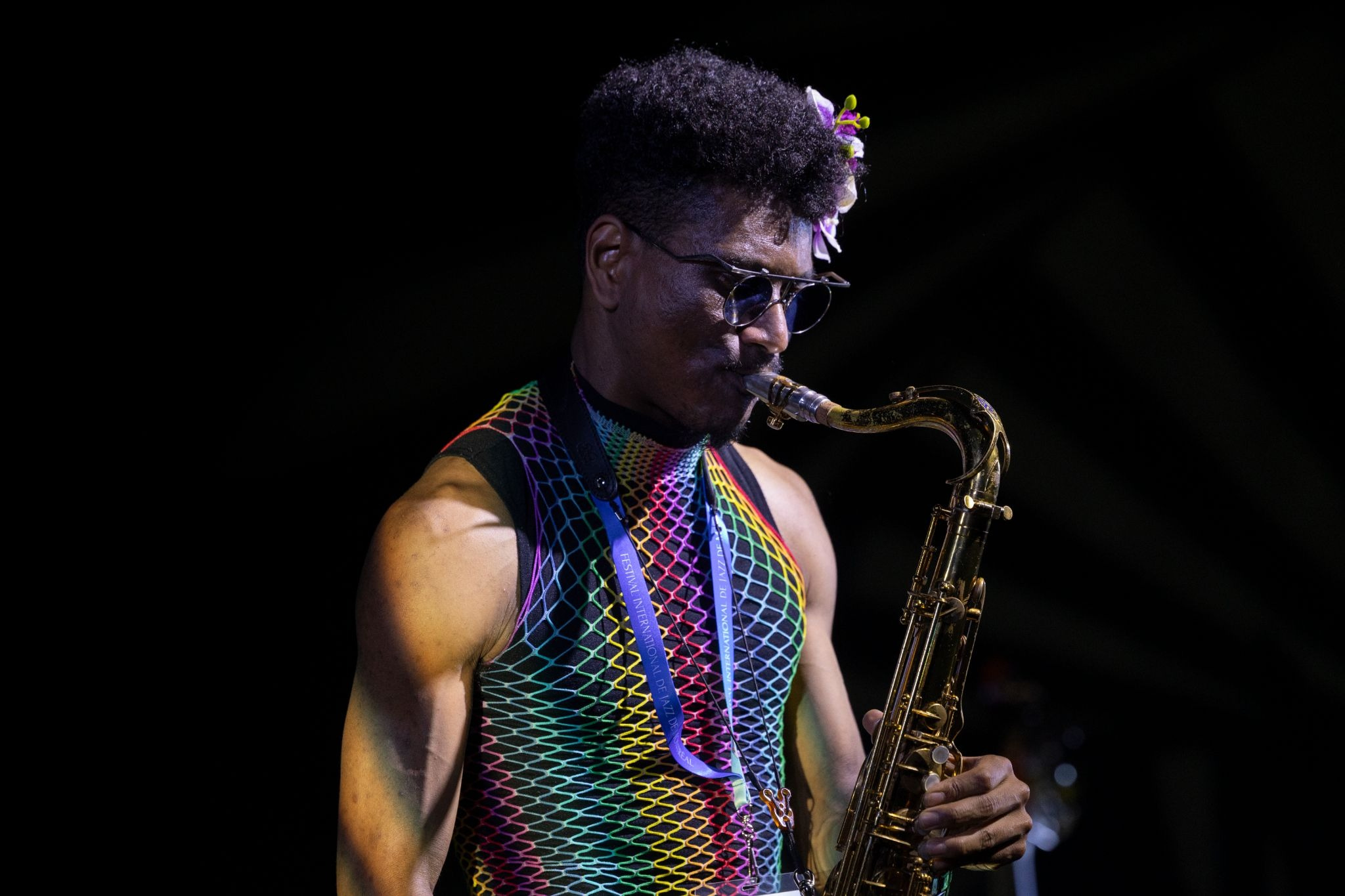
But in my annual pilgrimage to the largest jazz festival in the world, I’ve never felt Sanders more powerfully than this year, when his progeny, Tomoki Sanders, was leading their own band for the first time at the festival. I had originally encountered Tomoki in the summer of 2023 at the Black Cat in San Francisco and then a couple months later in Montreal, playing soprano sax at Jazz Fest in an insane ensemble led by drummer Kassa Overall. Midway through that set, the younger Sanders jumped off the stage, horn in hand, and zipped through the crowd, blowing into their sax and shrieking like a banshee. I couldn’t take my eyes off of them—as if knowing that they were a Sanders wasn’t intriguing enough to begin with.
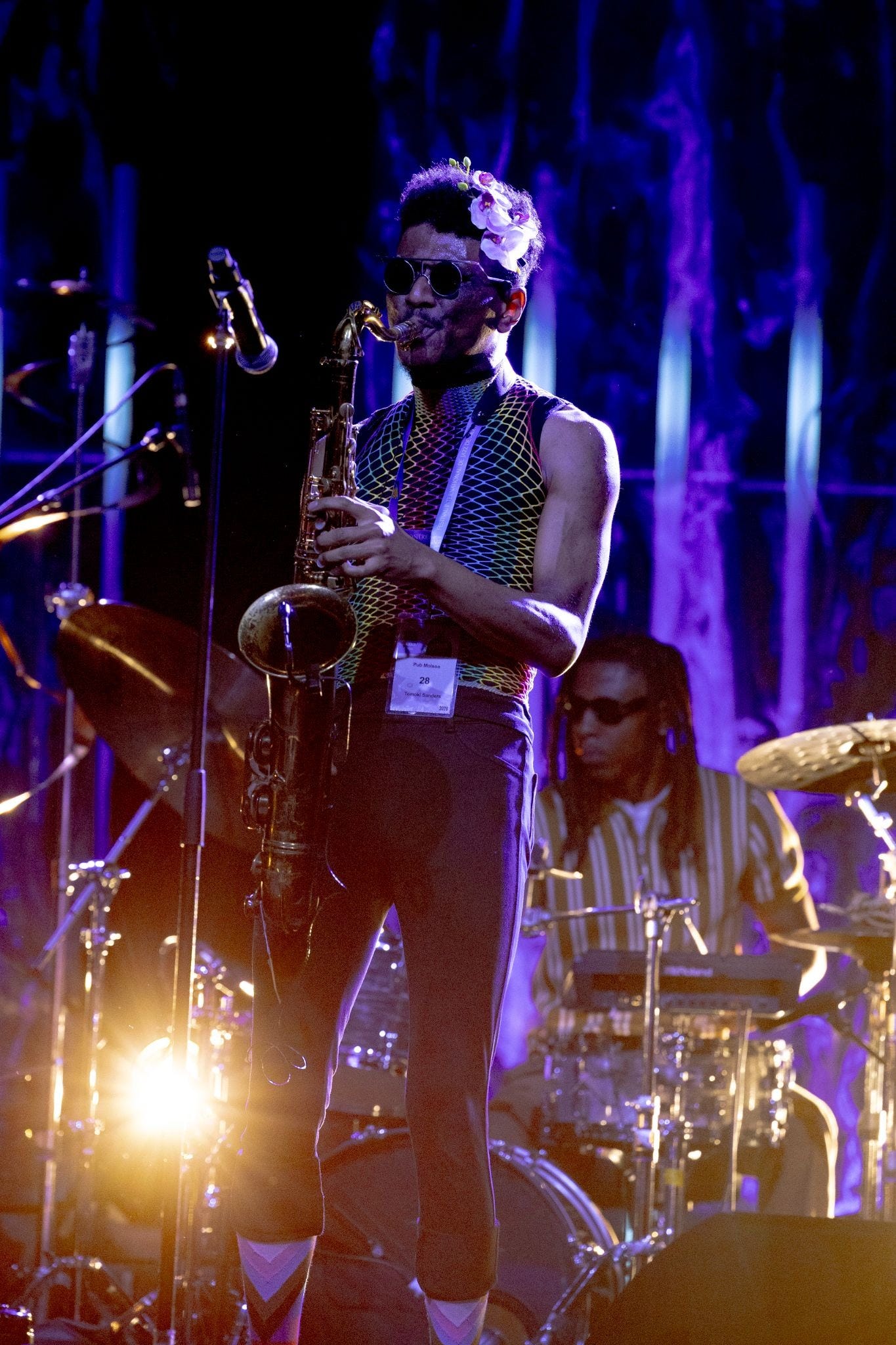
Now, Sanders is out in front of the show, in the midst of a Canadian and European tour that follows their signing to Gilles Peterson’s influential Brownswood Recordings label. They’re about to play a gig in front of a thousand or two folks at Pub Molson, an open-air jazz club stage of sorts that’s been a favorite of mine over the years. It’s a warm Quebec night that feels especially fresh after it rained prodigiously in the early afternoon. I’ve just left St. Vincent’s set, where Annie Clark was backed by an entire symphony orchestra (eat your heart out Cypress Hill) and Tomoki is blowing sweet, spiritual air into the night.
They shift between a tenor sax (no soprano sax in sight) and a small wooden flute resembling a clarinet that hangs from their neck. Pride month is coming to a close, and Sanders wears a rainbow mesh tank top over a sleeveless black mock neck that fits tightly around their wiry frame. Orchids are clipped to the side of their hair a la Billie Holiday, and they seem gregarious and ready to embrace this long-awaited moment in the limelight. Backed by Ian Fink on keys, Christian Napoleon on drums, and Paul “PapaBear” Johnson (elite jazz name alert) on bass and samples, the 31-year-old is forceful and elegant, with a polished edge. As a bandleader they seem, well, born to do this.
“Ever since I was a kid and I was watching videos of my Dad playing, I’d be like, ‘I want to do that. Exactly what he’s doing,’” Sanders tells me backstage before the show. “I really looked up to him.”
Tomoki was born in 1994 to Pharoah and a Japanese mother. They played drums and clarinet from an early age, but Pharoah gave them their first sax at the age of 10. They lived in Queens until moving to Japan as a teen with their mother (whom Pharoah divorced in 1997) and returned to America to attend the Berklee School of Music. Today they still shuttle between Japan and New York. They’re fluent in Japanese and, at times, a hint of a Japanese accent peeks through.
“Being half Black and half Japanese is a blessing to know I have both cultures,” Sanders says. “But also a curse, because it can feel like an identity crisis. Like you’re not Black enough or Japanese enough.”
Tomoki was named by their mother and grandmother after Japanese saxophonist Tomoki Takahashi; the name means “born with generosity” in Japanese, and one feels a distinct warmth when speaking to them. Coincidentally enough, Pharoah played his song, “Tomoki,” at the Le Gesù performance in 1994 just months before Tomoki was born, two years before it was released on the Message From Home album (the first in Sanders’ collaborative period with producer Bill Laswell). There’s an eerie similarity in the deep, gravelly voice—think Louis Armstrong—with which the elder Sanders sings the call and response parts of “Tomoki,” and introduces his band in the recording, with how Tomoki does it that night at Pub Molson. It’s both another potent reminder of the legend and of the familial relation that Tomoki carries with them.
Sanders says they grew up admiring a number of second generation musicians who were raised in “the shadow of their parents”: Liza Minelli, Ravi Coltrane, Matt Garrison, Felix Pastorius, and Norah Jones among them.
“Liza Minnelli became someone who had her own independent spirit and knew how to grow and utilize who she really is,” Sanders says of the daughter of early Hollywood royals Judy Garland and Vincente Minnelli. “Norah Jones had a gift from her Dad [Ravi Shankar] but it was shaped differently from that lineage. It’s like a seed and you’re responsible for providing it with enough water, fertilizer, and sunlight to grow this beautiful creative plant of who you are and your identity. Yeah, there are moments of pressure. But recently I learned to say to myself that, ‘I know what I want to do.’ Before he passed away, my Dad told me, passionately and as honestly as possible, ‘Do your own thing. Do what you want to do.’ And music is my sanctuary.”
“I was very close to him,” Sanders says of their father. “Asking him about health, life and spirituality. It wasn’t always music, but most of the time, yeah, it was music. It’s been four years and I really miss him.”
Another piece of advice that Pharoah imparted onto Tomoki was about being a bandleader: “Know who you put in your band. Know who they are as human beings.” When reflecting on this, Tomoki waxes on the theory of how art and the artist are not the same. They’re aware of that conceptually, but they’ve come to a deeper understanding of their father’s words. “In his own terms personally, I think he’s saying that the person and the artist is the equation, it’s like the yin and yang. Having good musicians in your band who are also good people.”
Sanders says they also learned a lot about being a bandleader from Kassa Overall. Among other things, the drummer taught them how to navigate the music business. Prior to that mentorship, they had the passion, the enthusiasm, and the concept, but weren’t ready to grasp the machinery operating adjacent to the music.
“I’m blessed and grateful for his guidance to help me become who I am on my own as a bandleader,” Sanders says. “It’s a lot of work. People think you just lead and go. But you have to trust and listen to your bandmates. A lot of people think it’s about being the most dominant person. There’s some form of that, but you have to learn to listen and be respectful and be vulnerable. That’s what empowers the team to another level.”
“Even when we played with Kassa we knew Tomoki was a star in the making,” says Fink, who played in the Kassa Overall band alongside Sanders for years. I could tell that people were attracted to Tomoki as a side person because of their incredible energy that balanced the group. Now it’s out front and Tomoki is a star and everyone’s excited.”
Like Sanders did with Overall, Montreal Jazz Festival is a place where sideplayers come to stand out and build their repertoire—to both show audiences that they can play, and start to feel out whether they have what it takes to lead their own band. It’s also a place where surging bandleaders come to show what they’ve built and who they’ve built it with.
As Tomoki’s performance is coming to a close, they’re in complete and utter harmony with the band—through both glimpses of music that’s coming out on their debut album later this year, as well as fantastic improvisations. The set closer, however, is from Pharoah’s catalog, “The Creator Has A Master Plan,” a godmode spiritual jazz standard. Fink’s keys, shapeshifting through different wavelengths, settle richly into the ubiquitous tune. Napoleon is steady, tight, precise, while Johnson’s bass paints the song’s distinct melody with lasting strokes. Sanders’ vibrations are tenacious, but sensitive. They’re a leader who’s maintaining the legacy of their elder, but also firmly forging their own unique pathway, clearly speaking through their horn, as if to say, “I am here, I am me and I am proud.” And in some other dimension, within the space of Montreal’s hallowed ground, Pharoah was right there too.

Loved this. Thanks for putting it together - I remember listening to Tomoki’s single “Komorebi” a few years back but now that he’s with Brownswood, hoping he can bring a full project into being that starts to give us a peek into how he’s similar and different from Papa Sanders. Looking foreword to seeing him play live too, sounds like he’s getting it dialed in.