


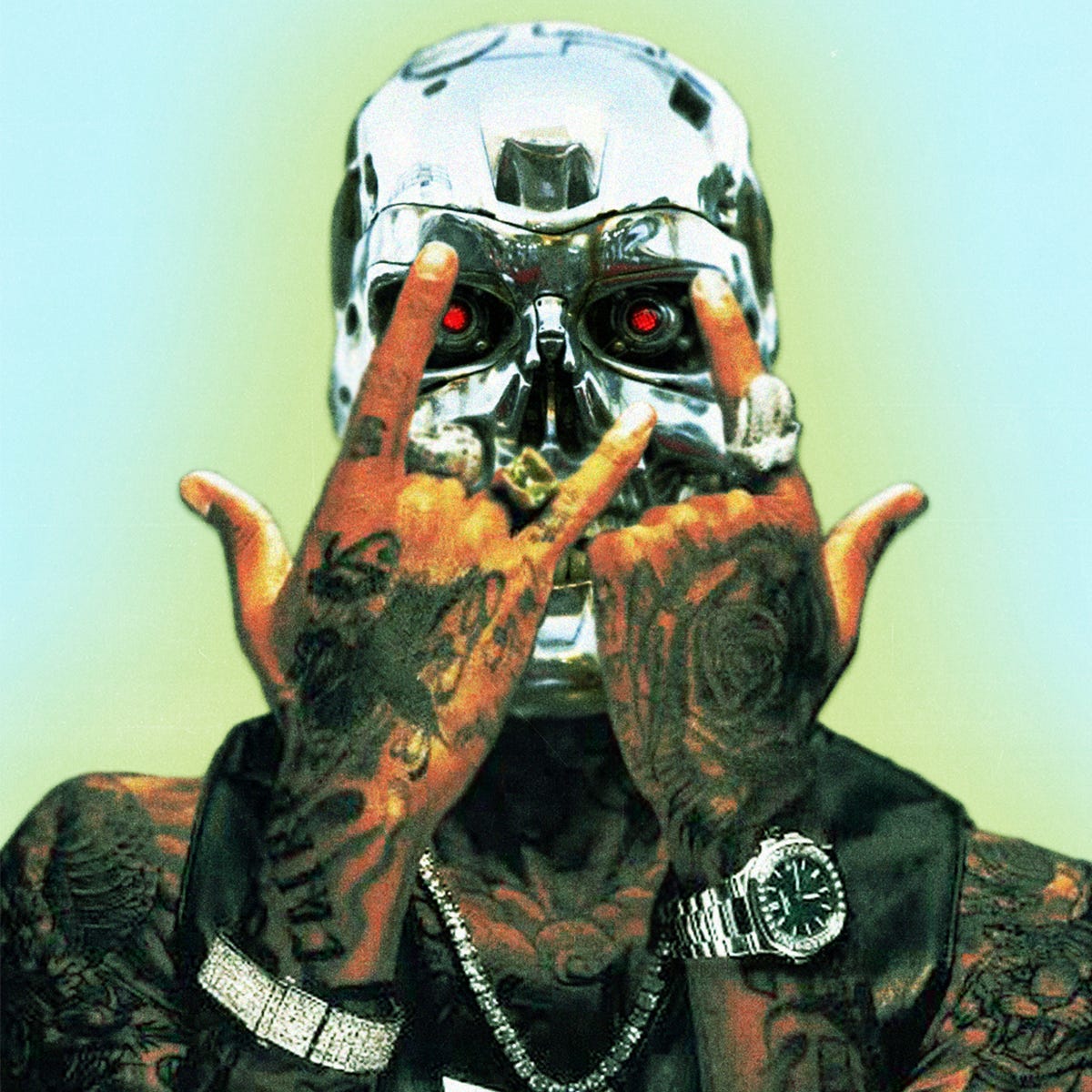
Drive 250 miles east from Rack City and you’ll come across a newly constructed data center. Were you to travel in the vicinity of this hulking industrial complex during July of 2026, you might have heard a faint hum emanating from these six acres’ worth of hastily constructed sheet metal. Past its barbed wires and amphetamine-hopped security detail, supercomupters hidden deep in the Nevada desert were working their ways through increasingly duplicative prompts: “Tyga+80s vibe,” “Tyga+throwback synth vibe,” “Tyga+Vice City singing,” “Tyga ballad synthwave,” “Tyga+Torey Lanez Alone at Prom+The Weeknd vibes.” Upon receiving its final prompt—“Make a Tyga album in the style of Fenix Flexin’s ‘RUBBERZ’”—the machine eased itself into a whisper, faced with the functionally effortless task of artificially generating a copy of an artificially generated song. The result, an LP called $TARFACE and attributed to the human hip-hop artist Tyga, might aptly be described as the most banal, cynical, and uninspired collection of recorded music I have ever heard, but to discuss this album in these terms would be to misuse the commonly held notion of the phrase “recorded music.” It would be more honest, then, to say that Tyga’s $TARFACE is the worst full-length artificial generation I have ever heard. $TARFACE contains across its ten overtly computer-generated songs neither a trace of humanity nor an interesting idea. It merits discussion only insofar as it poses the question of whether it will be the last full-length artificial generation I hear.
It’s a tale as old as time: with technological advancement comes fearful reaction. Luddites smashed industrial textile-processing machines, the radio threatened our literacy, and television rotted our brains until our phones turned us into slobbering cattle. One day the Lumière brothers are inventing tales of audiences stirred into a panic at the sight of an incoming train, and the next you’re competing against ticket-buying bots to see Travis Scott sing the story of a great warrior in IMAX. The unsexy answer, which typically happens to be the correct one, is that new technologies reshape their users and subjects in ways both to be harmful and helpful, though it is difficult in the moment to parse which is which. But then I’d be remiss to overlook Kubrick’s warning: The first thing that we do with new tools is use them to beat the shit out of each other.
It’s entirely possible that you, the reader, are unaware that Tyga has released a new album, much less that this album, $TARFACE, is meant to introduce a Miami Vice-inspired alter ego for the man who once boasted of having your grandmother on his dick. The only people who have heard, much less written a single word about this album are those who have been paid to do so; the only two things that distinguish me from the mercenary internet aggregator class as it relates to this release are that I will be paid not by Tyga’s label but by the readers of POW Magazine and that I will be paid the least of anyone who has listened to $TARFACE. Point being: You’re not supposed to know that $TARFACE exists. Or, at least: You’re not supposed to know that $TARFACE exists yet. $TARFACE was not generated with you, a human being, in mind. The first overtly A.I.-generated album attached to an ostensibly mainstream artist takes the data-dump approach to rap music in the era of streaming to its logical conclusion. If the current modus operandi of releasing music involves floating a bloated, incoherent record into the world, allowing invested early listeners to determine which, if any, tracks are worth pressing play on multiple times and prompting the perceptive streaming algorithms to foist those songs onto legions of more disinvested, passive audiences, then $TARFACE imagines a process through which the human work of early tastemaking is offshored to bot-run stream farms. You are not supposed to press play on $TARFACE. Rather, bots are supposed to stream songs from $TARFACE enough times for those one or two of those songs to reach escape velocity such that you begin hearing them on Instagram Reels, with your friends on a rented boat, at the gas station where you buy your vape and your overpriced, branded sparkling water. Such is the operative logic of artificial intelligence, which in the name of streamlining the human experience relies, above all else, on the narcoticizing effect of familiarity.
The history of recorded music is itself, definitionally, a history of technologies. The album, such as it is, derives its form from the physical limitations of a 12 inch vinyl; it is only through repeated practice and critical consensus that something as structurally arbitrary as a haiku comes to represent seriousness. Listening to guitar music meant hearing the recorded sounds of a band’s instruments roughly as they were played in a room until it meant hearing how the band’s instruments should have sounded as they were played in a room. Imagine, if you will, where we’d be without 808s. All of which is to say that artificial intelligence is a new technology that I, like many with whom I share a set of political beliefs, reflexively find odious, and yet I cannot with any confidence discount the possibility that musicians will use, or have already used, artificial intelligence as a tool with which to make genuinely valuable, moving music. But if artificial intelligence is compatible with musical flourishing, such compatibility is not evident throughout Tyga’s $TARFACE.
I’m old enough to remember when my favorite songs were by a man who, if the popular conversation was any indication, was singlehandedly destroying the musical tradition as we knew it. When you are a snot-nosed, sweaty kid dancing to “Kiss Kiss,” the question of whether or not T-Pain is an artist or a cynical opportunist is about as interesting to you as “Yellow Submarine.” Where autotune’s critics erred is in their thinking that this technology was being used to pass off bad singing as melodic when Pain and his hangers-on (Kanye West included) were in fact using vocal modulation to denaturalize their performance; that T-Pain has spent the better part of a decade on a stripped-back, chops-proving circuit speaks only to failures of the public imagination. And so, a postulate: the extent to which new technologies can contribute productively to the practice of recorded music is directly determined by the degree to which humans can dominate them. All of which begs the question of whether artificial intelligence could generate lyrics that attempted to rhyme “mansion” with “Wisconsin.”
As Alphonse Pierre writes in Pitchfork, A.I. is already inescapable in hip-hop; I feel comfortable hypothesizing that its reach transcends genre classifications. In so diagnosing, Pierre quotes an underground videographer who notes that A.I. usage is ubiquitous in backend work; for every music video in which a rapper briefly metamorphizes into Charlie Kirk, there are ten for which A.I. was used to streamline workflow and automate tedious tasks. For a listening public whose only identifiable recourse against the overnight A.I. revolution is to speculate whether or not a song or video “is A.I.,” this ubiquity poses an ontological dilemma. What makes music, well, A.I.?
I have heard artificial intelligence used interestingly in music exactly twice in my life. The first was part of the reclusive blog darling Jai Paul’s first, abortive foray into the public eye after his leaked 2013 record permanently mutated pop music’s genetics. In 2019, Paul shared a link to a collaboration he had undertaken with the artificial intelligence engine “Bronze” to generate an infinitely iterative remix of his single, “Jasmine.” With each play, the engine would rearrange the track’s stems to dream a unique, endless version of Paul’s sub-aquatic ballad. I recall losing entire afternoons to the pursuit of chasing the song’s perfect rendition; it was three years before OpenAI had released ChatGPT to the public, and the first word I thought of when I heard the letters “A.I.” was “practice.” The second was the night before Tyler, The Creator released his surprise, government-mandated dance album DON’T TAP THE GLASS. I clicked on a video that purported to be the record’s lead single and instead encountered 90 seconds of what was by now called “A.I. slop.” Imagine the guy from Sleep Token singing over a beat they use to announce the lineup for Ultra, but he’s just repeating the words “don’t tap the glass.” It was, as I’d learn the next morning, both catchier and more subversive than any song on the actual record.
I’ve realized, as I listen through $TARFACE against my better judgment, that I was hasty to write off its prospect as an interesting text. Across $TARFACE, an album that unintentionally recalls vaporwave’s ear for locating horrifying melancholy within nostalgia for the ostensibly saccharine hits of yesteryear, one hears a computer attempt to approximate humanity. You see, computers learn to sing much how they learn to write: from how we have done it in the past. On $TARFACE, a computer tries, such as it does, to approximate the emotions that have inspired great songwriting. But a song about, say, a person who has used the narrator as a tool, then abandoned said narrator when they no longer fit into their vision for a good life sounds differently when written by a human being. What I mean to say is that it is difficult to hear a computer sing “look at you now / check out the view now / everything is gone / now you’re alone,” as it does on “Tyga’s” “GAVE U RACKS,” without feeling the weight of inhabiting a world governed by machines trained on the emotions of scorned lovers.
At our current historical juncture, A.I. music can be identified in much the same way that the United States Supreme Court infamously defined obscene content: you know it when you hear it. There is, however, no reason to think that this will always be the case. Perhaps the most odious effect of platforms like Suno (aside, of course, from their theft from working musicians) is that they have created conditions under which we now encounter recorded music with paranoia. Until recently, A.I. music was presented as a novelty gimmick, from virtual popstars to A.I.-generated Drake songs. Such “music” recalled vape cloud tricks–tasteless, meant for men in unfathomably dirty living rooms, and ultimately harmless. I once rode in the backseat of an Uber as my driver played an A.I. rendering of Travis Scott’s UTOPIA. A.I. Travis Scott proclaimed that a woman just wanted his money and his dick, my driver harmonized in the background, and I realized, at 4:35am, that this man knew the words. But as the mode of disclosed, “type beat” fantasizing has given way to covert-yet-omnipresent artificially-generated music, A.I.-pessimistic listeners are increasingly asked to approach new music with suspicion. Take Fenix Flexin’s “RUBBERZ,” the dreadful crossover hit of the summer that imagines The Smiths fronted by Chet Holmgren. Across the countless debates of whether or not “RUBBERZ” is the work of humans or computers, partisans have pointed to both the track’s structure and lyrical delivery as smoking guns. A human, the argument goes, would not have made this decision. It’s the form of this argument, more than anything else, that illustrates the stymying effects of artificial intelligence on human creativity. All of my favorite music is the result of decisions that no human would have made up until that point. To concede idiosyncrasy is to concede the future.
But not just idiosyncrasy. Throughout his career, Tyga has exemplified a laziness so complete as to become transcendent. I have historically loved Tyga’s music precisely because of how little it asked of me. In a real sense, Tyga’s cynical $TARMAN gambit is meant to undermine the conditions within which another Tyga might come into being. It would be impossible, in 2026, to hear a rapper rhyme “she’s watching that Oxygen, I’m watching ESPN” as does Tyga on “Bedrock” without entertaining a suspicion that such a line were A.I.-generated. That, too, is a loss.
During his standup set, Rap World’s Jack Bensinger tells what has become my favorite joke of the year. As he discusses his membership in the San Diego Subwoofer Community Facebook group, he shares that the group’s banner photo has recently been changed to a “really cool graphic.” A member of the group comments asking whether the image is A.I., and the person who made the image responds “fuck yeah it is, let me know if you need anything!”
As A.I. models grow more sophisticated, A.I.-generated music will sound increasingly naturalistic. There is a version of the future that mirrors Flexin and Tyga’s low-effort gambits to serve as human salesmen for songs that neither they nor any human being ever wrote or performed. The more likely timeline, for my money, is the one of A.I. as ghostwriter-cum-producer, a technological coup that leaves only the world’s weed carriers safe. But even then, as now, there will be a tell: A.I. music can approximate much of what came before it, but it cannot sound new.

Awesome piece. POW on a relentless tear.