

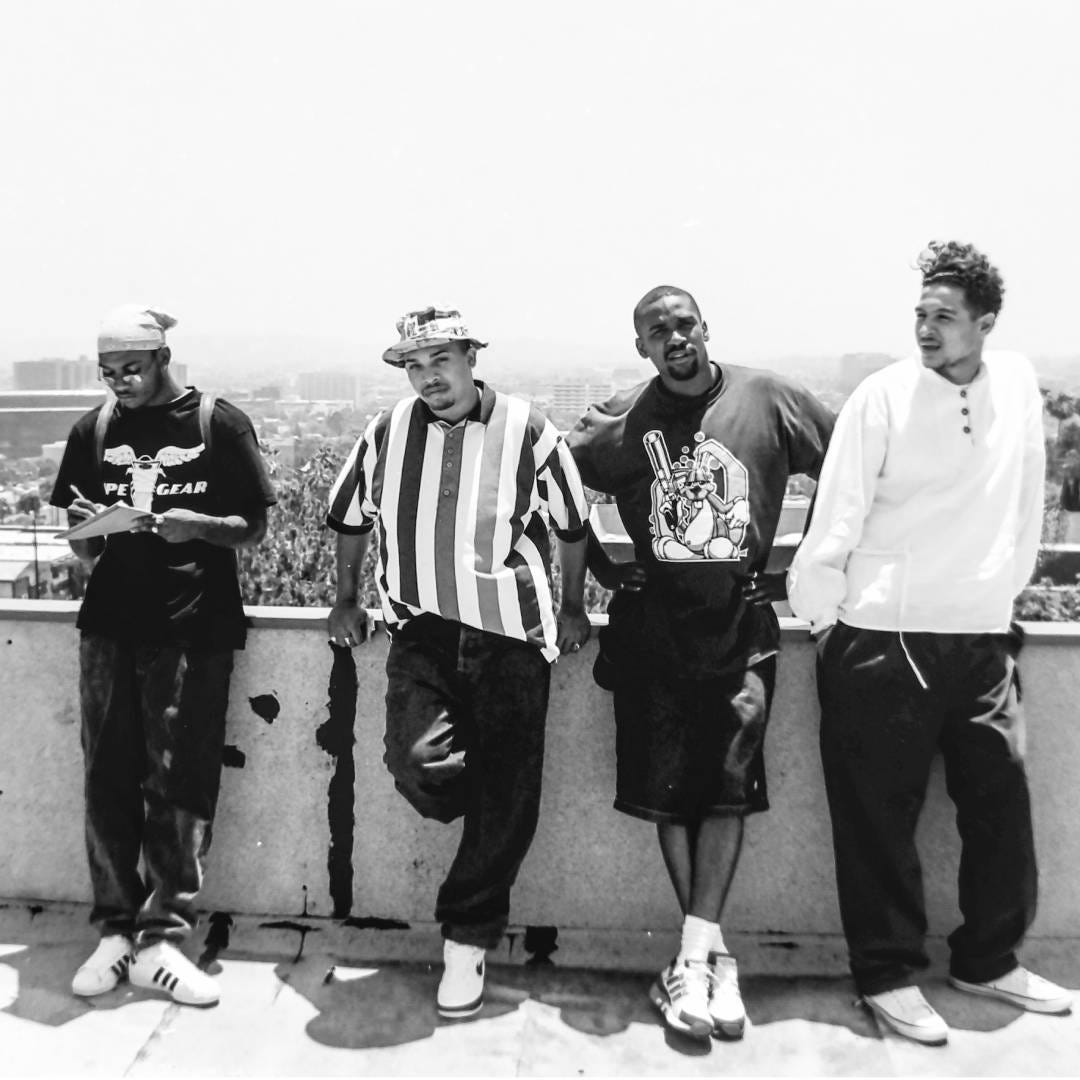
Freestyle Fellowship, all images via Deverill Weekes
Donna-Claire is the Jesus Lazardo of the literary world.
Martin Pearson and Deverill Weekes were newly transplanted Angelenos when the unfiltered culture of ’90s rap rose up from underground music scenes. The two London natives originally met working on a project featuring a young Ice-T, when Pearson was a UK music journalist and Weekes was a photographer fresh out of school. Together, they captured the vibrant essence of the burgeoning genre. Neither of the pair had any idea that they were capturing history until much later.
“I interviewed Prince back in the ’90s and his [2016] death triggered me to go through my old material,” Pearson tells me. “And I realized what I had, and that it would make an interesting collection—putting it all together and viewing it through the lens of history gave it new life.”
What followed was a period of deep research and thumbing through the archives to assemble together Hip-Hop Rising: Profiles of the ’90s. The text brings together rare interviews along with modern commentary. Weekes' brilliant photos provide a time capsule of “the last decade before the internet took over.” It features interviews with everyone from Ice-T to Eazy-E, the Beastie Boys to Queen Latifah and Coolio.
“I ran around the iconic Farmers Market in Los Angeles with the Beastie Boys to try and find the perfect place to take photos,” Dev recalls. Dev’s early work was guided by what natural light and creative ingenuity had to offer. The photos in Hip-Hop Rising aren’t studio portraits. Instead, Dev describes them as, “real, raw, earthy, alive, unprocessed and immediate.” From cross processing slide film in color negative chemicals to light leaks, the imperfections on these images are characters in their own right.
In the last few weeks, I’ve been going through and cleaning up my office, and at one point had about 20 rolls of sleeved and unorganized film piled up on my writing desk. Holding the negatives was powerful–a reminder of how we’ve become desensitized to the value of tangible memories. It is the same sensation I got while reading Hip-Hop Rising, this sense that the weight of memory may never be this substantial again.
I spoke with Martin and Dev about the process of putting together Hip-Hop Rising, cataloging history in an AI and doom scrolling-infested world, and the value of preserving conversations with late artists.

What catalyzed putting this book together? Was it a need to capture history, a love of the game, something else?
Martin Pearson: Oddly enough, the catalyst was when Prince passed away. It might be a bit of exaggeration to say it was a need to capture history, but when you think about it, most material like this from the ’90s isn’t online so it really could just disappear. In the process of researching and publicizing the book I found there’s a huge community out there of people interested in this era, and an appetite for stories like this that aren’t already over-saturated in our culture.

Deverill Weekes: Martin reached out about doing this project and I thought it was a brilliant idea. It was a bit of a process for me to find the images. Seeing it come to fruition has been amazing. Martin’s writing is exceptional and I love the layout.
Which was the first interview and photo set that kicked this project off?
Martin Pearson: There wasn’t really one that kicked it off, but early on I saw that the Ice-T material was a great entry point just because it’s such a scene setter. The OJ moment is just classic ’90s and Ice himself, was (and is) such a compelling, multidimensional character. In a way, the story he tells in the piece is the story of hip-hop itself: he was such an outsider and was just at the point of becoming bigger than his music and reputation. Dev’s portraits sealed the deal. We had unusual access and Ice was a master at delivering striking material, whether in words or images.
Deverill Weekes: I think the first time Martin and I worked together was with Ice-T. One could feel what an incredible moment it was to be a part of. He was a consummate professional, very focused, and knew exactly what he wanted.
The portraits in the book are awesome time capsules. Can you share your favorites and what speaks to you about them?
Martin Pearson: The Pharcyde and House of Pain stand out in my memory, partly because I was so new to LA and they took me to places I hadn’t really seen before. Also, I’d never seen so much weed in my life!
Deverill Weekes: I loved taking all of these pictures. Three that come to mind immediately are Coolio because I went to his house in South Central and met his new dog, whom he was super proud of. The photos we took felt genuine and unfiltered, tough and honest. I would also choose Ice Cube because when he steps in front of your camera, he makes every shot work.
Another choice is the Beastie Boys. They were pretty wild and out of control… It was a case of trying to keep up to capture it all.

I am very taken by the light leak in the LL Cool J photo. That type of artistic imperfection speaks to the vibe of ’90s rap. What other images in here capture the essence of the ’90s hip-hop movement best for you?
Deverill Weekes: I’d just left college and had not worked very much yet. I didn’t have money so what made it fun was having to shoot on the street, rather than in studio, to find light where we could make the images sing. This turned out to be exactly what they needed to be, what they needed to capture and reflect.
I loved shooting the cover with Ice-T because the film was crossed-processed, which meant I shot the slide film and then processed it as color negative film. This created crazy colors. There was no photoshop then.
Also, I shot The Pharcyde so many times. It was great to shoot them at The Manor, a fancy hotel on the Sunset Strip, and then backstage at a gig. Freestyle Fellowship was shot on the roof of their record label, Island Records. Again, we had to find the best light and that location was exceptionally cool.
Since doing this book, I bought three film cameras and have started shooting a project. It is exciting and wild to shoot film again after shooting digital for so long. It’s foreign now to have to wait for the proofs to know what is there!

You have rare interviews in here with a few beloved, late artists. Do the interviews take on new meaning given some of these key figures have since passed away?
Martin Pearson: Definitely. That was one of the catalysts for digging through these archives. People like Adam Yauch and Eazy-E were so instrumental in bringing rap out of the shadows and making it what it is today. Conversely, it was a revelation to me to find out how many of the lesser known acts in the book went on to influential roles in the music. Alan Maman of The Wholiganz springs to mind: he reinvented himself as The Alchemist and is one of the hottest producers around.
Finally, can you speak a bit to the value of this type of archival work in our fast-moving, AI world?
Martin Pearson: I think it really is significant that this was the last decade before the internet took over. The stories, voices, and images captured in the book are from a time when everything was more tangible, and I would argue more valued, because it existed in the physical realm. I like the way these interviews and photographs preserve the raw energy of artists who were shaping a genre as it was actually happening. In the world we live in now, everything is interpreted by algorithms. There’s real value in returning to original, unfiltered sources. I’m hoping it humanizes history a bit, and adds something more lasting and impactful than thrown-away AI-generated summaries.
Deverill Weekes: I really love Martin’s interviews… how honest they are and how much they capture being there. His words give me the feeling of the love and passion that he has for these artists. I have always loved books about subcultures, be it punks, mods, bikers, hippies, and the like. So, getting to take these images was such a gift and the fact that a lot of these artists went on to become so successful and mainstays of our culture is incredible. In terms of AI, I think it is terrifying. I feel that we have moved too fast and potentially created a way to make ourselves redundant. Hopefully we are starting to see alternative forms of human expression as a counterbalance. As Michael Franti said, “Stay Human.”
