

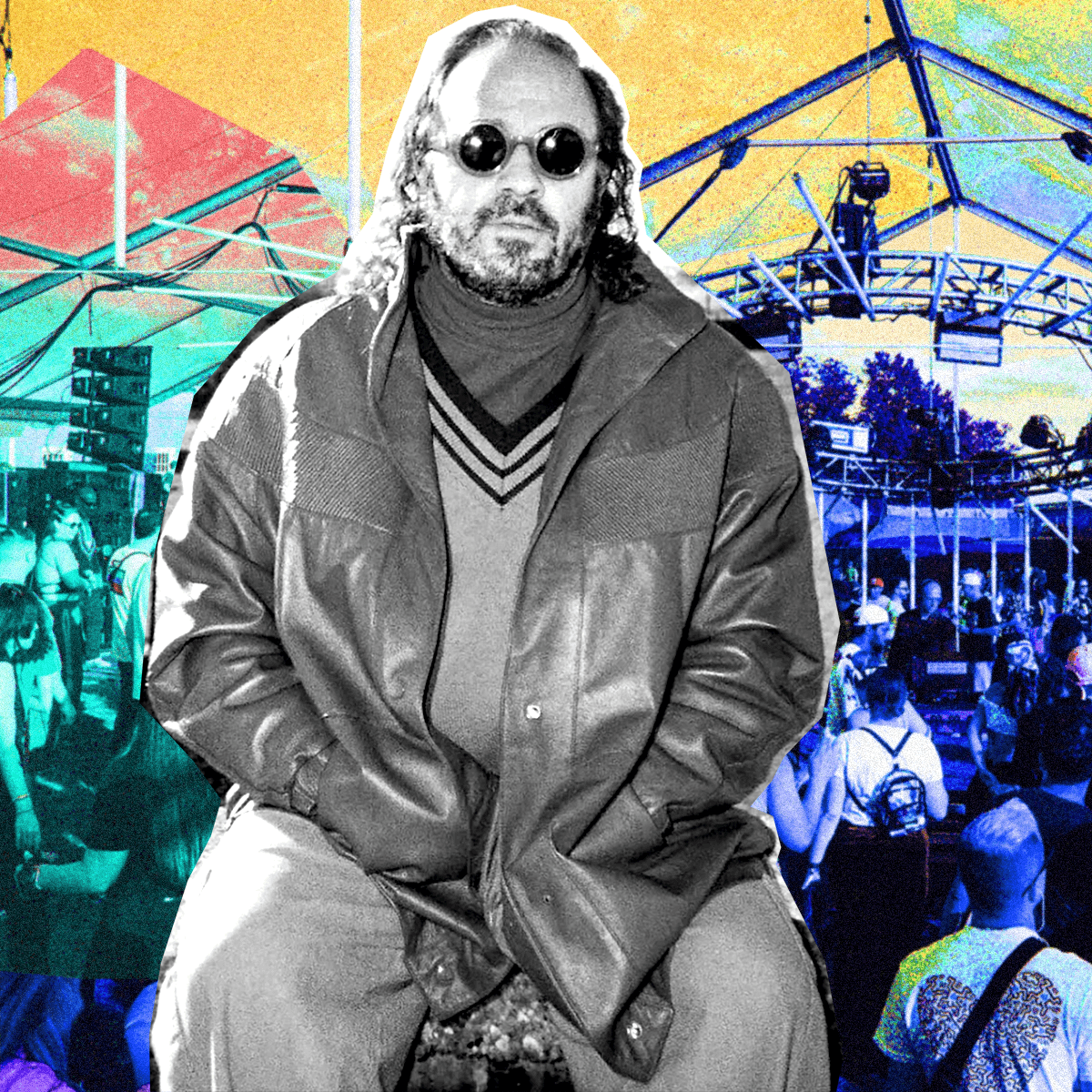
Art via Evan Solano
Pranav Trewn finds peace in his vinyl record collection.
Few groundbreaking cultural institutions survive more than two full decades intact. Back in 1999, Coachella broke through as a transgressive alternative to that year’s Woodstock revival – offering a home for artists like Spiritualized and DJ Shadow as opposed to Limp Bizkit and Korn. The festival would go on to enjoy an epoch-defining run setting the agenda of the modern music festival as a place where boundary-pushing iconoclasts like Bjork and Siouxsie and the Banshees were treated as the most important artists in the world. A place where influential musicians like the Pixies, Outkast, and LCD Soundsystem staged their grand returns to the world.
Flash forward, and the headliners for 2026’s iteration would be unrecognizable to the festival Coachella once was, presenting less the vanguard for contemporary music culture than an iHeartRadio showcase.
Meanwhile, Dave Pianka has weathered this tumultuous century in concert promotion and come out with his identity intact. It’s all part of his “transcendental plan”: the values by which he has oriented his own marquee three-day music festival Making Time ∞ (pronounced “Forever”).

Returning for its fifth year this weekend at Philadelphia’s revolutionary war memorial, Fort Mifflin, Making Time is keeping alive the countercultural spirit that has long since been compromised on by Coachella and Lollapalooza. It’s the only event this year where you’ll find a Laraaji-led meditation session sharing the same stage as the omnivorous viral party-starter ¥ØU$UK€ ¥UK1MAT$U, noisy amorphous rockers like YHWH Nailgun and Full Body 2 sequenced straight into precision-minded DJs like Nosedrip and Erol Alkan, or artists like Domenic "Nicky" Palermo from Nothing subverting expectations by performing shoegaze from a CDJ instead of a guitar.
It’s simply one of the most exciting collections of live music programming in the country, and it all starts with Dave P, who has been throwing multi-genre Making Time parties in the city for 25 years and counting. He is more than just the guy behind the scenes, but an ambassador for a culture few folks are still committed to cultivating at this scale.
During the hectic final days leading up to the festival, Dave P graciously made time to speak with me at length about his booking philosophy, the power of a cold call, and his definition of “transcendence.”
This is Making Times's 25th year. Walk me through the origins.
Dave P: I had graduated from Springfield College in ‘98, and just moved back to Philly. I was working at a coffee shop called the Last Drop on 13th and Pine, and while I was working there I was meeting lots of people that were DJs and in bands and doing all these creative projects.
I was also going to these DJ nights in Philly. There were three in particular – one called Sorted, which was a Britpop indie dance night, another one called the Turnaround that was more of a raw and mod soul night, and then there was another one called Rock & Roll Overdose that was like a glam punk rock DJ night. Going to those events inspired me, and gave me this idea to do a larger scale event, which had all three of these different parties under one roof on three different floors.
There was a publication called the City Paper that was kind of like our Village Voice in a way, and it had all the club listings. I went through all the larger clubs and I called all of them from the numbers in the City Paper. I got through to the owner of this club called Transit, and he offered me the night before Memorial Day, which traditionally in Philadelphia is like a weekend night where everybody would go to the beach.
So it was a really slow weekend in Philadelphia and he was just like, “If you can do something with this you can do the party.” And we did the party, and that first event was a huge success. There was over 700 people there, and it was great! But it wasn't really my intention to make this a consistent thing. We had the idea, thought it would be fun, somehow pulled it off, everybody was really happy, and I honestly didn't really even plan on doing it again. And then all the DJs were like, “Hey can we do this again?”
And I was like, “okay yeah, we can do it again.” And we did it again the night before July 4th. And then we did it again the Sunday before Labor Day. And then we did it again the night before Thanksgiving. We were doing all these nights before holidays, and it just kept getting bigger and bigger.
And then what really solidified the success of Making Time and put it on the trajectory that it’s on now – and also made me feel like this was something I was going to do with my life – was the one year anniversary in May 2001, when we had the Strokes play. That was this really special moment that just awakened me to the possibilities of what this could be. And that's when I started booking bands and international artists and it really got on the path to what it is now.
How did those parties eventually evolve into this three day festival?
Dave P: In 2010, we did a series of events throughout the summer to celebrate our ten year anniversary – “the 10 Year Anniversary Summer of Radness”. We had the Rapture play, we had Die Antwoord play, which was one of the most chaotic Making Times in history, but it was incredible. We actually had Liquid Liquid play, which was pretty amazing, but actually disappointing because no one really cared [laughs]. And it culminated with a finale at the Navy Yard in Philadelphia with LCD Soundsystem. It was a 5,000 person event and we did it in a naval cruise terminal in South Philly right on the water. I don’t know if you've ever been on a cruise, but you wait in these massive warehouses to board.
After that I saw the potential – we had produced this larger scale event and we pulled it off. There were obviously some minor issues – the biggest one that it was the end of September and wound up being 98 degrees that day, and the air conditioner in the navy cruise terminal wasn't powerful enough so it was so hot, it was brutal. Besides that it was very successful, and it planted the seed for doing these larger scale events. I started to explore the idea in 2012 of a multi-stage festival with AEG at the Navy Yard. The idea went pretty far down the line to the point where we were negotiating with the governing body of the Navy Yard to do this 25,000 person, two-day festival. And then in one of our final meetings, they asked us why we needed to have amplified sound?
So we quickly realized that we were not going to be able to do this event, and the dream died, and I kind of let it go for a while. Instead I was just doing all these parties all the time, and I never really had time to put together any type of concept for doing a larger event again. But then the 20 year anniversary was approaching in 2020, so I revisited the conversation with the Navy Yard, this time with Live Nation. We met with the Navy Yard and ended up securing dates for what was going to be the Making Time 20th Anniversary Festival. Again, two-days, 20-25,000 people a day. We were planning for it, sending offers and everything. But this was 2020.
Yep.
Dave P: So obviously that didn't happen. And it was really disappointing, but I thought that we would revisit the idea in 2021. I went back to the Navy Yard, but even though things were opening up at this time, they decided that they didn't feel comfortable doing a large-scale event like this in the wake, or in the midst, of COVID. Which honestly was better off for me because if I tried to do that event in September 2021, I probably would've had a really tough time and lost a lot of money.
But I was pretty determined to do something. I had the disappointment of 2013. I had the disappointment of 2020. And I was just like this has to happen. I need to do this. I started to think about other spaces where we could potentially do something like this on a larger scale. I then remembered a conversation that I had with a very close friend of mine Drew Scully in 2010, where he told me about a wedding that he went to at Fort Mifflin and that it was perfect for a larger scale outdoor event.

I dismissed it at the time because I was so fixated on the Navy Yard, and it's much smaller than the Navy Yard. I was fixated on this big festival idea, like “We wanna do this like the next Coachella” or whatever. But now I was open, and I called a number on the website this woman Beth answers. She tells me that this sounds great, let's try to do it. And I couldn't believe it. I was like, What? Excuse me? You actually think this is a good idea?
And she was like, “Yeah, this sounds cool.” She was the former director of Fort Mifflin – she moved on recently to another historical site in Bethlehem –and she was instrumental in making this happen, because she was so open-minded. I mean, I couldn’t believe they let me do this event at this revolutionary war fort. Everybody that talks to me is like, “How did you make this happen? How did you convince these people to do this?” And the fact of the matter is that I didn't have to do any convincing at all. I just asked.
It's funny, I think about the beginning of Making Time in 2000 when I went through the City Paper and was calling all these clubs and I got through to the guy and asked and he just goes “Here you can have this date.” 21 years later, I'm doing the same thing. I call Fort Mifflin and tell Beth this idea and the next thing you know, I have a date. Different scale, same thing.
I don't think it would be Making Time if it wasn't for the marketing around it. You describe it as a “transcendental” experience, and I would love to hear about what that word means to you and how you think it takes place in the context of the event.
Dave P: Music unto itself is just so powerful, it can bring about these spiritual experiences. But then when you combine it with this massive communal scale, and when you're experiencing these musical moments with this community in this magical space, it just becomes so powerful. It’s a really hard thing to explain to be honest, it's just something that happens. It's just like when you're on a dance floor and you hear the right song at the right time and you're with the right people and you just have this beautiful communal spiritual experience. And when you experience it, it's transcendent.

So what made you know that “transcendent” was something you wanted to make explicit in promoting the event?
Dave P: It's not even about trying to get people interested, it’s just I truly believe that these experiences are happening there. And I see them happening and I have them myself – there’s moments where I'm there and I'm looking at what's happening, and I’m hearing a certain track, and I'm seeing people being fully immersed in the experience. And I feel it – I feel that transcendent experience.
I strive to create a space where you have the music, you have the lighting, you have the people, you have the incredible magical environment, but then you also have the freedom. That's a big part of it, to give people as much freedom as possible in these situations. And that's where I think that all the combination of those things can lead to this transcendental experience, if that makes sense.
We put the DJ booths and even the live stages very low. The DJs are basically on the floor, and they're in the round. The highest stage that we have is two feet high. We strive to create these experiences where you're not just an attendee and you're not just a spectator. You're actually part of the experience. You're creating the experience, and you're just as important in creating that experience as the DJ or the band. Like everybody's fully immersed and everybody's fully part of the show.
Let's talk about curation, and how you put together the names on the lineup in terms of servicing that transcendental experience you're hoping to offer. Who's the team that's involved in making that happen?
Dave P: Oh, I'm the team [laughs]. I book the whole festival. That's the really fun part. I just have a list of like a hundred artists I want to have play. All of the booking for Making Time is based on things that I like. I don't book anything I don't like, and I never have.
I basically go through the list and start seeing who's available, and then based on the responses, the next phase of the booking process is where I start thinking about what the festival needs musically. What's missing? What kind of energy do we need in these different slots? Once I start having a better idea of where this is going, then I start to think specifically about certain times of day: Who's going to be the best person to have play at sunset? Who's gonna be the best person to close this stage on Saturday? Who's the best person to open the stage on Sunday? That's one of the things that I really enjoy doing with the booking, and I put as much energy into who's closing the main stage as to who's opening the smallest stage, because I think that the musical trajectory of the day is very important.
I always say that I book the festival like it's one of my DJ sets. I start off with all ambient music, no drums, playing maybe like 80 to 90 BPMs and then just slowly building from there to playing more like 120 BPMs. And then usually it ends with me playing 140-150 BPMs, and it gets pretty wild. So I think about the opening DJs for the festival, and that's where I'll have like Julien Dechery play. And then I think about who's next, and for instance this year, Gi Gi is really good at playing downtempo. And then it ends with SHERELLE playing the Majestic Stage. And in between, there's Chaos in the CBD playing in the afternoon and DJ Sunday. And I often talk to the artists about the direction that I'm thinking for their slot. And I mean, of course everybody has the freedom to play whatever they want, but I do talk about my vision for what I was thinking when I booked them.
I've read many tributes to you by the artists you've worked with over the years. What do you think it is about your philosophy as a promoter that makes Making Time such a special thing for performers themselves?
Dave P: One of the baselines is that this is supposed to be fun. I think people often forget that. I have this board with my transcendental plan, and the number one step is have fun. I’ve erased other things from the board, but I keep that there all the time.
I think people take electronic music so seriously sometimes. And of course it's an art and it should be taken seriously, but it's also supposed to be fun. I always try to remember that when I'm doing events. I do things in a way that's very flexible, I just let things take me to a certain place. I do have a plan – my “transcendental plan” – but I also am happy to change that plan and just follow the flow that something's going towards.
One of the narratives of this year's lineup is that there are noticeably more live acts than usual. Was that just the way things happened, or part of the transcendental plan?
Dave P: It’s funny because that goes back to the origins of Making Time. When I started the festival in 2021, I had a few live artists play, but it was mostly DJs. And over the years, if you look at the lineups, you'll see that gradually there's more and more live artists each year. The goal was to have a more even mix of live and DJs. That goes back to one of the founding principles of my booking process, which is musical diversity – having different types of artists play the same event.
For the most part, every Making Time party from 2000 to 2016 had a band. We had Interpol, LCD Soundsystem, Cut Copy, the Rapture. So many influential bands had played Making Time in that 16 year span. And then I don't know, bands wanted something different. From 2000 to 2016, bands wanted to play Making Time, because they wanted to play a party, they wanted to have fun. And then it seemed like things became more business oriented – everybody wanted to follow the trajectory of what everybody else was doing. They all wanted to sell out Mercury Lounge, and then sell out Bowery Ballroom, and then sell out Terminal Five or whatever that trajectory is. And I stopped booking bands because it just didn't feel right anymore.
But then when I started to do the festival, after the first year especially, I saw the potential to start bringing live bands back into the events. I always was hoping to have an opportunity to do that, because it was such an important component of Making Time.
It's funny because I think when people see it on paper, they're like, this doesn't make any sense. That's the fun part about doing the booking and the schedule, that you could throw Model/Actriz in the middle of two techno DJs and it's like, wow this is pretty sick. This actually makes a lot of sense. This year on Friday, it’s like VTSS, then Boy Harsher, then ¥ØU$UK€ ¥UK1MAT$U. That's going to be insane. It's just like boom, boom, boom. It's gonna be so cool, and I can't wait for people to experience that. It's so fun creating that trajectory – that's part of the transcendent experience is having the progression, of going along for this ride. I think that that trajectory really leads to that experience, and the energy is independent of what instruments are on stage necessarily.
Band have been selling their guitars for turntables and vice versa.
Dave P: Exactly. That's exactly it. It's a real cycle.
The current Nine Inch Nails tour…
Dave P: That’s a great example of it. I just went last week, it was incredible.
It's not just that the opening vs. headlining sets are different things, but they are switching it up mid-set, bringing on Boys Noize for remixes. And it makes sense!
Dave P: It’s cool to see those people who were into them in a different era see this evolution of what they're doing and be like, yeah that's cool too.
What they’re doing is so impressive and it's analogous to what's happening with Making Time and the idea that live and DJ – those things can work really well together if it's programmed properly. Obviously you can't just throw any band with any DJ, but if you program it right, it really can work.

Beyond just the bookings and the location, there's all this additional non-musical programming, from meditation sessions to sound baths. How did you determine what to dedicate the space to outside of the music?
Dave P: We used to do these events that had multiple rooms, and they were all party rooms – everything was a DJ, with one room being techno, another being house, you know all different genres. But it was always party music, you know? It was always super intense and focused on dancing, and I realized that, “Why am I just having these rooms where there's only the option for high energy experiences?”
Sometimes you just need to chill. If you're constantly hearing a DJ play 140 BPMs for six hours, after a while you just become immune to it. You're never going to reach that elevated experience after a certain point. Getting yourself out resets your palette and allows you to really take the experience to the next level. So I started to incorporate these chill out rooms where we had ambient music playing, and once I started that, we then always dedicated one group space within the club to having ambient DJs or live performances.
When we started Making Time Forever at Fort Mifflin, I saw this potential to create these alternative spaces within the festival where people could have that reset. And I really saw the importance of having those alternative experiences within the context of the larger event so that it leads to a greater appreciation of the other things that are happening. I’m really excited about the Laraaji Laughter Meditation this year. I think that's going to just be so cool, and a beautiful way to start the day. I mean, it's mentally, emotionally, even physically just going to prepare people for the experience that awaits for the next three days.
Going back to your earlier question, I think it's really important to have these alternative experiences just like it's important to have live bands. The combination of all those things is what makes you really appreciate the whole event more.
It’s also something that makes the artist and their appearance at this festival something different than their usual set-up they bring to every other festival. You can see a lot of artists play at the “T-Mobile Stage” or whatever branded platform, a model that's copy-and-pasted around the country. But you’re booking them in this space and to host sets that they might not have the license to do in other places.
Dave P: I love talking to artists about the idea of doing alternative sets. Last year we had Optimo do the hardcore set, and 2manydjs do the Belgian New Beat set. This year, like with having Nabihah Iqbal do a jazz set, we were in the Catskills hanging out, having dinner, and I just talked about how much I love her NTS show. And she was like, “I've always wanted to do a jazz set.” I was like, “Let's do it!” I think that's so important, and one of the things that makes the festival so special, is that people are able to have these totally unique experiences that you're not going to have anywhere else.

The landscape for live music in some ways has been more lucrative in terms of demand, and then in other ways has been more challenging with the increased cost of production. Lots of vendors are going out of business, booking fees are higher, the infrastructure for touring acts has just shifted so dramatically. For Making Time ∞, what has allowed you to continue to excel in your programming and navigate your vision in spite of the economic environment?
Dave P: The simplest answer is I just really believe in it. I'm very persistent, and stubborn. But it's a struggle, I'm not gonna lie. The first three years of the festival we lost a very significant amount of money. But I was persistent because I believed in what we're doing and I think it's important to the dance music community, and just the music community and the music industry more broadly. I think it's important to have these independent festivals and events in a world where there's not many of them anymore.
But it's really hard. I paid the debts of past festivals by DJing and doing events throughout the year. The model is that I can't just do a festival – the DJing I do throughout the year goes back into supporting this event. Last year was the first year we actually were able to make money, and that was great, and that money went into paying off past debt. So that’s where we're at, but we’re making it work. And I believe that we can continue to do this. But we're still learning how to make it work too.
When I lost money on the first festival, I remember being frustrated. Like I've been doing this for 21 years – why isn't this just working? What I realized is that this isn't a continuation of what I've been doing for those 21 years. This is a whole new thing that I had only done for one year. All the experience I had is contributing to this, and enables me to do it at the level that I'm doing it, but this is a whole new thing and there's new things that I need to learn while I'm doing it.
I'm not going to paint a rosy picture. It's very difficult, and especially this year's tough too. Everything's getting more expensive. But one thing that enables us to continue is that we are really scrappy. We're a really small team that does a lot of work and it's kind of the only way it can work. This year we are scaling up a lot, and there's a lot of challenges to that and we're still facing those challenges. We keep things very lean, and we're able to make it work because that's how we offset all these insane rising costs of everything. There's no “if you have a role, you're doing only that role” – you're also doing about 10 other things too.
That's what makes it a vision, right? Like as much as it is a business, what I’m trying to realize is greater than just getting a return. There is already plenty of business in the music industry.