

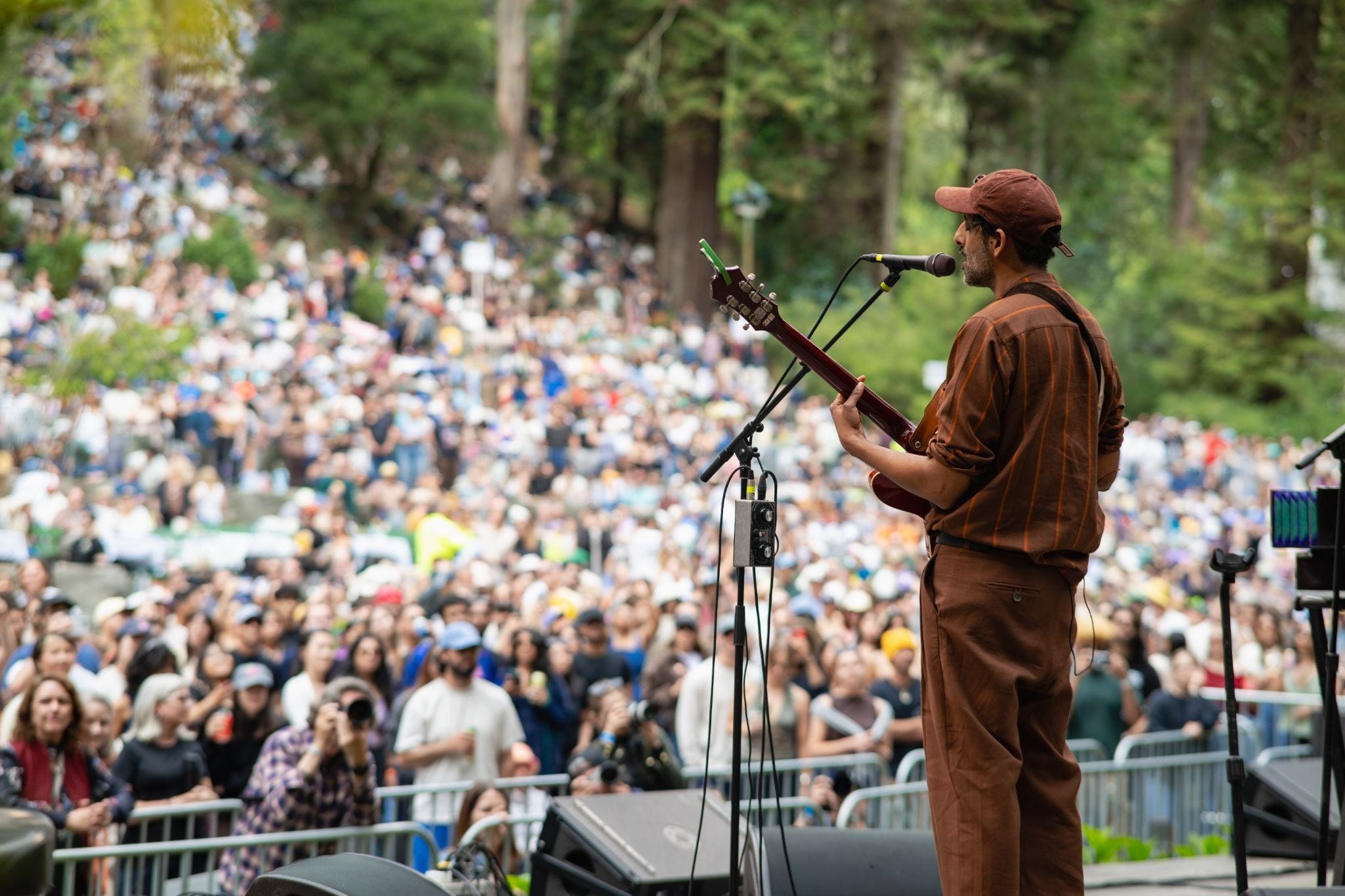
The first time I saw Peter Cat Recording Co. perform was at India Cocktail Week in 2023, a tented convention of liquor vendors hosted outside of New Delhi’s Dhyan Chand National Stadium. The band, which specializes in textually rich, baroque rock-and-roll, came across joyous and lush even within a setting where music served primarily to motivate sales for flavored vodka cans.
So it was no surprise that the group sounded even better surrounded amongst the eucalyptus trees of San Francisco’s Sigmund Stern Grove Park, a 33-acre forested playground for pups and daytime strollers that so happens to hold a massive outdoor amphitheater. This is where the annual Stern Grove Festival takes place—the longest running free music festival in the country, and a beloved tradition the city wholeheartedly embraces every Sunday for nine weeks from June through August.
The programming for the series has always been strong, and has become increasingly eclectic and expansive in its 89th year, with a lineup that spans not only Delhi’s finest, but indie starlets Japanese Breakfast and Suki Waterhouse, tropical party starters Bomba Estéreo and Major Lazer, and then a double-header closing weekend with indefatigable legends Public Enemy and Al Green.
There are a number of reasons Stern Grove is a rare bright spot for live music in 2026—how it’s remained free for nearly nine decades and counting in an industry gouging its customers more blatantly than ever, the easy embrace of diversity and inclusion in a country that’s turned every stage into a colosseum for the culture wars—yet I find the setting to be among its most vital qualities. The wood paneled botanical backdrop and the dozen-tiered platforms optimized for both picnic blankets and sight lines form a dreamscape for audiences. With the strength of its brand and focus on accessibility, Stern Grove is also able to promise its performers a massive turnout—as they did with Peter Cat, who performed in front of their largest crowd to date of over 11,000 people.
The result is a combinatorial audience of grateful diehards singing every word, curious listeners open to discovery, and families and friend groups receptive to any sounds as an excuse to frolic amongst the trees. It’s a warm environment both literally and emotionally, and it means the artists you catch are likely to deliver an experience that surpasses that of an alternative outlet—whether a weekend music festival with its aggressive influence of branding and social media activations, or an impersonal and anonymous arena show where the price of admission can sour even a strong performance.
“I think of it that you’re brewing this pot of elements together that create something really special and magical, especially for the artists,” Stern Grove’s Director of Programming Stacy Horne told me in the days leading up to this year’s festival. “The Commodores played a few years ago, and they were just blown away by their experience. For many years they primarily played fairs, festivals, casinos—and to put them in the Stern Grove setting where it’s like ‘We’re here to really celebrate your music over the decades’, it makes for a magical stage for special things to happen.”
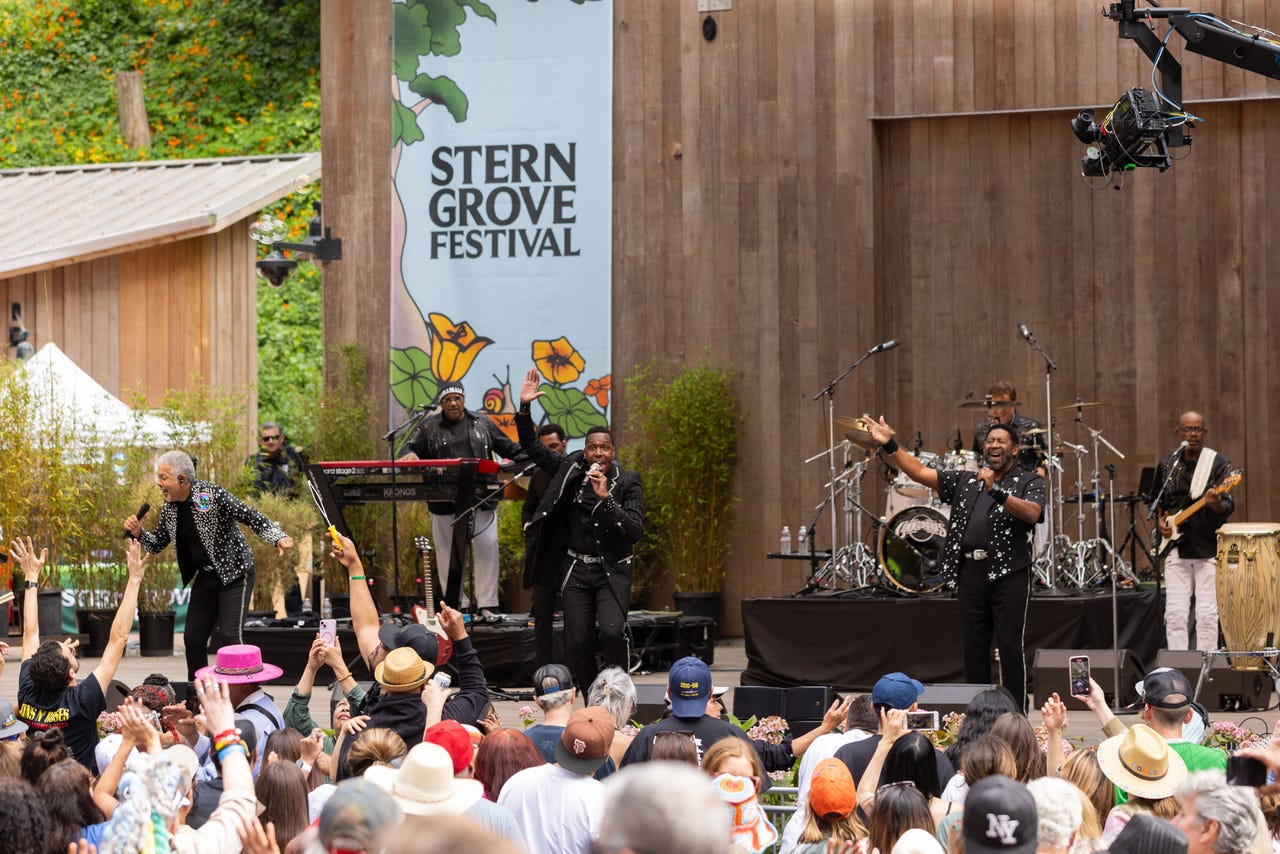
That vision for how Stern Grove can enhance the default live music transaction guides Horne’s approach to programming. “We have this luxury as a free event that is supported through donations,” Horne explained. “So while we of course want to book amazing artists that people want to come out for, at the same time we get to push the boundaries a little and host artists that maybe wouldn’t sell 10,000 tickets, but will certainly bring out a crowd of 10,000.”
Stern Grove is thus the only place in the country this year you could hear Peter Cat hits like “Memory Box” and “People Never Change” activate a minor league baseball stadium’s worth of bodies to collective euphoria, or Bomba Estéreo transport a meaningful chunk of the city to Columbia for an afternoon. It’s this experiential range that falls under Stern Grove’s expansive identity that draws fans back again and again throughout the summer, knowing that no two days in the park will feel the same.
“We try to have almost every show be a different genre, representing a different demographic, bringing out all different kinds of people, so that there’s something for everybody,” Horne said. “And on top of that we’re always wanting to stay focused on the Bay Area as much as possible.”
So while Peter Cat flew around the world just for Stern Grove, the festival also hosted the Marin County-based psychedelic Latin songwriter Marinero to open for the band—a dynamic juxtaposition that showed how similar the craft of two musicians separated by a 16-hour flight can be. Over half of the programming this summer comes from local artists, including Vallejo phenom LaRussell, the beloved church choir the GLIDE Ensemble, and the eclectic duo and Boots Riley collaborators Tune-Yards.
This local focus extends to Stern Grove’s philosophy on accessibility. The festival caused a stir when during the pandemic to better monitor entry they switched over from first come first serve queuing for the shows to an in-advance lottery. That meant dedicated fans could no longer guarantee they’d get into a show if they woke up early enough. Horne hears the grumbles, but in her mind it was a necessary step towards “making everything as fair and equitable as possible.”
The lottery ended up resulting in a number of simultaneous improvements, from more accurate attendance forecasts to facilitating stronger safety measures. It also leads to a more diverse audience, rather than simply a more privileged one able to easily line-up on a Thursday during working hours. “We really put so much time and focus and energy on being accessible, and have really proactive communications with seniors and people who need special accommodations,” Horne beamed. “We can’t fit everyone that wants to come to the show, so we try to do what we can to make sure that everyone has an experience at least once over the summer.”
As a Bay Area resident, Stern Grove serves an especially valuable function in an industry in which Live Nation has hollowed out many of the city’s local landmarks, from the Fillmore to the Masonic. Yet although they have managed to remain faithful to their founder Rosalie Meyer Stern’s original gift of the park and programming in 1931, Stern Grove is not immune to the competitive pressures of this moment. “A lot of arts funding has dried up over the years,” Horne lamented. “Stern Grove used to be funded much more by grants, and now that’s shifted more towards corporate sponsorship.”
“We don’t take it for granted. I mean things can always change, and we wouldn’t have the same budgets,” Horne sighed. Yet she is optimistic in the face of the dismal economic environment, primarily due to the festival’s strong relationship with the public. “As we’re leveling up, I would say the audience is leveling up with us. They are understanding that a free show isn’t free to produce,” Horne continued. “We are seeing more and more of those on-site donations – $10, $20 – where in the past maybe people saw that since it’s a free show they didn’t need to contribute. I think we’re doing a lot better on educating the audience about the importance of their contribution, and as we’ve become more popular we’re increasingly attractive to corporate sponsors and can deliver a good return on their investment to be part of the festival.”
Beyond simply driving more economic activity, this personal connection is what has furthered Stern Grove’s local impact—a focus of San Francisco’s arts policies that I’ve discussed in previous editions of the column. This means not just continuing to refine their programming in the park, but expanding their mission to bringing free shows to other pockets of San Francisco. For the first time this year, Stern Grove programmed performances at the airport prior to festival days (called Terminal Sessions), with fans willing to trek on the AirTrain to catch Peter Cat and Bomba Estéreo rock Gate B4 last month.
Stern Grove is not operating in a silo in filling every nook and cranny of the city with sound. Horne also works on San Francisco’s annual “Music Week”, where she is “so blown away by all the new energy there seems to consistently be, people who are indie promoters or creating new parties and nightlife opportunities.” From reenergized veteran institutions like Noise Pop to upstarts like program audio taking over a former Fotomat kiosk, these groups are all cultivating a reciprocal exchange between the audience and the promoter, cementing a longitudinal relationship with fans who see the value and are willing to invest in helping the community grow.
As fan backlash against insatiable artists and promoters grows increasingly hostile, that level of trust is going to be an ever more impactful competitive advantage. Even with deep-pocketed companies like OpenAI, Bloomberg, and Levi’s attached as sponsors this year, Stern Grove’s homegrown roots and consistent focus on the audience experience has encouraged folks to contribute to funding this idyllic vision for live music. A future without the current pains of ticketing and touring seems to be still a long way off, so it’s reassuring to have a vision you can believe in thriving in your backyard.