


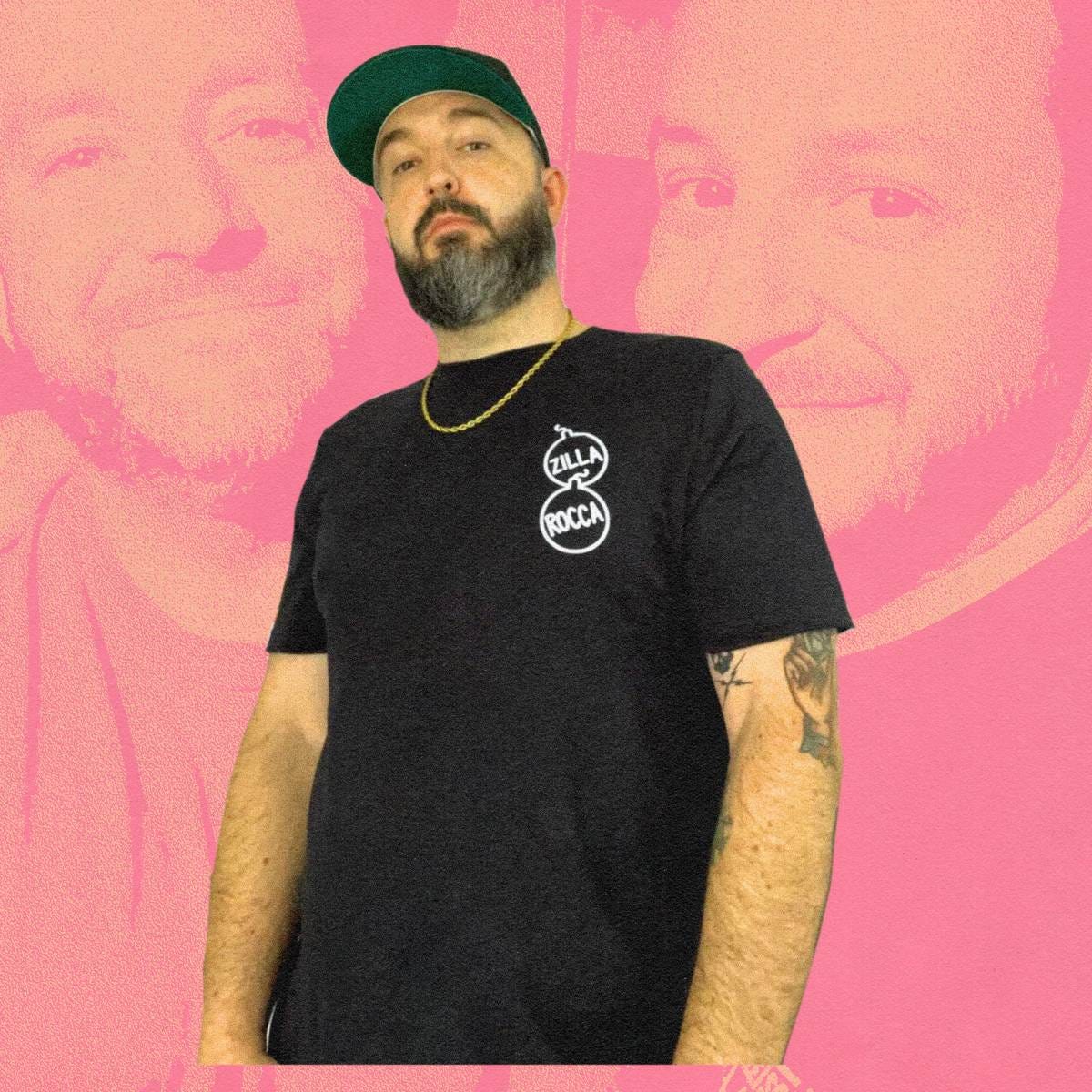
Art by Evan Solano
The fact that someone is always watching SORCERER on Letterboxd gives Will Schube faith in humanity.
Instead of watching Bravo shows or doomscrolling on Twitter in the crevices of time between their day jobs, Philly rapper Zilla Rocca and producer Disco Vietnam are instead making some of the best indie rap records of the last 10 years. Their latest, FAST EDDIE, follows in this tradition of art for passion’s sake–one's life’s work versus their livelihood.
“I don't like money having anything to do with my music,” Disco Vietnam says. The Long Island native has been releasing music for a while, but this true hero of modernity keeps his list of collaborators tight. Aside from his House Rabbi Series, the only artist he regularly works with is Zilla. The beatmaker served as an executive producer on Zilla’s excellent 2021 record Vegas Vic.
For DV, the process is the reward. “You have to live life to be an artist. If all you do all day is be an artist, I’m not entirely sure I can relate to you and I’m not entirely sure you can relate to me,” he explains. For him, the beats on FAST EDDIE came from real life: from taking the train, from grinding through the day. “Art’s gotta come out of that real life. It can’t always be escapism. I’m old enough now that I don’t need that.”
The two have been close friends and collaborators since linking up on the POW Forums in the mid-2000s, which led to a handful of one-off collaborations, and eventually, Disco Vietnam served as an executive producer on Zilla’s excellent 2021 record Vegas Vic.
Both artists had aspirations of pursuing music professionally, but eventually came to the same realization: money is messy. Case in point, Zilla’s been a staple of Philly’s underground rap scene since 2008, but sometime in the mid 2010s, he stopped rapping full time. I think it’s the best decision he’s ever made. It’s allowed him to thrive without pressure, to rap because it’s what he’s best at, not what he has to do to make money.
Zilla just wants to be rap’s equivalent of Travis Fryman. For people unfamiliar with ’90s baseball, Fryman was an extremely solid third baseman. He was a five-time All-Star, won a Gold Glove and a Silver Slugger award. When he was on your team, there was one less thing to worry about. “He could hit third, he could hit sixth, no headaches. It’s solid,” Zilla says. Another reference point for Z? “I just wanna make a great 3.5 mic album in The Source.”
For Disco Vietnam, the stakes are similar: “I don’t put out enough music to not put my best foot forward. I always want 12 bangers. I want an album that people say is really good. I want an album that I’ll be proud of 10 years from now and not wince.”
For the latest installment of Above the Influence we spoke with Zilla Rocca and Disco Vietnam about the work that inspires them, and the magic of being able to rap for fun.
You and Zilla have known each other forever. When did this project really get off the ground?
Barry Schwartz: I executive produced Vegas Vic, which came out a few Zilla albums ago. That was three or four years ago. I had about four or five beats on there and my brother mixed that album. But there were also beats from Small Pro, Doc Heller, and The Expert.
Me and Zilla have a great workflow, and my brother and I work really well together, too. Zilla and I have known each other since Jeff introduced us way back when on an old message board, “The What.” We just became friends. He lives in Philly. I'd seen him a few times and we just started texting more and more and we found that we share the same philosophy about music and what we consider good.
Can you extrapolate on that philosophy a little bit?
Barry Schwartz: A lot of our conversations at the time were about wanting to make something really dynamic. We didn’t want a song to have three verses just 'cause. If you can get in and out and move on to the next thing, that’s what people want. That’s what makes rap really unique. You can have a minute long song and have that be enough. We’ve always been talking about making a record that sounds good. One of our philosophies is the idea that ‘sounding like shit’ is not an aesthetic. We wanted to put our best foot forward and make sure that this was a record that sounded great. I put a lot of effort into my music and Zilla puts a lot of effort into his writing. We just want to be able to make sure that what we put out we’ll like 10 years from now.
Are the beats on the album new, ones you’ve had for a while, or a combination?
Barry Schwartz: Eight or so of the beats on this record have appeared on my beat tapes, the House Rabbi Series, but the rest I made just for Zilla. I must have made like 10 the night before he came up to visit me because I was so excited that he was coming. I wanted us to have a lot of music to go through. The thing about Zilla is that when I first started making beats again back in like 2017, when I finished one, I'd send it to him. He would tell me if it was good or bad. That was enough for me. Some of the beats on this album are things I sent him years and years ago, that I didn’t even remember that I sent.
After Vegas Vic, we started talking about making another record together. I just wanted to do a sequel to Vegas Vic. I wanted the same guys doing production ’cause it was really well received and I was really happy with it. But Zilla wanted me to produce the whole thing. That’s a different responsibility. You’re very exposed, you’re very vulnerable, and one beat’s gonna be better than the other. You’re gonna be able to rank them all. One of them is the worst. I embraced it and I knew that having Kenny [Schwartz] on the mix would go a long way because when you send a beat out, maybe you’ll get to hear the final version before it gets put out. Maybe you'll be happy with it. I don’t get paid to do this. I’m not charging anybody for it. All I want is to be happy with it. It was worth it to me to fly down to Texas to visit my brother and sit next to him while we mixed the whole record. Once we were both happy with it, we sent it to Zilla and had his notes. From there, we just had minor edits to make.
Did you and Zilla record together at your spot?
Barry Schwartz: We didn’t record here, but we did a lot of writing here and picked a lot of the beats here. One thing I’m really happy about with this record is how many of the songs we were together for. Every song with andrew on it was me, Zilla, and andrew. I drove down to Philly and we had a session where we did four or five songs. The songs that we did with PremRock. I was at Steel Tip Dove’s studio in Brooklyn and it was the four of us having a great time. That was the whole point of doing this in the first place: to be with people and make things. I’ve never wanted to be a part of an email record or work on something where people I don’t even know are hitting me up. We end up getting in huge fights before anything is even started because it’s like, ‘I don't know you. I don’t know if I want you to rap on this beat.’ Having a guy like Zilla, a friend, someone I trust, that allows me to put my best foot forward because he respects that and wants to do the same.
Having a full-time job and doing this for fun…Are you making beats all the time? Do you have a routine?
Barry Schwartz: I probably shouldn't say this, but it's been a minute since I've made a beat. I've been very focused on this record. I also play guitar and I've been writing songs with my brother again and we've been recording those songs. It’s weird if someone were to hear this record and be like, ‘I want to get beats from Disco Vietnam,’ because I don't have any that you haven’t heard yet.
Let’s talk about some records that inspired the album.
Barry Schwartz: A strange one that comes to mind is Diamond District, with Oddisee and yU and them. I knew Oddisee through the Low Budget crew in DC, via Peter Rosenberg. Oddisee knows me and I know Oddisee. If I saw him on the street, he’d be like, ‘What up, Barry?’ That feels good. But he has a beat on that album called “Hologram,” and that beat really inspired me.
The way it’s structured, the way he pulls sounds in and out…It’s a full listening experience. Even if you took the raps out, it’s an interesting beat that develops musically. That’s always been a North Star. Make a beat like “Hologram” and you’re in good shape.
Do you have a favorite Oddisee solo record?
Barry Schwartz: The Beauty in All. I remember reaching out to him and telling him I thought it was his best work. I also always liked when he would put out EPs or instrumental tapes. When I was living in Hawaii, I would listen to his beat tapes as they were coming out. He’s a unique individual, very smart guy. He’s very talented. He has his own lane and I really respect him.
What made his beat tapes uniquely suited to the Hawaiian aloha lifestyle?
Barry Schwartz: They were very colorful. That’s another thing about this album that I’m really proud of: the color. The choices that I’ve made musically and the beats that Zilla chose have a lot of color. You can see them. My friends and I like to make fun of beige music. I don’t have like synesthesia or anything, but when you listen to a Kings of Leon record, you know it’s beige. You can hear the beige. I wanted a vibrant album. The sources that I use are fully orchestrated in a lot of ways. I don’t like to add a lot of instrumentation. I make sure to find a really colorful sample that’s worth listening to over and over and over.
What makes Zilla such a good collaborator?
Barry Schwartz: His sense of humor. He’s also a guy who knows who he is and is very comfortable with who he is. Rap is a young man’s game, but it’s very interesting seeing all these guys grow up, become fathers and husbands and homeowners, but still have a passion for it. If they’re willing to spend the time on it, what they have to say is very valuable, ’cause they’ve lived life. As you get older, you should just get better. Music is very youth-oriented, but I don't think that means that old heads don't have anything to say. I’ve always respected Zilla as a person. He’s been an influential person in my life. He was the guy who told me to marry my best friend.
He was the guy who said, ‘Okay, you date her for a year, then you move in with each other. You live with each other for a year, then you get engaged.’ I followed that rubric and I’m about to move into my house with my wife. Zilla was a hundred percent right. He’s a trustworthy guy. He’s upfront about things. He’s not funny style. Um. He has confidence in his raps. There’s a whole crew of people around Zilla — PremRock, andrew, Curly Castro, even woods. They have a relationship and I think Zilla fits right in. He is just as talented as any of those guys. You can plug him in with all those guys and they have chemistry. That was another thing about doing a record with Zilla. I know that I’ve got some guest appearances I’m confident in. Defcee, Reef the Lost Cauze, andrew, PremRock…we’re in really good shape.
Any other records that helped inspire the sound of Fast Eddie?
Barry Schwartz: Zilla mentioned Free at Last, the second Freeway album. He says that album is Philly as fuck. I'm not from Philly, but I do love Freeway and I do love the second Freeway album. There’s a song on there called “Nothing on Me” that I think is pretty great.
But I’ve been so locked into my own chamber that it's hard to think about specific records. Zilla and I have known each other for 15 years and so much music has come out in that time. We’ve had so much to say about all of it. You can’t really point to a specific thing. It all just got funneled in.
I’m influenced by True Master. I think he’s the best. When you think of Wu-Tang, you associate the sound with the RZA, but the sound of it is actually a True Master beat. The aesthetic, the quality, the sonority, what you’re imagining is actually a True Master beat. He’s someone I’ve looked up to. Madlib, of course, is his own thing. I love Pete Rock. I think he hasn't made his best beat yet. He's got a real musical mind, so there's no reason to believe that he can't keep doing it.
Kev Brown is somebody who's inspired me since I was a kid. He was probably the first guy I ever saw make a beat on a machine. I don't make beats on machines, but I could see how he played it as an instrument. That guy could be a bassist. He should be a bassist. He probably can play bass, but he does it on the MPC and it's incredible the way he goes about it. He opened my eyes to the musical talent required to be a really good producer. Rap isn’t different from any other genre. You need some talent.
How do you make your beats?
Barry Schwartz: I do all my beats in Acid Music. It’s a primitive digital workstation and I’m just really patient. I’m willing to copy and paste forever. I’m willing to move things around. I’m willing to make the magnifying glass as small as possible to make changes. It always starts with listening to something, even something I've never heard. There’s a beat on this album that’s based on a song I’ve been listening to since I was born.
Which one?
Barry Schwartz: I can’t say, ’cause it’ll get popped by AI, but it's a really famous song by a really famous guy that I've been listening to forever. But no one's ever thought to just take this one thing and turn it into a beat. I was like, ‘I'm the guy. I love it. I've earned it. I've been listening to this song for 40 years.’ That song became “Bourbon Generals Theme Pt. 3” with Zilla and PremRock. That’s a real banger.
Which other producers do you like?
Barry Schwartz: Conductor Williams. I think that guy is a top 10 all-time producer already. It's pretty remarkable how good his beat is compared to everyone else on whatever project he’s on. He always has the best one. He’s still figuring out how to do a whole album, but anytime he’s on a Westside Gunn record, a Mach-Hommy record, or a Rome Streetz record, he’s got the best beat. They have a unique quality. They've got the thing that makes a rap beat, a rap beat where it makes your head do the thing. He's got that and that's a unique thing. I don't know if I have that, but he's got it.
What do you think is the difference between being able to cook up one tremendous beat versus being able to carry that through an entire album?
Barry Schwartz: There is no difference. If you make a banging beat, you want it to have like 11 cousins, you know? The philosophy when we started this album was all bangers. Zilla sent me a version of “Fifties and Hundreds” with Defcee and Reef the Lost Cauze. It was one of my beats and it was fine. It was good, but the beat wasn’t a banger. The rhymes were great, but we needed to find a better home for it. He re-recorded the song on another beat I sent. I was like, ‘I don't know man. Let's see if we can get a better one.’ I sent him a beat from like five tapes ago that he’d never heard. He was like, ‘This is incredible.’ That’s the beat on the record. You have to have that patience to say ‘Hold on, is this the best we can do?’
Are you a perfectionist?
Barry Schwartz: No, but I don't put out enough music to not put my best foot forward. I always want 12 bangers. I want an album that people say is really good. I want an album that I’ll be proud of 10 years from now and not wince. Like, ‘Why did I put the drum there?’ I don't want any of that. I've been doing this a long time and there's music I put out that I don't wanna listen to ’cause I can hear the thing that I would change. I try to avoid that now. With Zilla, if we get to the end and we’re both happy, we’ve made a good album.
https://youtu.be/L4O1pxfiAd0?si=3ZBWr2yn41eAzyen
Does this inspire you to work with any other artists?
Barry Schwartz: It’s Zilla and Method Man. That’s it. I’ll work with those two guys. Even since we put out the record, people have been hitting me up, like, ‘Can I lease your beats?’ What the hell is that? It feels like taking money from people. I don't like money having anything to do with my music. I think it just fucks it up. I was friendly with Ka and that was always the thing that I admired about him. He was totally uncompromised because he was allowed to make his own music how he wanted to, and there was no gatekeeper. There was no one in the way. It was just direct to consumer from his brain, because he had a job that he was happy with that made him enough money to live his life.
I think that's better than what people are doing where they sacrifice their entire life and dedicate their life to their music. My brother did that and it worked out for him, but for most people it does not work out, especially in this genre. Ka made me realize, ‘Hey, maybe the best rapper in the world is right over there in the cubicle next to you.’ Maybe he just can't be doing it right now. He has a wife and kids, but he has that advantage of no one to say no. There’s no one to correct it. There's no one to change it or influence it in a way that has nothing to do with the creativity of the person who's putting it out.
When money comes in, everything changes.
Barry Schwartz: If someone's like, ‘Hey, I’ll give you $500 to make me a beat,’ that just changes how I feel. When I start the process, I have to make one person happy. I have to deliver a return on investment. That's not my process. That's not how I like going about it. Any time there's been money involved, it’s just not fun anymore.
It’s just much healthier to pursue art without the monetary aspects tied to it, though not everyone is fortunate enough to be in that circumstance, of course.
Barry Schwartz: Also, you have to live life to be an artist. If all you do all day is be an artist, I'm not entirely sure I can relate to you and I'm not entirely sure you can relate to me. I just got off the train. I was on the train for an hour and then I got in my car and I drove home from the train station. Art's gotta come out of that real life. It can't always be escapism. I'm old enough now that I don't need that. I'll watch the Lord of the Rings if I wanna escape.
Do you have any other records that inspired Fast Eddie?
Barry Schwartz: So much of it is based on the randomness of listening to a whole lot of music, hearing a thing that triggers a feeling and starts the creative process. However long I'm inspired, whatever comes out of that is the beat. You'll stop working on something and say, ‘Alright, I'm gonna go back to that.’ You never do, you start something new. I had to get to a place where I was like, all right, whatever came out of this moment in time is the thing that I did. I don't get to go back and fix it. I'd rather move on to the next thing. That's how you make a lot of beats.
This whole process of making beats started because I wanted to write a book. I was like, ‘Well, I don't have the discipline to write a book.’ You have to write a book every day. Have I ever just sat down and been creative every day? No. I decided I was gonna make a beat every day. I'll erase that beat if I don't like it. Never be precious about it. Just keep moving, keep working at it. There was no time when I was like, ‘This is officially a beat I'm working on.’ It could come at any time. It’s a healthier way to approach it.
Barry said a lot of his beats span many, many years. Is that similar with your raps, or were these written with Fast Eddie in mind?
Zilla Rocca: Did you play baseball?
Yeah.
Zilla Rocca: Okay, when someone like Greg Maddux was pitching, he was always trying to steal outs. He won, like, 18 Gold Gloves because he was like, I can get two or three easy outs of balls back to the mound. When I’m doing records, we’re all excited, everyone’s pumped up. You knock out the first three, four songs, you’re all juiced up. You're trying to impress the producer and engineers, whoever, and then you hit a lull. Then you come back, you make a couple more, and then by the time you hit 10 songs, you're like, I need to get some easy wins, some easy outs. That’s when I start going through my notebooks and voice memos, and I’ll find stuff that I wrote down, stuff I started and didn't finish or something I put on a beat before a project changed.
With every record I'll find stuff that has just been forgotten. On this record, “Circus” was an older song that’s about a breakup. I just forgot about it. When I heard that beat, I was like, Man, this beat's sad. The verse is old, but the chorus was recorded in the moment. What goes in between the chorus? I had the bread, what’s the meat? “Seen A Lot” features old verses too. All your verses find the right beat and every beat finds its rightful rapper. Some of the Barry beats were seven years old, eight years old, but “Fifties and Hundreds” was brand new. We did that like four months ago. Other beats I have had from him since 2015. You’re always collating and compiling shit to be like, this rap needs a home. You have all the bricks in your hand. Then you build a house. If I just have a drawing of a house and no bricks, well, then, shit.
It's a lot of organization too.
Zilla Rocca: Yeah, but when I did the mixtape Easy Street to promote the record, I just came up with the idea and I was like, Yeah, I'm gonna do it in a month.
I had one month and I gave myself a deadline. Everyone I hit up was down to do the verses quickly and they were pumped. Everything about that was fast because there was no pressure of the album. We just put cool beats on and reacted to them. With mixtapes, you can hear when people have fun because they’re not trying to build everything from the bottom up. It's like, Oh, I could just hop on this. It was a great way to lean into the album, which is more conceptual and personal and fun.
What’s the difference between Three Dollar Pistol and Wrecking Crew?
Zilla Rocca: When I recently did a show with Small Pro, AJ Suede booked us as Career Crooks, but Small Pro’s not on this album. PremRock is on the album twice, [Curly] Castro’s on the record. We all have the same sensibilities, but we all have a different strain of what we’re into.
When ShrapKnel put out their three records this year, the ohbliv record they did and the Raphy album that I'm on, those are records that I would pick a lot of the beats from on my own. With the Mike Ladd record, half of it I would never pick, and the other half I’m like, Damn, I wish I was on half this record.
With Fast Eddie, the songs we made with Prem were made on the spot, in the room, nothing pre-written. All of us were there at Steel Tip Dove’s spot. When we made those, they weren’t intended to be on the record, we were all just hanging out. Again, they found a home.
When we do Wrecking Crew deliberately, like when we did Sedale Threat a couple years back and we had the song with Bruiser Wolf and Thirstin Howl, it was like, Yo, we’re doing it. We’re all gonna combine resources. We’re gonna hit up producers we like. ShrapKnel, when they do their thing, that's a Prem and Castro connection. Sometimes I’ll be on those records or I’ll come to the show or I’ll be on the bill. Or not. But we’re all just comfortable guys, so there’s no, Why didn't you get me? Like, what the hell? When you’re 25, like that's a real problem. There’s a scarcity mindset of like, If I don't get this, I'm not shit.
Making cash off your records is amazing, but it must be a relief in some ways that you’re not relying on albums sales for rent money.
Zilla Rocca: It makes a huge difference. On the label side, Three Dollar Pistol was just my home base when I first went solo in 2010. During COVID, I was like, Okay, what if I put out other people? I only put out people I like or trust because you start putting out artists, you deal with their problems. You hear about their girlfriends, their boyfriends, their job, their health, whatever. I got enough problems. I put out a record from Prem and a Small Pro and Castro record on wax. I’m happy to work with my friends and put things out on my label. Even new friends, new artists, like Milc and Rich Jones, I put out their records. Even as we're talking, the homie Marcus Pinn is sending me demos for his follow up instrumental record.
I like dealing with people like that and building those relationships, seeing how it works from a label side and an artist side. When we’re doing Wrecking Crew, it’s like we’re all artists. Once in a while, someone will take the lead and be like, Alright, I think we should do this, or we should go here, or we should press this up, or we should pick these beats.
Sometimes it’s Castro, sometimes it’s Prem, sometimes it’s me. Sometimes it’s Small Pro. But again, if you don’t fuck with each other or you’re very petty and jealous, or you’re just younger, it’s very different. I did it. It was a nightmare. It’s a headache. I took a long time off, and now I’ve figured out how to navigate it. Like, Barry and I partnered on this record. We’ve known each other since 2007 or some shit. That relationship’s in place. If I was hiring him to produce for me as a label, it would be a very different set of circumstances because it would just be commerce. It would be really weird.
Is there gonna be a Fast Eddie followup in 25 years like The Color of Money?
Zilla Rocca: That’s pretty funny, but even on this record, we took so long to make it that a lot has changed since I first wrote some of it; even from 2023 or whatever. I don’t know what’ll happen next, but if we do it’ll be as old men.
I wanna talk about influences that went into this record, but you had a Greg Maddux reference pretty early on. If this record’s an athlete, who is it?
Zilla Rocca: No one’s ever asked me something like that, so I gotta think. Let’s stick with baseball. I envision a perennial, .280 hitter, you know what I mean? .280, 28 home runs, 95 to 102 RBIs. You know what you're getting.
Placido Polanco or someone like that?
Zilla Rocca: Naw, he didn’t hit home runs like that. It would have been someone like Travis Fryman. A very solid third baseman. Troy Glaus, Nolan Arenado. You look over there and you’re like, We’re set. That’s gonna be alright. We’re okay with that.
It’s a player you never have to worry about.
Zilla Rocca: With the record, there’s enough diversity of sound, but it’s also one thing. If you’re a South Philly person, you see the artwork and you get it instinctively. If you’re not, maybe you had an older aunt or a grandparent and you’re like, This looks familiar. It feels lived in. Even a guy like Travis Fryman, he was never an MVP, but third base was always locked in. He could hit third, he could hit sixth, no headaches. It’s solid. I just wanna make a great 3.5 mic album in The Source. If you say five mics, people are like, What? That's fucking crazy. Time goes on, you go back, You're like, That's not a five. If it’s a three-and-a-half, I’m rocking it. It’s in the rotation. As the years go by, you discover new things about the record. Now it’s a four. I’m just Travis Fryman, bro. .280. I’m set.
Barry mentioned you took some inspiration from Freeway’s Free At Last.
Zilla Rocca: No one talks about that record. When you find it, You’re like, Oh shit. It doesn’t have “Roc The Mic” with Beans [Beanie Sigel] and it doesn’t have “What We Do is Wrong,” which is an anthem. But when you play it, You’re like, Oh god damn, this is good. Free At Last was something I came to more recently, but it reminds me of an album like O.C.’s Jewelz. There are pockets of that record that I’m not sure I like, but any time I make a mix, there are three others I put on no matter what. Some of the feedback I've gotten from people were about stretches in the middle they liked, or “Circus,” which people have been hitting me the most about. That’s fascinating, ’cause I was like, I don't know if anyone's gonna like this. There are all these bangers and then there’s a real serious breakup record.
Even at the end, there’s “Tire Swing,” which is about my uncle who passed away. It has this Just Blaze-type of big beat, but the verse is really sad at the end of the record. O.C. was always good at that. He would have really serious joints. He would have party banger joints and then he would have sad, introspective records. Jewelz is kind of like that to me. When you bring it up around certain people, they’ll be like, Oh shit. You know ball. I’m never far from that record. It’s always in the background somewhere.
That came out on Payday. Do you have any other favorite Payday releases?
Zilla Rocca: I think they did the first Jeru the Damaja record. Westside Gunn did that single with Premier that was randomly on Payday, like three or four years ago. The one where they flipped the Rick Ross sample. I would love to be on Payday. Fuck it, man. It’s a great logo. I still have the O.C. cassette.
Can I ask a hard question? You got a favorite DJ Premier beat right now?
Zilla Rocca: He didn't do the record, but I go back to that Christina Aguilera shit, bro. He had to do like A parts and B parts and C parts of beats. He had to update what he was doing for a pop star. When that came out, I burned a CD for my girlfriend at the time and I just put all his songs on it and threw the rest of that shit out. That’s kinda a cheat answer, but I don’t wanna go with the standards.
It’s either that or Gang Starr, and my favorite Gang Starr record depends on the day. Right now it’s probably Hard to Earn. The answer is Hard to Earn or Christina Aguilera. Group Home’s the obvious answer because they’re the most rappable beats ever. I just said this to Small Pro the other day, I was like, Yo, if we do another Career Crooks record, I want it to be jiggy DJ Premier beats he would give Roc-A-Fella and Biggie. Like, when he does jiggy shit, that’s my favorite Premier. I like the experimental, weird ’93 to ’95 Premier, but then ’97 to 2000 Premier jiggy shit…People were playing them in their cars. Everywhere I was going, people were saying those records out loud. It was the glossy Premier.
Any other records that inspired Fast Eddie?
Zilla Rocca: Paul McCartney’s Ram. Once you get tapped into that shit, you just always play it. It’s not obvious compared to Sgt. Pepper’s or “Imagine,” or even the George Harrison shit, like All Things Must Pass. You hear “My Sweet Lord.” I don't hear a lot of songs from Ram when I’m out, not even as much as I've heard like other Wings songs.
Yeah, you don’t hear “Monkberry Moon Delight” a lot.
Zilla Rocca: I was recently listening to our NPR station when I was cooking and they played the original. I never knew it was a cover! That record, “Uncle Albert,” “In The Heart of the Country,” it’s something I even referenced on my POW Records album 10 years ago, Future Former Rapper. I rap, “I’m only good at math when I’m counting money/ Beard like McCartney in the heart of the country.”
I connect with the McCartney record because I try to make hooks that are memorable and rhyme things that stick with you. I wish I was a billy woods type where people just like write my fucking lyrics all day and love it and have accounts dedicated to me. That would be really cool. I love lyrics. I'm a lyrics person. But where me and Barry connect is that the melody and the warmth is first. If that’s not there, then what are we doing? Even “Fifties and Hundreds” is a raw, Method Man Tical-type beat. But that’s the only beat really like that. We don't have a lot of unorthodox joints, but it stands out ’cause it’s like, Oh shit. But with “Prism,” he sent me that, and I was like, I wanna cry listening to this beat. It’s so nice and warm and welcoming, but kind of sad and wistful.
You mentioned Tical. Right now, what’s your favorite Wu-Tang solo album?
Zilla Rocca: Ironman’s my favorite album in music history, but Ghost just pisses me off so much. I’m just so annoyed. Supreme Clientele 2 was just a bag grab. Right now, though, the older I've been getting, the more I’m into my Cuban Linx era again. Cuban Linx was the cool, go-to “you weren't outside, you weren't selling drugs like I was” album. I was around when Cuban Linx hit and there was a fervor around it.
People would be arguing at school between Ghost and Rae. Now that all the time has passed, Rae just remains so steady. I also think it’s like the best produced album ever.