


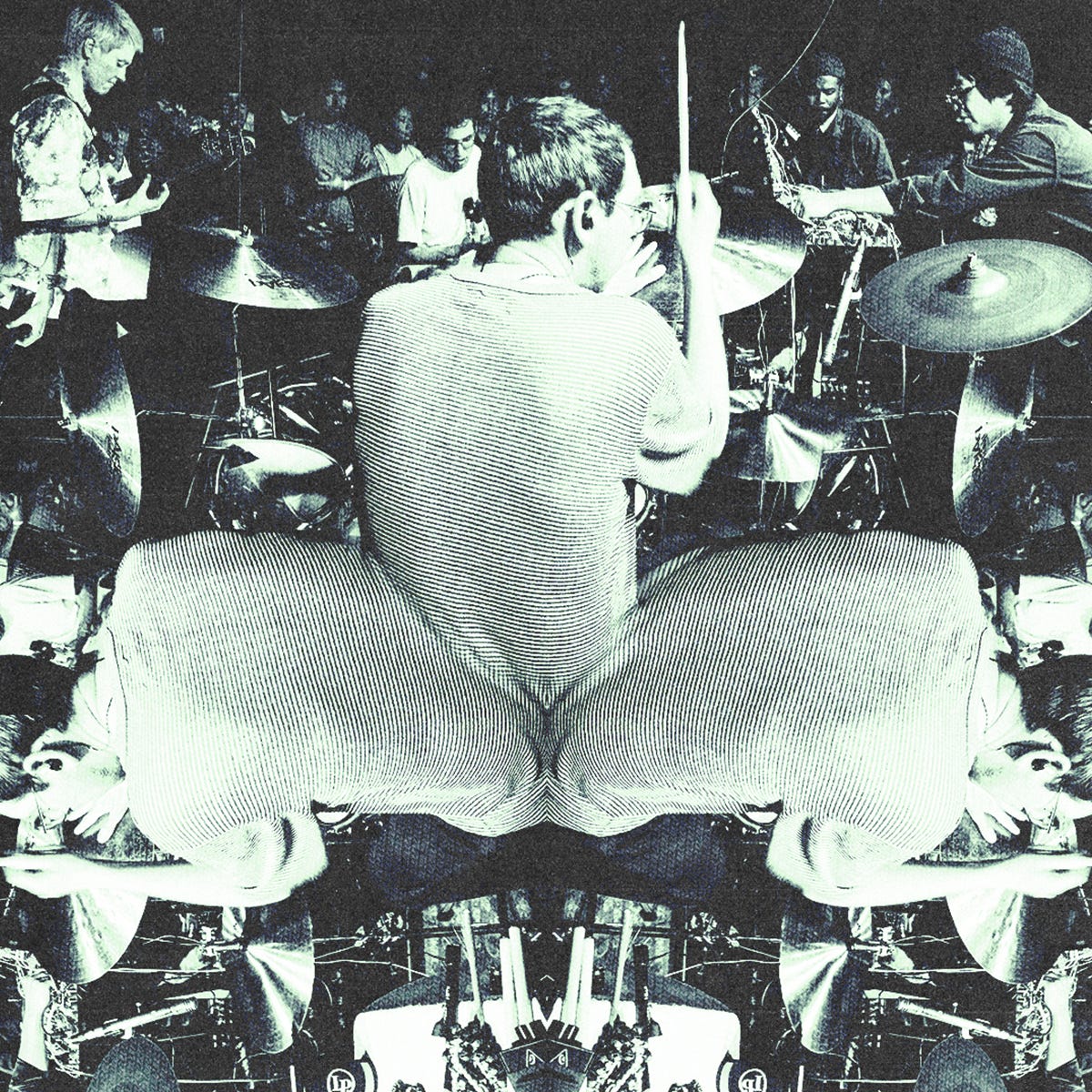
I walked into Zebulon and gently shouldered myself into the large “O” encircling a group of musicians. It was July 2024, and the semi-nascent quintet SML was performing to commemorate the release of their debut album, Small Medium Large. I hadn’t heard of them and had no idea what to expect, but I grew mesmerized by their fluidity. A pall covered the crowd, a collective laser focus. When a song, jam, offering—whatever you want to call it—finished, a hush would hover as eyes fluttered open, lips broke to reveal soft smiles, and warm mmms of satisfaction peppered the air.
Put reductively, the band consists of guitarist Gregory Uhlmann, saxophonist Joshua Johnson, drummer Booker Stardrum, bassist Anna Butterss, and synthesist Jeremiah Chiu. In reality, every member is constantly flirting with the perceived limits of their instrument, bending time and sound via pedals and unexpected syncopations. Whatever you think a specific instrument does, SML challenges the notion. They operate with a precise, hard-earned kind of whimsy.
In the time since that Zebulon show and debut album, the group has toured the world, held a successful Big Ears residency, and released two more albums: 2025’s How You Been and Spontaneous Music Live, which came out on June 26. All their albums have been released by International Anthem, the Los Angeles by-way-of Chicago label responsible for giving a home to radical, progressive sounds from the likes of Jeff Parker, Carlos Niño, jamie branch, Makaya McCraven, and many more.
Spontaneous Music Live differs greatly from their previous albums in that it is, as its name suggests, two recorded live sets presented as-is. Their other records were, conversely, a collection of highly-produced songs using live elements as the source material to manipulate. The musicians were essentially flexing twice on those works, taking something they’d done in the past and reworking it through their unique lens once again. Both of those albums were highly praised, with much of the acclaim coming from the live material they had to work with. Which is why people are likely champing at the bit for this new album that preserves some of that SML secret sauce.
I say likely, but I know it is true. I went to their show on June 27, the second night they were playing to commemorate the release of Spontaneous and to celebrate the 21st birthday of the beloved audio journal Aquarium Drunkard. The records were sold out before the show was over.
People wanted to hold on to the sorcery they just experienced. It was interesting to see SML perform almost exactly two years later, again in a circle in the middle of the audience—only this time elevated above the crowd. It reminded me of a pentagram, on some cult kind of tip. I say that with reverence. Things happen inside that circle that feel unnatural, other-worldly. A pentagram is appropriate for their presence: a five-pointed star drawn from a single, continuous line.
SML live is the embodiment of an entity being greater than the sum of its parts; as a group, their caliber upshifts into exponential overload. I was impressed by the economy of movement for the sheer amount of sound being produced; Johnson, Uhlmann, Butterss, and Chiu move with a refined delicacy. But their sonic subtleties pack a wallop. About halfway though the set, a combination of crowd-like and nature sounds began looping. Butters made a face that conveyed peculiar interest and stopped playing their bass, listening to the sounds over a rolling beat from Stardrum. Something sparked and Butterss got off their stool and headed to the synth bass to tinkle across those keys. They started smiling, bopping their head. I looked across the stage, Chiu started smiling, too. His head bowed seriously over his gear, but a dimple peeked through as the group skated from those cyclical, lilting sounds into something hard, edgy, and propulsive. Suddenly I felt like I was at a concert for The Prodigy, head-banging to an inventive intro to “Smack My Bitch Up.” The group has range. They’re artists crafting sonic sculptures in realtime.
I talked to Chiu, Butterss, and Stardrum on a Google Meet about ten days before the release of Spontaneous Music Live. Chiu was in Los Angeles, Stardrum was at home in Kingston, NY about to give a lesson, and Butterss was in Brussels to play a show with Jason Isbell. We talked about the origins of the group, the magic and terror of improvised music, the shaping of their sound, the role of the audience, and how SML names their goods.
This interview has been edited for length and clarity.
I guess the first question I want to ask is: do you guys spend time together or are you actually only in person on stage?
Jeremiah: We spend time together.
Anna: We’re friends.
Jeremiah: Friends scattered. Everyone is in so many different projects and traveling all the time, that we spend different amounts of time with different partitions of the group.
I had dinner with Josh the other night, and it was great. But I had this one thought, hilariously, which was, “The more we tour, the more we’re spending time together. But if we have an opportunity, we might be on vacation together before we’re a band together.”
Wow.
Anna: Do it. I’m down.
That’s great to hear. You’re all very busy with wildly different projects. I thought it was maybe a strategy to keep the improvisation pure. As if you have to keep re-meeting each other on stage and find your footing. Do you have a way of talking about the formation of SML or did it just kind of happen?
Anna: It was because those first two ETA shows [Uhlmann’s in 2022] where the band kind of formed. But, neither of them were all five of us playing together. Night one was Jeremiah, Josh, and Greg. Then night two was me, Booker, Greg, and Jeremiah.
Right after that, I think Scotty [Scott McNiece, International Anthem label co-founder] came in, and we all started talking about it together. So it’s definitely a collective. We have different roles in terms of organizational things for sure, but, musically and creatively, it’s a collective.
Jeremiah: For sure. I almost think of ETA IVtet, Ryan [Julio, ETA’s booker] and Bryce [Gonzales, ETA’s recording engineer] are kinda collectively the foundation for a lot of this stuff. People like Ryan who are tapped into different musicians in town and give people opportunities to do what they want—that’s a pretty special environment and it nurtures a community like this.
So we’re all sort of operating around a space Ryan created. And then, the other big part of it is, none of this would’ve probably made it beyond those doors unless Bryce had recorded all of it. So I think there’s just this combination of all these things that feel truly like nobody was intending for it to do anything beyond facilitate a place for the community.

It feels like ETA is kind of having this longer swan song of everyone lamenting its loss as a venue. I feel like it’s getting more shine now, publicly, than it did before. I ran into one of their old bartenders recently and we were having this kind of sad, eulogy-esque conversation about what that space was and what it represented.
Jeremiah mentioned the ETA IVtet, which Anna and Josh are part of. Do you see the sound of SML as forged in the sound of ETA and the teachings of Jeff Parker—who has also been in contact with many of you in different entities.
Anna: I don’t actually know if I would say SML, the sound and conception of it, is deeply rooted in ETA. I think it wouldn’t exist without ETA for sure, but we played four shows there. I think ETA brought us together and that community and physical space, but the music has mostly been made outside of that space. So it’s transitioned pretty quickly into new spaces. And I also think that, while, while we’ve all been extremely influenced by Jeff and that whole Chicago scene and the music around Tortoise and the Chicago Underground, we’ve been trying to do something that doesn’t sound derivative or come completely derivative of that.
And, you know, I think we’re a new band and we’re still building our sound in a lot of ways. But, in that building, we’re definitely looking forward.
Jeremiah: Yeah, that feels accurate. For me in terms of less the sound, but more the ethos of what Anna’s describing. There’s this spirit of Chicago groups that are just ‘looking for new.’ I feel like that happens to us the more we play. I understand how we play as individuals better every time we play together, and then it allows me more freedom to come and try to throw something else into the mix and see how people respond.
I think everyone probably does that to a certain extent. I don’t think that’s always the case in groups. This sort of unspoken trust that anyone can bring something into the mix that’s unexpected. People will respond in a positive way versus the opposite. Booker, does that feel true for you?
Booker: Yeah. I was just having a sort of loving feeling towards the larger music community. You know, we’re sort of talking about it.
You [Nereya] were asking these kind of leading questions about where we fall within the context of the scene at ETA. I see it as a little bit bigger than that. I mean, maybe that’s my perspective because I lived in LA for several years, but I’m coming in as someone who doesn’t live there anymore.
The nature of us coming together is something that feels very organic, and it feels very much like a product of sort of the larger experience of being in a pretty expansive music community. We all have so many friends and collaborators and people all over. It’s a really large community of people doing things together, and the nature of being an improvising musician is sometimes you just get put together with people. Anna and I met at the first show that we played. Now we’re touring the world with each other.
I’m feeling sentimental that we, like, shook hands and then just started jamming. And it was fun and we got lucky that our good friend Scotty was in the audience and was like, “Let’s do this.”
There was kind of a happy accident that we were sort of nurtured into being something together. But it really is the way that musicians—especially improvising musicians—gather.
Sometimes we’re just kind of put together, sometimes we’re introduced, and then a few years go by and you’re best friends with these people and you’re making music with them all the time. It’s actually just a really beautiful process.
Jeremiah: You know, that term “improvised music”is oftentimes in a jazz context, and I definitely didn’t come to it from that place. Booker and I knew each other prior and we were playing more experimental music. Improvisation in that space is very different than in a jazz-oriented context. I don’t have those skills the same way.
So there’s some level of healthy discomfort that I still have every time we’re playing together. I won’t speak for anyone else, but I really like it. It puts me on edge to basically be like, “Is what I’m doing cool?” I have to bring a level of presence and focus. I have to really be in there to hang because everyone in the group is such a heavy hitter.
It feels fun for me to continue to do that. It’s not easy every time. The moments that sort of express ease are always when we’re listening back and I remember that, in that moment, I felt like, “This is a ride that I’m hanging on for dear life.”
I saw you guys in summer 2024 at Zebulon. It was amazing and, as a viewer not at all steeped in the language of improvisation and the adaptability it requires, it does seem quite effortless. It feels like you’re listening to a fluency in a language.
Are there certain roles that you find that you guys do play? Is there someone who really consistently takes you out further? Someone who always brings people back home?
Booker: I feel like we all have our moments of bringing it home and of being the disruptor. Like, Jeremiah, for maybe 70% of our sets I would say, is sort of setting some kind of backbone and pacing because he’s setting up rhythmic sequences on his modular setup. Then we’re all kind of jumping in and live arranging around that sequence.
I feel like Jeremiah might be some kind of backbone. But then there’re a few times in a set where we’re locked into something, and it’s Jeremiah who disrupts the rhythm of it or starts sampling us and passing our sounds around.
I think we all have our moments like that. Jeremiah, Greg, and Josh are all doing a lot of electronics, so it’s often hard to pick out who’s doing what. It obviously doesn’t matter at all, but we don’t know what’s going on. I mean, the bass and the drums are a little bit simpler to parse out—we have our roles, we kinda hold it down playing grooves and stuff. But also, not only that.
I think it’s a pretty dynamic kind of experience. I don’t know. Does anyone else wanna elaborate on that?
Anna: I agree with that. To go back on what Jeremiah was saying a little earlier, I think because it is an environment that can feel really intimidating: just jumping in and trying to create something really good and having to accept that it might not always be good.
For me, I find there are spaces—zones, rhythms, melodies, harmonics—that feel a little more comfortable for each of us. It can be really easy to unintentionally settle into those. I think something that we’re all aligned on is that we want to disrupt the idea of there being a set role. I think it can be really easy to say, “You play the drums, you usually do this type of thing.” But I think we have a constant process of creating discomfort for ourselves so that the music can go forward.
But it’s hard to do because…well…beacuse it’s uncomfortable! It’s nice to be able to play a show where you can just relax and everything feels good, but I think that’s kind of anti-SML in a way.
Jeremiah: I’m seeing this idea of discomfort as actually creating opportunities for intuition and trust, right? You’re sort of forced to respond, but also be hyper present. I think that that feels fresh. To Booker’s point, it’s why I’ll do things like sample the drums or the sax or et cetera. It starts to be a little disorienting because you’re like, “I thought that Josh was the only person that can make the saxophone sound, and now this is coming a different way.”
Then, vice versa, Greg and Anna have also brought some synth into the mix, too. There’s an assumption that because I have the modular on stage, a lot of the synthetic sounds are coming from me, but they’re absolutely not. They’re coming from everybody in a wide variety of ways.
Booker: A phrase that came to my mind where I feel like we’re fluent with discomfort. I think the five of us are OK with a little unknown and maybe we’re quite good at handling the emotions that surround that feeling. I think we’re both uncomfortable and comfortable at the same time.
With this new album, what prompted the decision to just release it as the sets and not go through the editing process of your previous albums?
Jeremiah: I don’t know if we’ve talked about it yet fully. We’re sitting on a ton of recordings right now. We’ve gotten into this really nice place where we played more shows in the last year or so than we had in those first two records combined.
So there’s just many more sets of material to mine from. I think we’re also currently working through how to continue to create new approaches to album-making. This felt like a moment where we talked about doing the opposite of what we’ve just done in editing from live. Instead we found a couple nuggets that expand that narrative a little bit more.
Anna: It also puts the studio records in context for people. People are pretty familiar with how we make records. We’ve talked about it a lot, and it’s been, the whole formation of the band. But most people who are into our records have not had a chance to come see us live. I don’t know if this was something we were specifically thinking about when we had the idea to do it, but I really like that it contextualizes what we do, how the records are made, and it’s kind of pulling back the curtain a little bit. It expands the SML universe, I think.
Providing the raw material. It’s interesting for you guys as you’re “touring a record” [air quotes], right? Because you’re always working on whatever will be the new record while you’re touring. The majority of musical acts are playing something they made in the past over and over. But anyone who’s at one of your shows doesn’t know if that’s gonna be the source material for the next record, which is exciting as an audience. You never know if Jeremiah’s gonna sample someone’s conversation as they were walking in, you know?
Jeremiah: Yeah, watch out.
I know.
Jeremiah: I think Makaya McCraven was at the show you were at and he was like, “You gotta yell. You know, if they’re recording it, that’s how you get yourself on a record.”
That show was my first introduction to you guys. After that show, I went and listened to, Small Medium Large, it was the only album out at that time, I think.
Booker: Yeah. Because that show you went to actually, two tracks from How You Been are from that run at Zebulon.
OK. Yeah. Well after I listened, I thought I should’ve laughed an obnoxious laugh. You know in a comedy show that one person’s laugh gets in there somewhere.
Anna: You’re on the record in spirit.
Thank you for that, Anna.
Jeremiah: For the record, I’m not the one recording that stuff often. It’s Bryce. It’s the front of house.
Oh! That extends into what you were saying before of how multiple individuals helped forge SML as a band.
Jeremiah: Yeah, for sure. I mean, those Bryce recordings are special because he’s captured a live performance that sounds like a studio recording.
I’m always wondering how he made this thing sound so good, so well-mixed, and so usable?! It doesn’t come out of the gate as being a live recording or a live record. We can actually work with that source material to edit from, and I think that that’s quite amazing, too.
I love a title that explains the plot. Spontaneous. Music. Live. Great. That’s what you’re getting. How, how do you guys usually go through the naming process for your works?
Anna: We have a hard time naming things. We have to suggest a lot of very bad names before we get to a good one.
With this one specifically, how did “The Drums” and “Roundabout” get named?
Anna: “The Drums” was a reference to this Keith Jarrett record that me and Booker really love called “Fort Yawuh,” a live record. They play a song called “De Drums.” It has this great bass solo thing on it. And because Booker…well…The story behind that track was that Booker has Jeremiah in his ears. So Jeremiah started a sequence and Booker started playing along to what he was hearing in his ears, but Jeremiah didn’t have anything coming through the house yet. So Booker thought he was playing with Jeremiah, and actually he was just playing drums by himself.
When he found out, he wasn’t thrilled. We all thought it was great.
Booker: It was the last time we played together, and it was the first song on the first night. I come in so hot. My partner was like, “Wow, like you really just took a drum solo right up front.” I was like, “What do you mean?” Jeremiah kind of tricked me on that one. I’ve forgiven him. It’s totally cool.
For “Roundabouts,” we were listening to the tracks and trying to come up with names and that track has this circular feeling. We’ve got all these repeating patterns happening. In my head, I was thinking “circles” and “round.” Kingston, the town I live in, has two prominent roundabouts and, actually you guys don’t know this, I have a good friend who has a gallery here called “Roundabouts Now.” I like that name and it came into my head, I proposed it, and people were into it.
Anna: Mm-hmm.
Booker: I can’t remember who came up with Spontaneous Music Live. I think that’s Jeremiah.
Anna: Yeah. Jeremiah. At least he texted it to me and I was like, “Yes.”
Jeremiah: The SML letters.
Booker: Oh!
You didn’t put that together?
Anna: No, no, he’s joking. He’s joking.
Booker: I’m not joking. I don’t think I’ve put that together.
Anna: Booker. What?
Booker: Listen, you guys like to play lots of word games.
Anna: That’s true.
Booker: I’m just, you know, I’m just a dumb drummer over here. No, I really didn’t put that together. That’s so funny.
Anna: I…have to leave. Not just because of this, but I have to go play a show.
Booker: Where are you? The Netherlands?
Anna: Brussels.
Booker: OK. I saw you drinking that Spa seltzer with the nice effervescence. Have a good show.
[Anna leaves]
Are there differences in a quintet versus other formations? Advantages or more challenges? Especially for improvisation?
Jeremiah: Travel is more challenging with the quintet. Playing…well, I’ve played in slightly bigger or smaller groups. The smaller the group, the more you feel like you have to be doing.
I don’t know if you feel that way, Booker, but I think it’s quite nice in this group that there’s some level of like, I can just…for example, the Salt Room show, where it almost felt like we partitioned into two groups–
Booker: Hmm ...
Jeremiah: —in the middle of the set. It was Greg, Anna, and Booker just going, and they’re in their own zone. It allowed me to just look at Josh and we started to work something out to disrupt them and rattle something new into that fold. That was quite cool. I don’t know if we’ve done exactly the same thing, but it became a strategy in the moment. We were like, “Oh yeah, we don’t always have to be playing. We can kind of actually start to work something, prepare, and then go in there.” So it’s a trio and a duo. Booker, what do you think?
Booker: Oh, yeah. Totally. I think we could probably make better use of that strategy, We could do it more, breaking off into little sectionals. We’re a band that operates with a lot of controlled density. There’s a lot of layered sounds and ideas and we’re always sort of playing with that. Layering things on top of each other and rhythmic cycles that are interacting with each other in maybe odd ways.
There’s so much to be done as a quintet with all five people playing at the same time. With that said, being in a larger group does relieve people of the necessity to be playing all the time and having some moments of space. Josh does a great job of playing and not playing. He’s a very patient musician. He’ll wait till the right moment, and then he’ll blast off. That dynamic moment is so clutch. Where as I’m very… [laughs]
Are you the impulsive one?
Booker: I like to push things around. I love sitting on an idea for a long time and letting it develop really slowly.
I had an experience recently where I saw a duo play and—to Jeremiah’s point—I could tell that at every moment they had this feeling like they had to make something happen. I kept thinking, “You don’t actually have to make something happen right now. The music’s already happening. The instrumentation’s beautiful. The sound of the space is great. Let us just feast on the minimalism.”
I can take that, too. I’m gonna wash myself in that idea.
Booker, I know you need to go so I’m going to ask two questions and you can choose which one. First: You said before that it felt like the formation of SML was the broader music community fusing together opportunities. Do you have a similar feeling now of where the community wants to take the future of jazz/improvisational music? Second: People often describe you guys as avant-garde, and I’m wondering what that means to you.
Booker: I don’t know if I have a thought out, smart answer for where I think any music is going. I don’t know where jazz is going or improvised music. I can kind of see where it is, but we’ll just have to see where it goes.
One thing I’ve been reflecting on recently while watching the [NBA 2026] playoffs. I was thinking about how special it is to gather with my friends and know there’s a couple other million people watching the same thing at any given point.
Jeremiah: Mm-hmm.
Booker: You spoke about the idea of how normally a band puts out a record, and then they tour on that record that already came out—it’s been done for a year and a half. By the time the music comes out, at least in my experience, I might be sick of it. I don’t want to make that music anymore. I want to move on. There’s something very special for me in SML that we’re always just creating something new. The next record’s always being made.
We’re not really ever looking back very. Watching the playoffs, I was thinking about how special it is to watch something unfold that’s truly live. We have no idea where this thing is going. I mean, I’m a Knicks fan, and watching them come back from being behind by 30 points or something and you’re like, “What the fuck? How is it possible that this is happening?!”
So I’m not gonna talk about the music, I’m gonna talk about the audience. I think with the rise of A.I. and music that feels quite canned and homogenous…very live music has the potential and the power to touch people in a special way. There’s so much predictability in a lot of art. I think it’s quite special to be an audience member and watch something unfold in real time and have little to no expectations about where something’s gonna go.
Jeremiah: Mm-hmm.
Booker: So I don’t know where the music is going, but I feel very grateful that I’m making improvised and spontaneous music. Because there’s something very real there that touches people and touches on something that people desire.
Your audience behavior also kind of speaks to that. At your guys’ shows, there’s such a reverent hush. Sometimes we’re not sure if the song’s over, but most often we’re just taking it in, still processing, and appreciating. Not to say it’s transactional to applaud for someone,, but there isn’t the same feeling of, “This happened, now I clap.” Everyone is very much in the place of letting the gravity of what was watched sit for a second instead, and then cheering as well. They’re heavier pauses.
Jeremiah: A lot of why we always push for playing in the round is because the audience is a part of that experience. We want to create the intimacy where it becomes a shared experience together versus a more transactional state, there’s less of a barrier between the two things. I remember you [Booker] seeing New York post-Knicks win and you were like, “Oh man, this is what the city could be like all the time.” Which is: joyous, positivity flourishing. There is some level of us trying to create those experiences at a micro level in these small venues with these immediate communities to flourish in the same way.
It takes a bit of courage to go and do the thing that’s improvised. Maybe that’s the avant perspective. We know we’re capable of writing a song and performing it perfectly time and time again. What’s more unknown and may result in something even more impactful or special is forging into that space together and having the trust that the audience is there with us. They’re part of that whole story.
Booker: Wow. You bridged the two questions beautifully.

I can no longer handle the amount of incredible output from this establishment.