

While many people this summer were diving into new albums from Jeff Parker, SML, and Ahmed—none of which hit me as hard as they did others—I went down a deep rabbit hole of excellent recordings by duos. If it wasn’t for my favorite album of the year so far, a new record from one of my favorite quartets, and a trio that blurs the acoustic-electronic binary in fresh ways, this (late) summer edition of the POW jazz roundup could have been a “duos only” affair. One note: Although I don’t like to write negative reviews, I felt the need to write up an album that I wanted so much more from.
WRENS, LIVE @ NUBLU [Out of Your Head Records]
When WRENS emcee and trumpeter Ryan Easter first addresses the crowd at the band’s live show at Nublu in New York, he warns them that if they don’t cheer loud enough, he “does slap the shit outta n----s.” Later, when explaining why he doesn’t care there is already a band called Wrens—which hasn’t made an album in a couple decades—he says “if you ain’t moving no work on your block, bitch, it’s mine.” Mixing I-don’t-give-a-fuck swagger with left-field sonic exploration, WRENS is not your standard issue, Downbeat-friendly jazz meets hip-hop band.
Easter is a charismatic presence on the mic and the trumpet, and the set flows between instrumental avant fusion and vocal pieces where the boundaries between rapping, stage banter, spoken word, and off-the-cuff asides are blurry at best. Easter sets his words against a nimble rhythm section that if it wanted, could be the one of the hottest experimental jazz trios going. Austrian keyboardist and synthesist Elias Stemeseder’s recent albums are abstract and complex thickets of sound. With WRENS he lays down gritty de-tuned synth swells and punchy bass lines; R2-D2 soliloquies and the wheezes of a dying calliope. Cellist Lester St. Louis, whose avant-garde and contemporary classical credentials are too numerous to mention, weaves in and out of the always morphing textures, playing recognizable cello lines or mimicking Stemeseder’s synths. Drummer Jason Nazary has worked with the most far-out, adventurous free jazz and sound artists on the block, but as part of WRENS, he will just as soon snap your neck with his snare drum.
On “Charlie Parker,” Easter critiques the institutionalization of jazz and Black music in higher education, in which he tells all the “jazz muhfuckas who went to school to be a jazz muhfucka” that they could have saved their $60k/year tuition if they channeled their experience living in the real world into their music instead. To illustrate this point, he relates the legend of Parker—“a genius of the modern world” and the “epitome of ‘aye bro I’m just trying to get up out the mud’”—getting head in the back of a yellow cab while eating a bucket of chicken. Easter’s lesson: Bird’s music was rich because his life was. Other pieces are less provocative. “Marvelous” is a straight up braggadocio boast and the mostly instrumental “Crayola” is a deep trip into what Miles or Mwandishi would sound like twenty thousand leagues under the sea.
While an alienating-for-some free jazz rhythm section teaming up with a rapper and instrumentalist who would be right at home recording with the Backwoodz Studioz crew might seem counterintuitive, WRENS makes music that shouldn’t work on paper but kills in practice. It shouldn’t be surprising that they opened up for ELUCID that night. Members of the jazz police will hate this record—it’s disrespectful and irreverent, it doesn’t make sense (to them), and there’s copious use of the N-word. That, along with the band’s inventiveness and free creative spirit are more than enough reasons to buy it. LIVE @ NUBLU is my feel-good hit of the summer.
Recommended if you like: Fucking with all the humorless jazz dudes—the Damien Chazelle fans—who think jazz is “serious music” and nothing to be laughed at.
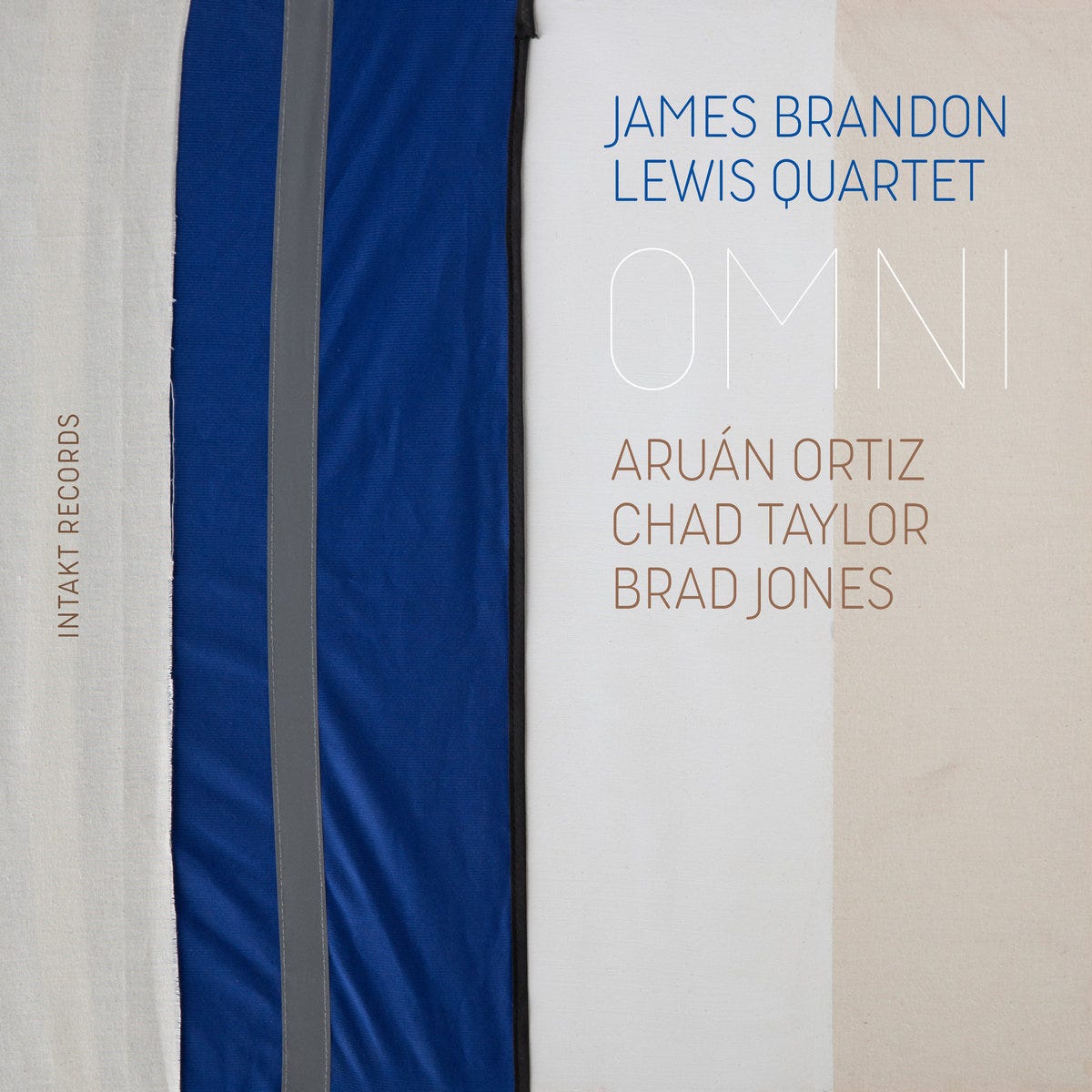
James Brandon Lewis Quartet, Omni [Intakt Records]
James Brandon Lewis is one of the most dynamic saxophonists working today. Whether playing with a classical string quartet, as a member of The Mezzthetics (Fugazi’s rhythm section with guitarist Anthony Pirog), or making rock-jazz fusion albums, his output is uniformly strong and his bold saxophone voice is immediately identifiable. His quartet of pianist Aruán Ortiz, bassist Brad Jones, and drummer Chad Taylor represents the cutting edge of contemporary post-bop acoustic jazz. Omni is their latest of many albums for the Swiss label Intakt. “Testify” has all of the things I love about this group. From Lewis’s free jazz wail on the track’s opening salvo to his husky-toned blues shouting to his take on Coltrane’s sheets of sound, Lewis synthesizes nearly the entire tenor saxophone tradition while the rhythm section slowly churns out a groove I’ve not heard before. Ortiz, Jones, and Taylor give “The Sermon” a nasty swagger, “Call to Worship” sounds like its title, and “Line Upon Line” is a smash and grab job of furious saxophone blowing and banging piano clusters. Lewis’s quartet is already critically recognized as one of today’s top groups. I don’t think it’s hyperbole to say that it shouldn’t be long before Lewis and his quartet are considered to be of generational significance.
RIYL: back-to-back home runs; a very hoppy IPA

Jason Moran, BlankFor.ms, and Marcus Gilmore, Shards [Red Hook]
Pianist Jason Moran, electronic musician BlankFor.ms, and drummer Marcus Gilmore have one of the most intriguing and beautiful trios going right now. While their 2023 debut Refract was a revelation, with Shards they have refined their approach and found a more cohesive and uniform sound. Moran and Gilmore draw on their vast vocabulary, providing everything from charging contemporary jazz to ambient-adjacent moments of clarity and stillness; from snapping snare back beats to polyrhythmic torrents of drums and cymbals. BlankFor.ms uses tape loops and live processing to send what Moran and Gilmore played right back at them with a new identity, which can range from a slightly sped-up version to fully rewired electronic deconstructions. “Tape Loop A Echo” starts with what sounds like several tape loops running in reverse, as if a family of mellotrons all caught the same cold. Gilmore plays his tom drums over these sickly loops while Moran slowly transforms a repeating piano stab into ever-lengthening phrases as the acoustic part of the band takes over. On “Shard II,” BlankFor.ms silently works away on something while Moran plays gentle chords and single notes over Gilmore’s quiet toms. With the push of a button, he releases a giant wash of sound. It is as if Moran and Gilmore are instantly bathed in warm sunlight: the trio is as one, breathing the same air, delighting in the collective sound.
On “Barbershop” BlankFor.ms takes Moran’s bottom of the piano bass pattern and mangles it to pieces. The result is some sort of industrial/EDM mashup machine that marches forward with bad intentions until its batteries die. One of the pleasures of listening to Shards is trying to figure out what BlankFor.ms might be doing in real time, what materials he is pulling from, what he is about to do with them, and how his collaborators will react. While Moran and Gilmore provide the dynamic source material, contours, shapes, and inspirations, BlankFor.ms’s contributions come with the spark of life.
RIYL: Electronics that won’t bring on the end times
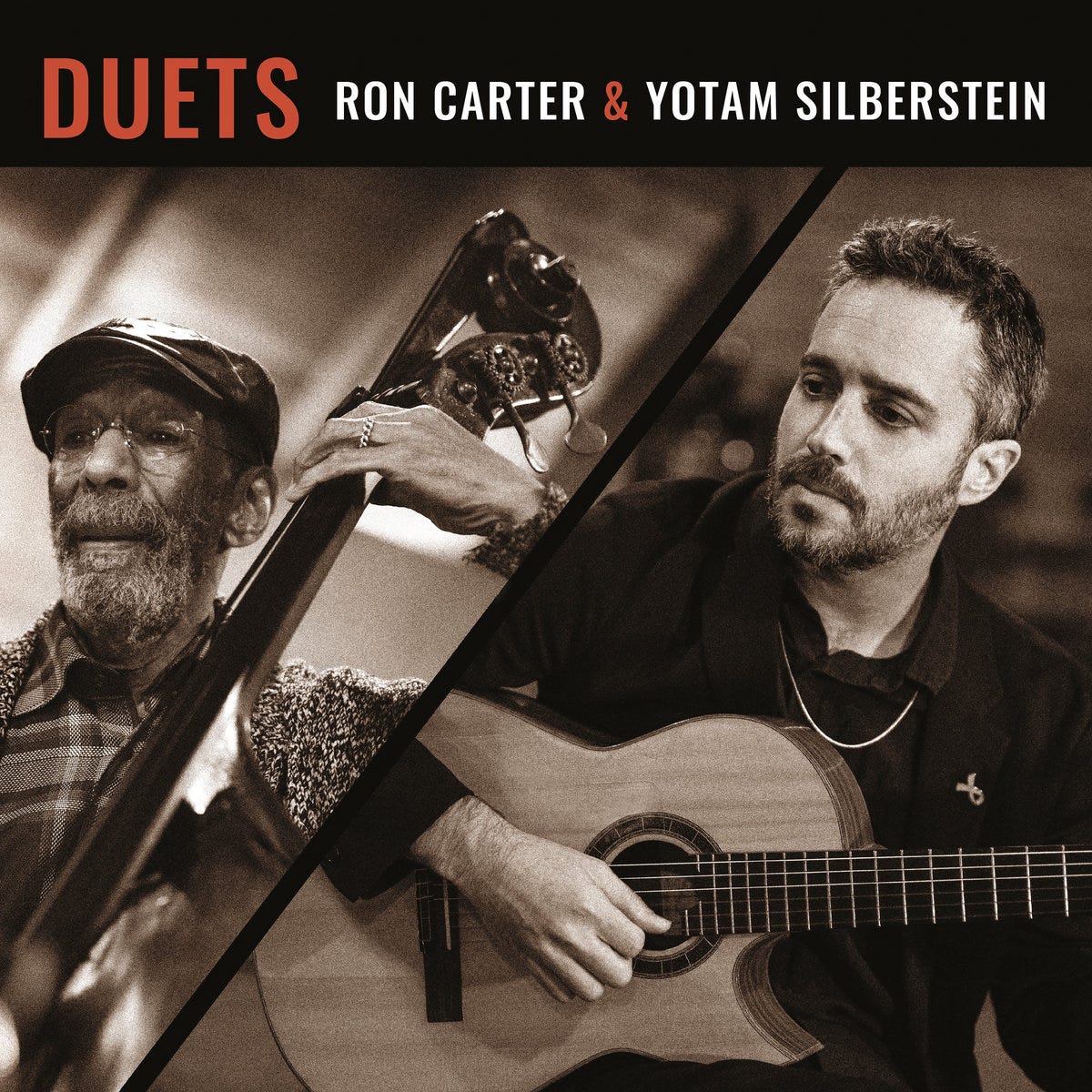
Ron Carter & Yotam Silberstein, Duets [JOJO Records]
Inspired in part by Ron Carter’s duo recordings with Jim Hall in the 1970s and ‘80s, the 89-year-old bass legend teams up with guitarist Yotam Silberstein for this set of sterling performances. Duets opens with the delicious Brazilian tune “Nova Ilusão.” As Silberstein plays over Carter’s round, supple notes, it’s not difficult to picture a guitar and a bass dancing around each other. “Blues for Brother Malone” is written for the late guitarist Russell Malone, who died suddenly in 2024 while on tour with Carter. Silberstein captures Malone’s melodicism, clean technique, unwavering swing feel, and his deep roots in the blues. “The Lamp is Low,” based on a composition by Maurice Ravel, gets a fast treatment and the melodicism and steadfastness of Carter’s bass lines demonstrate why people have called on him to record more than any other bassist in history. Duets is suffused with a charm and refined elegance that can only come from musicians who know exactly what they want to accomplish and do no more than necessary to pull it off. Carter says he has been on a mission to “find the right notes” for his entire career. Although Carter will probably never consider his mission complete, on Duets he and Silberstein found nothing but right notes.
RIYL: Quiet bars; warm memories
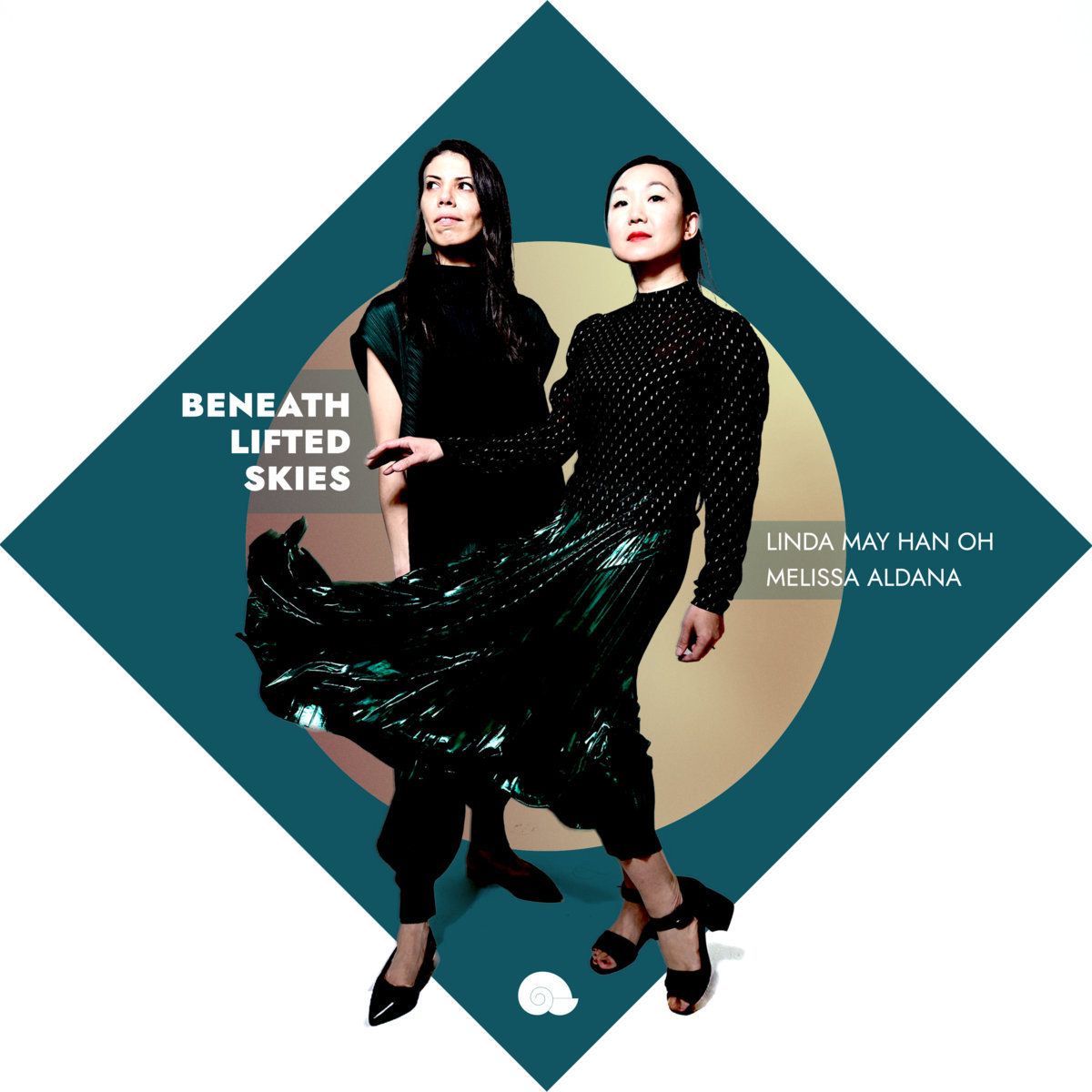
Linda May Han Oh & Melissa Aldana, Beneath Lifted Skies [Biophilia Records]
On their first album as a duo, bassist Linda May Han Oh and tenor saxophonist Melissa Aldana use a number of jazz standards as points of departure to create a stirring and exquisite album. The pair have a ridiculous hookup. On Parker and Gillespie’s “Anthropology,” Oh plays the winding, angular bebop melody with Aldana, as if doing so on the bass was just something all bassists do. Their three freely improvised cuts suggest they’ve been playing as a duo for much longer than they have. The second one, “Revolve,” is so well constructed that I first thought it was another interpretation of a standard. Aldana’s performance on Charles Mingus’s ballad “Duke Ellington’s Sound of Love” is an album standout and model of subtlety and lyricism. Aldana’s light, quiet tone and the way her lengthy phrases float and stay suspended in the ether is a perfect match for Oh, whose approach is more akin to Ron Carter than Charles Mingus, as she privileges clarity of tone and facility over power. Oh’s solo renditions of Herbie Hancock’s “The Sorcerer” and Billie Holiday’s “God Bless the Child” illuminates her musicality and brushes aside stale assumptions that bass solos can be glossed over. Beneath Lifted Skies is my favorite recording of Aldana’s and it’s the ideal point of entry for those wanting to dive into her and Oh’s music.
RIYL: Conversations that last deep into the night; hummingbirds
Camila Nebbia & Chris Corsano, Six or Seven Ways Towards Becoming Undone [Relative Pitch Records]
Draw a straight line from tenor saxophonist Camila Nebbia and drummer Chris Corsano back through the great history of saxophone-drum duos of the likes of Anthony Braxton and Max Roach; Peter Brötzmann and Han Bennink; and back to John Coltrane and Rashied Ali’s classic Interstellar Space. The unbridled fire and exploration that all those duos reveled in is found here in abundance. There are no throat-clearing free jazz cliches or treading water while someone waits for an idea. The pair jump right in to create dynamic music that unfolds in unpredictable plots. Nebbia might be screaming alongside bashing drums one minute, and the next her barely audible squeals are only a few decibels below Corsano’s toms and cymbals. Nebbia has a complex and edgy tenor sound that she might mix in some growling grit or overblow a phrase to unleash the horn’s inherent full power. The pair excel at playing off each other. Corsano will mimic a round of Nebbia’s rapid-fire notes on his drums, and he’ll gladly follow when she moves from more conventional melodies to marauding honks, runs, trills, and screams. Conversely, Nebbia will match her sound to fit inside the controlled ringing cloud of Corsano’s cymbals. This is top-shelf free improvisation. Strap in.
RIYL: Kicking your fears to the curb and sending it
Fathers, Fathers [Blue Note]
Frankly, I expected more from this quartet of CARRTOONS, Kenny Beats, Kiefer, and Nate Smith. Given the group’s combined credits producing or recording with the likes of Anderson .Paak, Geese, Vince Staples, Freddie Gibbs, Michael Jackson, Pat Metheny, Childish Gambino, and more, this eight-track long debut should have slapped from top to bottom. Everything is correct and there isn’t a misplaced note, which is maybe the problem. The tempo on the opening track “Eye Level” feels wrong and there’s no drive. Relaxed grooves can be great, but they still need to move forward. The Brazilian infused “Pearl” lacks the jump of the sambas that inspired it. CARRTOONS’s bass is too far down in the mix throughout the album and he plays on the back side of the beat instead of carving out a deep pocket. Kiefer’s synths sometimes sound dated and there are some odd production choices: why bring in a saxophonist on “Pearl” if they are only going to appear for a few seconds? Listeners get a glimpse of the quartet’s potential on the boom bap “The Leak,” on which Smith’s cracking snare gives the music a snap that most of the album lacks. “Front Yard” isn’t so much a fully formed piece as it is the setting for a yacht rock feature for Michael McDonald (which would have been awesome). The melody isn’t strong enough to stand on its own and the cheesy drum machine (a Roland CompuRhythm?) cameos on the cut are too cute by half. Not quite soul jazz, not quite funk, hip-hop, or R&B—not quite what it could have been.
RIYL: A red delicious apple
Also of note
Ambrose Akinmusire & Mary Halvorson, Slo-Mo Neon Luminate Hoverings [Nonesuch]: A wholly unique, unconventional, and odd but compelling recording from trumpeter Akinmusire and guitarist Halvorson.
Ella Zirina & Teis Semey, Dark Yellow: Music for Two Guitars [AGS Recordings]: A beautiful and occasionally experimental guitar duo.
Miguel Zenon & Luis Pedromo, El Arte del Bolero Vol. 3 [Miel Music]: Alto saxophonist Zenon and long-time pianist Pedromo in a beautiful and intimate set of compositions in their ongoing bolero project.
Paul Dunmall, Afraid to Speak [Discus Music]: A quintet led by British saxophonist Dunmall; one of the best avant-garde albums of the year.
Sam Barsh, Keyon Harrold, and Mark Giuliana: Straight08 [La Reserve]: Keyboardist Barsh, trumpeter Harrold, and drummer Giuliana’s mostly banging fusion set inspired by the sounds of the 808.
Lakecia Benjamin, We Dream [Artwork Records]: A fiery set from alto saxophonist Benjamin featuring a massive cast of guest stars.
On the horizon
A 3CD/6LP box set of live recordings from three of Dave Holland’s bands spanning the last quarter-century
Grammy Award-winning pianist Sullivan Fortner’s Leave That in There.
Stefon Harris & Blackout’s Legacy Dances, a tribute to bandmember Casey Benjamin, who passed away in 2024.
The Monkathon—a live concert film of Miles Okazaki playing the complete works of Thelonious Monk on solo guitar.
What is sure to be a glut of Black Friday/Record Store Day historical albums; there will be gems, to be sure.