

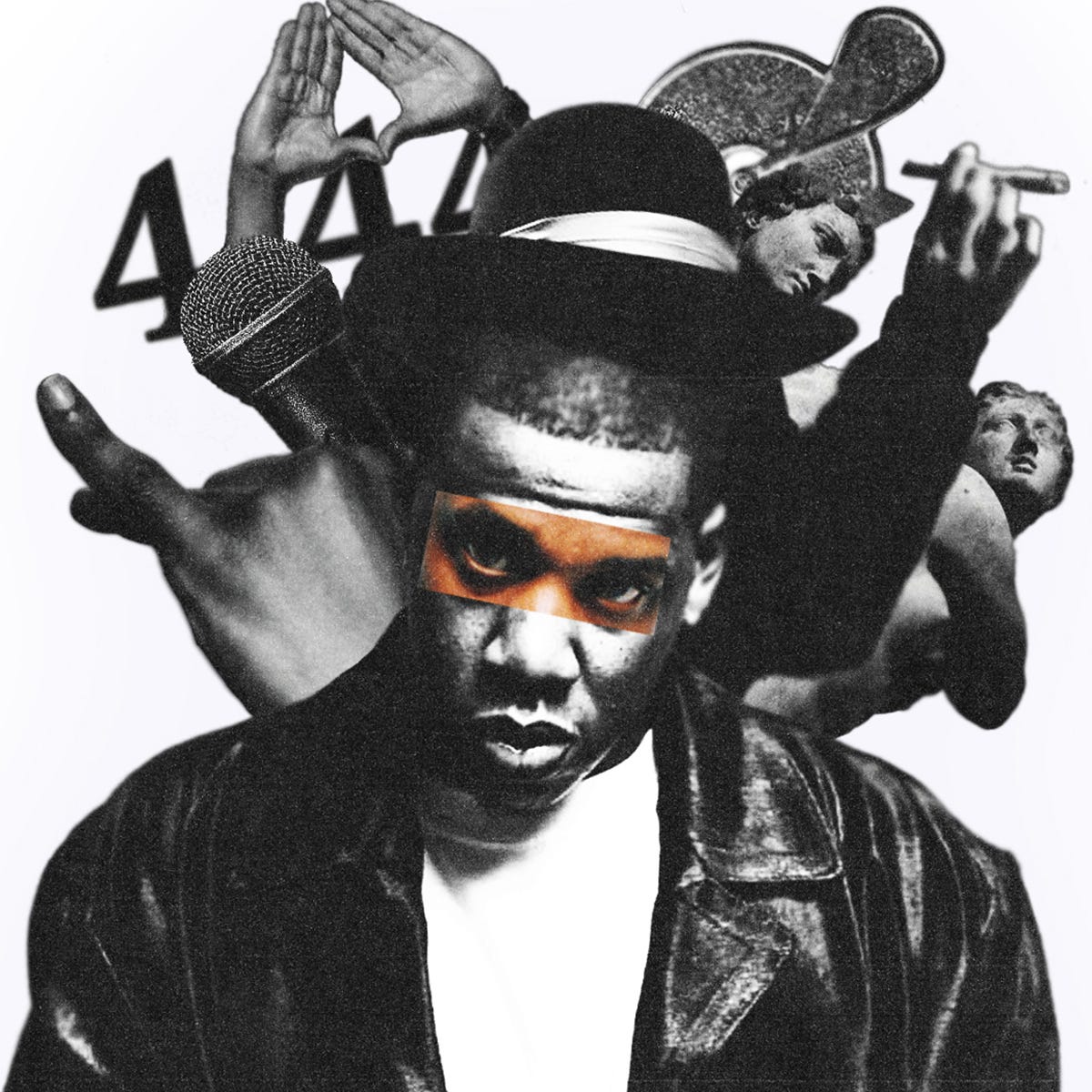
Earlier in Jay-Z Week at POW: A ranking of his 99 greatest songs and essays on Reasonable Doubt and The Blueprint.
13. Kingdom Come [2006]
In 2002, desperate to claw back some respectability after “Ether” and his own mother’s criticism of “Supa Ugly,” Jay tried to contrast himself with a morally dubious Nas by citing his donations to the victims of the Columbine school shooting and the September 11 attacks. It sounds, predictably, defensive. Four years later, after a boxer-brief retirement and stint as Def Jam’s president—and, crucially, Hurricane Katrina—he felt differently about philanthropy. “Sure, I ponied up a mil’, but I didn’t give my time/So in reality, I didn’t give a dime/Or a damn. I just put my monies in the hands/Of the same people that left my people stranded/Nothing but a bandit, left them folks abandoned.” There are bright spots on the front side of Kingdom Come: the reframing, on “Do U Wanna Ride,” of his fly talk as vicarious escape for incarcerated friends; Just Blaze flipping the other part of “Super Freak” on the title track; the entirety of “The Prelude.” But that missive on “Minority Report” aside, the second half of Kingdom Come is the worst stretch of Jay’s long career, an easy pick for the bottom of this list. Who knew that when he rapped, on The Black Album, about coming back “like Jordan, wearing the 4-5,” he meant it so literally. —PAUL THOMPSON
12. The Blueprint 3 [2009]
I like Blueprint 3 because Jay-Z clearly had no fucking idea what he was supposed to be doing. Last time he was out of moves, he “retired.” He expected a warm reception with his comeback, but Kingdom Come was a smug stinker that everyone hated. American Gangster was good but you can only make that once. Besides, Gucci Mane was the meta, and nobody was checking for his old, Jeezy-loving ass in Zone 6. Hov was in quite a pickle!
The result is an inconsistent mess. The foundation is tepid Graduation-era Kanye shit, bolstered by some entirely-too-clean Timbaland joints that were probably cut in the “Promiscuous Girl” era. After 15 years of being too cool to even write his rhymes down, BP3 finds Jay-Z legitimately flustered, bumbling around on “What We Talkin’ About,” shaking his fist at the kids on “D.O.A.,” unconvincingly proclaiming he is “Forever Young.” “Run This Town” might be the worst song Rihanna has ever participated in, only salvaged by Kanye’s shots at the humble Toyota RAV4.
And yet. The highs on BP3 are as good as anything post-millenial Jigga ever did. “On To The Next One” and “D.O.A.” are both kind of silly, but also find him effectively channeling his frustration over top tier production from Swizz and No I.D. respectively. “Empire State of Mind” is a victim of its own success, a generational anthem that both of your parents know. “So Ambitious” and “Real As It Gets” are fun. “Venus V. Mars” just should have come out five years earlier.
I think BP3 looks better in retrospect because it’s not Magna Carta Holy Grail. The worst thing you can do when you are losing your edge is pretend you still have it, and to then force it on every new Samsung customer. Instead, Hov throws a bunch of stuff at the wall and sees what sticks. Unsurprisingly, some of it does. Is it good? Sort of. Don’t like it? Buy his old albums. —ANDREW FRIEDMAN
11. Magna Carta… Holy Grail [2013]
About halfway through “Picasso Baby,” you can hear Jay-Z stop thinking nouveau riche and start thinking first-generational wealth. MCHG was an unwitting dichotomy from the moment it debuted, when Jay allotted a million free copies to anyone with a Samsung smartphone. Ostentatious flexes about the Louvre and Caesar unfold over some of the most understated production of Timbaland’s career: the hefty buzz of “FuckwithmeyouknowIgotit,” the stilted kick staircase on “Tom Ford.” Tracks that should soundtrack a winner’s parade—the star-saturated “BBC,” the Beyoncé duet and “our relationship is fine” screed “Part II”—are delivered on the defensive. It tracks that Jay, a rapper who emerged from hardscrabble Brooklyn upbringing hardened and gleaming like onyx, would chafe a little entering the Black billionaire class; it also tracks that his new allegiance to the haves alienated some fans who had grown fond of a certain level of scrap.
Still, within the echoey estate of MCHG lie some of Jay’s more interesting mid-career musings. “Jay Z Blue,” a conflicted ode to fatherhood, fears nature and nurture (“Apologies to Blue Ivy, my daughter/If it was up to me, you would be with me, sort of like daddy dearest”); “Heaven,” through a clever retrofitting of R.E.M.’s “Losing My Religion,” takes the ethos of “Mo’ Money Mo’ Problems” to biblical proportions. If Jay really is a prophet walking among us, isn’t that just more pressure to watch his back? Underneath the glassy, expensive mastering, there’s some valuable reflection on a hinge point in Jay’s career that set the tone for the actual victory laps to come. —HATTIE LINDERT
10. 4:44 [2017]
I don’t understand people who scoff at the way Jay-Z’s politics play out in his writing. On 4:44, his belief in generational wealth is downright pathological. How is that not interesting? A child’s voice asking “Daddy, what’s a will?” A billionaire still kicking himself over missed real estate investments from 20 years ago. “What’s better than one billionaire?” treated as if it’s a rhetorical question only he can answer. You imagine that 4:44 is divided, in Jay’s mind, into two lines of thought: money and legacy on one hand, the infidelity addressed in its title track on the other. The reality is far more fascinating—the whole world an analyst’s couch, the promises to only confide in one’s wife and to set up trust funds both Hail Mary attempts to keep a family together. —PAUL THOMPSON
9. The Blueprint 2: The Gift & The Curse [2002]
Let me tell you something that’s all feeling, no data. When The Blueprint came out, I was basically only into West Coast production and rock music. If it didn’t sound like DJ Quik or Battlecat or Green Day or the Red Hot Chili Peppers, I wasn’t jacking it, son. So I missed how good Blueprint was. But my ex-wife, my baby mom, was the biggest Jay-Z fan in the world, and was always cutting off my vibes to play that. When the Blueprint 2 came out, I think that’s when Jay got a little more California and a little more Philly. When I heard “The Bounce,” I lost my mind.
It made me go back and listen to The Blueprint; by that time I was already battle rapping, and so I had a real respect for and understanding of how hard it was to make a song. The architecture of The Blueprint is incredible. It’s probably the most structurally sound rap album to exist, and I look at Jay as probably the most structurally sound popular rapper to exist, and I know I’m right about that because he’s still standing to this day. Blueprint 2 was getting into the more curvy, cursive version of Jay. The structural soundness of Blueprint—that’s the Humvee on spinners of rap albums—it gave him the freedom to really play. I’m a video game-ass, joking-ass motherfucker, and I love when rappers get to play.
As for “The Bounce”: That’s a b-boy song. It’s the jam song without being a pop song. A b-boy song is something you can put on where motherfuckers will break dance, motherfuckers will Harlem Shake, motherfuckers will Crip walk. They’ll do whatever their version of a boogie is in a circle. At that time, a dance song was usually something very corny, and very sex-driven. I feel like hip-hop, while there can be ass-shaking and whatnot, is b-boy shit: it’s a room rocking where gender becomes kind of neutral. Alright, but can you do these steps? Even the flow: Jay’s talking this shit. It reminds me of a lot of shit that was coming out of Philly—Peedi Crack, playful shit. Songs like that you can play forever. If you know how to Harlem Shake or Crip walk, you can put that shit on in Africa. You can put it on in Polynesia. If there’s a tribal dance that fits that BPM, it’ll bring it out. The room gon’ rock. It don’t really matter what he say, as long as he say it with some bass in his chest. —ALL CITY JIMMY
8. American Gangster [2007]
By 2007, Jay-Z had traded his name for new initials: “S.C., CEO.” In his final year as president of Def Jam, he assumed an imperial presence in America: interviews with Charlie Rose, write-ups in the Wall Street Journal, recognition by the United Nations.
“My man Jay-Z has been a wonderful partner to the UN, and a champion of those in need around the world,” said secretary-general Ban Ki Moon.
Maybe that explains American Gangster’s “concept,” the return to familiar territory, but from a distance; the need to see these songs through the eyes of his father, uncle, and Frank Lucas rather than his own. Ostensibly, American Gangster is a hustler’s story—you could even consider it a self-titled work—but by the time Jay got around to telling it, he’d already gone legit. Previously, he’d lived it to tell us the tale; instead, American Gangster occupies an uncanny valley, an excellent album that looks and feels like his work, but somehow lacks his signature.
While it’s thought of as, arguably, Jay’s best “post-retirement” LP, it’s more accurate to lump it together with the rest of his solo albums after and including The Blueprint—a lengthy period of hits followed by misses that, relative to his ‘90s run, saw him soften his rougher edges and trademark his delivery to become more business than man. The album was his tenth to debut at No. 1, tying him with Elvis Presley—another brand name, like Pepsi. —GUS TURNER
7. The Dynasty: Roc La Familia [2000]
On The Blueprint, Jay-Z walks into the canon alone. He creates beautiful, lonely, Freudian work. Heavy is the head that wears the Yankees hat, etc.
Now The Dynasty: Roc La Familia? The album right before it? The album that people forget was an official Jay-Z album because the singles and album tracks are so idiosyncratic? That’s the classic before the Classic.
On The Dynasty, Jay gets by with a little help from his friends. He’s got Pharrell on “I Just Wanna Love U (Give It 2 Me),” a midnight pool party with a Rick James inspired hook and load bearing catch phrases for elder Millennials. He’s got Scarface counseling a grieving parent on “This Can’t Be Life.” “1-900-Hustler” became one of the great groups tracks of the 2000s, Roc-A-Fella’s finest hour, song-as-montage, Beanie Sigel playing operator as Jigga and Freeway and Memphis Bleek school rookies over the phone and demand swift remuneration.
Beanie Sigel is the keystone to The Dynasty. Squint and it might look like his album. Presented to audiences as social evidence that Jay-Z was still outside, Beanie installs South Philly and its fearless, flinty soul at the core of the project. Sigel’s verses sound like the ones with mortal consequences.
Sigel’s gifts, and the best efforts of what would ultimately be a short-lived version of the label, gave Jay room on The Dynasty to play teacher, preacher, drinker, lover, rake, mourner, friend and confidant. For one last moment, Shawn Carter sounded happy to just be a man among men. —EVAN MCGARVEY
6. Vol. 3… Life and Times of S. Carter [1999]
Recently I was debating with POW’s recently minted in-house Jay-Z scholar and laureate, Frazier Tharpe, whether Vol. 3 is at long last “properly rated.” Because I’m an old New York Jew raised on East Coast rap, I have heard nerds argue for Vol. 3’s place in Jay’s top three (if not higher) since the album dropped, and I don’t know that “underrated” can apply anymore (The Summerman begs to differ). Maybe because it’s a sneakily dense album you have to sit with. Maybe because there are a few swing-and-miss crossover hits with beats and hooks that haven’t aged well (along with some of his best, including his final collab with Preemo and the highwater marks of his work with Timbaland), and it took a few months for “Big Pimpin” to worm its way into America’s ear, mind, and heart. Maybe because it doesn’t have the same cinematic coherence of its proper bookends, Reasonable Doubt and The Blueprint, there’s a persistent notion that Vol. 3 is forever the underacknowledged stepchild in Jay-Z’s catalog, as infamous for being the motive for Jay (ALLEGEDLY) stabbing Lance Rivera as it is for its incredible music. It’s always been hard for me to buy because I was grown by the time this album dropped and was fully outside to witness its omnipresence in New York during this moment, but I also can’t really imagine a full summer-long, citywide activation celebrating the 30th anniversary of Life and Times inspiring the same fervor RD and BP has in 2029, so perhaps I’ll concede the point.
Narrative positioning aside, what matters all these years later is how focused and intense the effort is here. It’s a guy defined by making the impossible look easy pressing 94 feet like he’s on a 10-day rather than looking for the supermax in the pop rap firmament this album would earn him. Vol. 3 expands on Vol. 2’s fireball theatrics but resists any corresponding lack of focus by the bar. Even the infamous misfired radio plays, trying too hard to make “S dot Carter” happen, with a Swizz beat pan flute and Mariah on the hook (cue Frazier: “Actually crack”) feature technically pristine and vicious delivery. It may not be Jay-Z’s greatest start to finish collection of songs, but might just live as the greatest hour of pure rapping we ever got from one of the greatest rappers who ever lived. —ABE BEAME
5. The Black Album [2003]
At this risk of vastly overstating my own importance (which should be fine when I’m writing about an album that opens with an artist’s mother noting his birth weight) I’m among the critics who have tried to correct the historical about Jay-Z’s 1997-2000 output. After The Blueprint, The Black Album, and his retirement, a conventional wisdom calcified: those LPs and Reasonable Doubt were the Great Works, the others compromised, cynical, of their era. Technicalities, necessary near-evils.
It’s possible that we’ve been a little too successful: I received ballots for this list that had The Black Album near the bottom of Jay’s catalog. In truth, it’s an astonishing balancing act, self-mythology that never takes itself too seriously to morph, reinvent, or poke fun. It is also quietly a spiritual successor to Vol. 2, a record where nearly every track would go on to become iconic on its own and the (fuck) blueprint for a legion of imitators.
The neuroses betrayed on “Lucifer” (a lust for revenge, an inability to move on) and “Allure” (an inability to stop holding his hand over the flame) do burnish the legend, but they also suggest someone imprisoned just a bit by his own success, that famous second verse of “Moment of Clarity” made realer, baser, more capital-t tragic. It’s sort of like how, on “99 Problems,” the relitigation of his place in pop culture comes to a dead stop over the one variable that never changes: “Half a mil for bail ‘cause I’m African.” He’s running, and he’s running, and he’s running, and he’s…
While Jay mostly set aside the technical virtuosity that defined that ‘97-2000 work to be more legible and harder to take in bad faith. Take this passage in “Threat,” a prismatic riff on desert sand and astonishing bit of syllable shuffling:
I dig a hole in the desert, then build the Sands on you
Lay out blueprint plans on you
We Rat Pack n——s, let Sam tap dance on you
Then I Sinatra, shot ya, goddamn you
I put the boy in the box, like David Blaine
Let the audience watch, it ain’t a thang
Y’all wish I was frontin’, I George Bush the button
For the oil in your car, lift up your hood, nigga, run it
Then lift up your whole hood, like you got oil under it
Your boy got the goods, y’all don’t want nothin’ of it
Like castor oil, I’ll Castor Troy you
Change your face, or the bullets’ll change all that for you
Then you imagine him somewhere with no mosquitos. —PAUL THOMPSON
4. In My Lifetime, Vol. 1 [1997]
The critics, including Jay himself, are wrong. Upon its release, In My Lifetime, Vol. 1 became the archetype for the sophomore slump in rap, a crossover attempt beset by too much gloss. But his rapping—he dives into pockets tricker than anything on Reasonable Doubt and comes out clean—is exquisite. The prestige of Doubt comes from the dark scenery writing, Jay recounting Odyssean drug transactions in Trenton and Maryland. But Vol. 1 is the version of Jay we grew to adore: loaded with money and status as his cocksure voice pats us on the head like a babysitter putting unruly kids on timeout. “The City Is Mine,” much maligned at times but quietly otherworldly, affirms his place as the new king of New York now that Big has died; “Streets Is Watching” made Big himself scared with its crescendo of a third verse, a simmer building to a volcano of paranoia and regret; “Imaginary Players” is disrespectfully arrogant, leaving you sullen, staring at your checking account to see if you really are that broke. (You are.) What else is there to say about “Where I’m From,” a self-referential account of how the Marcy projects created the hood soldier and hero rolled into one. Like he said, if not for him, “niggas’d still be dying for whores.” —JAYSON BUFORD
3. Vol. 2… Hard Knock Life [1998]
History is told by those in the Ferrari or Jaguar, switching four lanes. The tales of the unlucky hustlers—those outlaws stopped and “locked up in the bing”—don’t get shouted in joyous freeway duets with Jermaine Dupri. During those early umlaut years, Jay-Z’s shrewdly constructed folklore always revolved around high stakes and narrow escapes. The Roc-A-Fella don always understood that the best soliloquies revealed the right secrets and left others purposely clandestine.
From the first verses of Vol. 1, Jay slyly fanned the flames of the rumors circling him (“Is it true he stayed in beef and slept with a Tec?)” By the time the blockbuster sequel dropped ten months later, he had further refined the art of mythmaking. In a series of magazine cover stories that accompanied his first No. 1 album, Jay told harrowing anecdotes about his origins—but did so selectively. A murdered uncle and a haunted father—who chased his brother’s killer into the night, only to abandon his own family shortly thereafter, having become a shadowy, heroin-ravaged ghost. The time that a 12-year-old Jay shot his crack-addicted brother. An incident in Marcy circa 1990, when a rival dealer pulled out a Tec-9 but missed all three shots. Then the gun jammed. Young Shawn fled. The miracle when he was pulled over by two Maryland state troopers outside of Baltimore, bricks stashed in the sunroof of his Nissan Maxima. The cops called for drug-sniffing dogs, but the K9s were previously indisposed. He went free. In another fragment, Jay was detained and brought to central booking, but one of his partners successfully tossed the weapon out of the car, just in time.
These were merely the pre-fame brushes with fate. Wariness understandably remained. No one initially wanted to sign him. The independently released debut was an East Coast classic, but the CD was out of print and hard to find for years. Despite showcasing some of his most brilliant and unguarded material, his sophomore album was widely considered a critical and commercial disappointment—a crossover failure that overdosed on artificial sunshine, jigginess, and excess Glenn Frey. Jay wasn’t about to fade into oblivion, but the time was now. He was pushing 30, slightly closer in age to Rakim and Kane than Biggie and Pac, whose memories still cast a towering shadow over hip-hop. Unlike many of his peers, there was no purist streak. All the respect and admiration only went so far without a real solo hit.
In 2026, when Jay-Z is in charge of who plays the Super Bowl, it’s bizarre to think that it was once considered radical for him to sample Orphan Annie. Even more unlikely was the prospect of clearing the thing. Forget selling water to a well (or whale) Jay-Z went multi-platinum talking about “murdering everything moving” on a song built off a Broadway musical about a rags-to-riches red-haired ragamuffin. That’s one reason why he branded himself Hova. His story is testament to both the possibility of divine ordination and relentless perseverance. Vol. 2 is the album where he coins his mantra, “I will not lose,” which makes sense when you can concoct a false backstory that convinces the “It’s the Hard Knock Life” songwriters to let you write a new age showtune about sleeplessness, struggle, and fleeing crime scenes. And that was after sweettalking the 45 King into giving him the instrumental in the first place.
From the moment that “Hard Knock Life (Ghetto Anthem)” hit the radio, it was a foregone conclusion that Jay would become the biggest rapper in the world. Famously released on the same September ’98 day as Outkast’s Aquemini, Tribe Called Quest’s The Love Movement, and Mos Def and Talib Kweli are Blackstar, he wound up selling more than twice as many as the other three combined. Hov won his first Best Rap Album Grammy and boycotted the ceremony for disrespecting the genre. But the first single was an outlier on a 5x Platinum album that ranks among the most paranoid, morbid, and unrepentant in his catalogue.
Part of Jay’s gift lies in his ability to make an unreliable narration seem like an unvarnished confessional. He may have been spiritually honest and adherent to a street code, but he understood the truth as a weapon to be slyly encrypted, manipulated, and occasionally weaponized for maximum impact. From the first moments of this album, the ersatz Goodfellas-style narrator offers a fake out. This could be the last album. The “new and improved Jay-Z” Memphis Bleek was about to take over (narrator voice: he wasn’t). Jay brags about going platinum a million times before he had even technically done it once. He was always somewhere between Frank Lucas, Frank Sinatra, and Donald Francis Draper.
Drug dealers often make for the best rappers (and writers) because underworld survivors are forced to be astute and realistic observers of the human condition. Any misjudgment can prove fatal. If the first two albums found Jay-Z alternately reveling in the riches and regrets of his illicit lifestyle, he sounds wary and fatalistic here. Apart from “Money Ain’t A Thang,” which was effectively a tacked-on bonus track, the songs on Volume 2 inhabit a nervous interzone between street life and superstardom. Afterwards, the imperial era begins. In six years, Jay would echo Caesar by bragging that he came, he saw, he conquered. But here, he’s slaughtering the hordes in Gaul, leaving Beans and Bleek behind as consuls, and crossing the Rubicon back to New Rome.
Enemies and death constantly encroach. On “If I Should Die,” Jay composes his own eulogy, telling 2Pac’s ghost that “life is miserable in the physical form.” “Ride Or Die” finds him (presumably) dissing Mase over shrapnel-laced strings supplied by the Hit Men’s Stevie J. The Too Short-aided “A Week Ago” is a sneering tale of betrayal, aimed at an ex-dope game partner who snitched, which sends our disdainful antihero running to the spy store to remove potential phone taps. The changes that fame has wrought appear most acute on the sequel to “Coming Of Age.” If the initial version from Reasonable Doubt was almost a happy go-lucky tale of mentorship, its follow-up is conspiratorial and tormented. A Chekov short story about how quickly money and success breeds envy and hatred, where the action unspools almost entirely in Jay and Bleek’s interior monologues.
On Vol. 2, the pressures of stardom have ostensibly stripped Jay of his affection for anything other than sex, money, and revenge.. “Can I Get A…” laughs at the premise of love in favor of meaningless, transactional and fleeting pleasure. Everything is a mercenary exchange, right down to letting Irv Gotti add Ja Rule to the track. His carnal boasts on “N---- What, N---- Who” seem as clinical and fun as a prostate exam. He boasts about a condo with nothing but condoms in it, one of the more emotionally desolate and architecturally minimalist lines in rap history.
If the knock on his previous album was that it was too ornate and shiny, Volume 2 is stripped down, quicksilver, and cavernous. It grabs the jiggy aesthetic by the lapels, inverts it, and shakes the sequins out. Timbaland’s production sounds like it was created inside a nuclear reactor on Betelgeuse. Swizz sounds like he’s playing the Casio keyboard with a guillotine. “It’s Alright” samples both Kraftwerk and “Once in a Lifetime,” where Jay-Z admits to inheriting Big’s stress before shrugging, Marlowe-like, that whatever you want to do is alright with him.
Jay-Z was far from the first hustler-turned-rapper, but he popularized the trope. He was always effortless, unflappable, above the fray, allergic to gimmicks. For the mortals, being a rapper meant exerting effort, acquiescing to industry machinery, working for the devils. It’s no accident that he burnished his legend by misdirecting audiences away from how much he actually cared. Yet it’s obvious on Vol. 2. Despite the cynical street poses, the double-barreled attacks aimed at anyone who would double cross him, you can hear how much he loves rapping. Music might be the only thing that matters. He’s constantly changing flows every other bar, twisting and hanging in mid-air like Jordan, toying with tempo, chopping, deploying assonance, internal rhyme, alliteration, similes. All the stuff that becomes profoundly uncool and stripped of magic as soon as you write it down.
Here it all felt innate, a secret blessing from Jehovah. Who needed paper when the words were being beamed into his head from a mystic power source? How could he lose? —JEFF WEISS
2. The Blueprint [2001]
Read Paul Thompson’s essay on The Blueprint from earlier this week.
For an album that not only became so momentous, but was designed and presented that way, The Blueprint’s process suggests something slick, even surreptitious. While Jay was at the time one of the most famous rappers in the world, shockingly few of its beats were originally meant for him. Kanye West had made “Heart of the City” with DMX in mind, given “Never Change” to a local rapper from Chicago, and had Cam’ron considering the Jackson 5-sampling “Izzo (H.O.V.A.)” for the album that would become Come Home With Me; Just Blaze wanted to send “Girls, Girls, Girls” to Ghostface; the Trackmasters wanted N.O.R.E. on “Jigga That N----”; Bink’s “The Ruler’s Back” was passed on by Loon and Black Rob, and “All I Need” belonged to a group from Philadelphia but was relinquished when one of its members passed away. The album’s lone feature, “Renegade,” was originally a collaboration between Eminem and fellow Detroit MC Royce da 5’9”.
By the time they were corralled together and released on September 11, though, these beats would not only define Jay, but propel him into a new strata of American popular music. It’s fair to hear that and shrug—who cares which rappers are inducted into “The Songwriters Hall of Fame”?—or to lament the more straightforward flows replacing the athletic and idiosyncratic raps that Jay meted out from 1997 through 2000. But the canonization was deserved. The Blueprint is a singular record, the kind that coils a whole genre around its tics and offers them as new tenets. Written (or not written, as the case may be) under a cloud of legal uncertainty and released as Jay was entering the biggest feud in rap history, it’s an album as overwhelming in a vacuum as it is when examined against its million contingencies.
1. Reasonable Doubt [1996]
The first hook you hear on Reasonable Doubt is, more than anything else, a flex: Bad Boy’s own Mary J. Blige on the record, her voice fluttering over the downtempo “My Life”–sampling intro track, cooing and taunting the mafioso who just called himself one of the best to have done it, six digits and running. But it’s also a probing question:
Who do you think you aaaaarrre?
Who was this guy, kicking off his debut record—on his own label!—by inserting himself into Scarface scenes and rapping like he’d already made it, tackling the Queen of R&B’s defining track and slipping her ten bands in a shoebox to hit the studio? Shawn Carter had been chipping away at this sort of coming-out for nearly a decade, navigating industry bullshit, rhyming with remarkable timing, landing whatever features he could, stacking dough from whoever, wherever, however. For his big-name statement in the rap game, for the first official entry on the nascent Roc-A-Fella brand, Jay-Z was no longer the lanky, style-buckwild kid from Marcy riding the coattails of Big Jaz, Big Daddy Kane, or Biggie Smalls. Reasonable Doubt was the voice of someone who was already a veteran of the streets, of the neverending hustle, of some real shit these jokers couldn’t imagine. Who did he think he was? The entire LP was his answer: After all he’d been through, who did he think he couldn’t be? Take a look at his life; see what he sees. On “Can’t Knock the Hustle,” Mary J. answers her own question: “One day, you’ll be a starrr … ”
More prescient than anyone at the Roc could have foreseen. Yet long before he could become the new Sinatra, Jay had to get some shit off his chest. First, the one-two of “Hustle” and “Politics as Usual,” revealing a slower, thoughtful wordsmith baring his scars on tape; the venom with which Jay signs off on the latter, resigned to the inevitability of Giuliani’s cops watchin’ while the champagne’s poppin’, is still palpable all these decades later (“I hate ’em”). Then, on “Dead Presidents II,” the grief: “Murder is a tough thing to digest, it’s a slow process/and I ain’t got nothin’ but time.” And on “Can I Live,” the relentless paranoia and PTSD: “I don’t sleep, I’m tired, I feel wired like codeine, these days/a brother gotta admire me from four fiends away.”
Still, it wouldn’t be money if it weren’t celebrated. And there’s plenty of rich-man bravado here: the lyrical boxing matches of “Brooklyn’s Finest” and “Bring It On,” the resplendent dick-swinging of “Ain’t No” and “Cashmere Thoughts,” the triumphant comradery of “Coming of Age.” Along with, sometimes, a stumble back and forth between the valleys and peaks, as on “Feelin’ It.” (“Them dreams you say you got, give me the chills/But these mills, well they make me hot.”) And all throughout, in whichever mood, the remarkable dexterity of Jay’s never-written bars, reappropriating the crisp, pristine diction and internal rhymes of his early rapping style into stunning evocations of his newly crafted image. Somehow, it all fits together, no incongruity to be found.
Reasonable Doubt is rich, complex tableau, unfolding like Jay-Z’s own Great American Noir, rugged like Iceberg Slim and suspenseful like Chester Himes, fleshed out with double-meanings and brand references and vivid memories that reward close, repeated listens. Before the overproduced anthems, before the Forbes lists, before Beyoncé—raw, hardened, one eye open at all times. It’s not an easy listen, and it’s not exactly a showcase of the pop megastar he would become. But it remains Jay-Z at his most unvarnished, printing his own legend before the legend took hold, still allowing himself some doubts and regrets on the way to the crown. Can’t knock the hustle, for real. —NITISH PAHWA